Free online activity explains MESSENGER spacecraft's Mercury flyby on Sept. 29
September 21, 2009
Free online activity explains MESSENGER spacecraft's Mercury flyby on Sept. 29

Enlarge

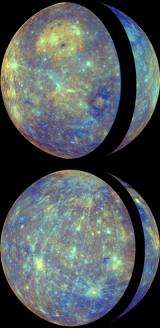
The spacecraft MESSENGER is on a journey to become the first spacecraft to orbit Mercury. While it won't orbit the planet until March 2011, it has already collected valuable data, such as these enhanced-color image mosaics shown in orthographic projection and created from wide-angle camera images. A free online simulator created by staff at MSU's Burns Technology Center helps explain how the spacecraft uses gravity to alter its path. Image courtesy: NASA/Johns Hopkins University Applied Physics Laboratory/Arizona State University/Carnegie Institution of Washington

(PhysOrg.com) -- NASA's MESSENGER spacecraft will fly past the planet Mercury on Sept. 29, and a free online simulator created by staff at Montana State University's Burns Technology Center helps explain how the spacecraft uses gravity to alter its path.

Designed for people of all ages and ability levels, it is available, along with other space science resources for teachers and the public, at: http://www.messeng … imations.php

MESSENGER, whose mission is to study Mercury, was launched atop a Delta II Rocket in 2004 and has since flown more than 3.5 billion miles. On Sept. 29, MESSENGER will fly past Mercury for the third and final time before being inserted into orbit about Mercury in 2011, where it will remain to collect data for one full Earth year.

MESSENGER stands for "MErcury Surface, Space ENvironment, GEochemistry, and Ranging."

The online simulator explores the "gravity-assist maneuver," in which a nears a planet and uses that planet's to alter the speed and of its flight path. MESSENGER will have used this maneuver six times during its mission--flying past Earth once, Venus twice and Mercury three times.

The Assist Simulator was developed by staff at MSU's Burns Technology Center as part of a NASA-funded outreach grant. For more information, go to: http://www.messenger-education.org/students/animations.php

Provided by Montana State University (news : web)

Filter


Move the slider to adjust rank threshold, so that you can hide some of the comments.


Display comments: newest first

zevkirsh
Sep 21, 2009

Rank: not rated yet
seems like the best way to study mercury for a long time would be from it's L2 Lagrange point, shielded permanently from the ridiculously hot sun. surely, the solar wind and extended radioation will fry any sattelite in a short period of time. then again theres' no sense in being in the sahde all the time, so perhaps a highly elliptical orbit where the sattlite is only on the sunny side of mercury for a short period of time relative to the shady side.
Rank 3 /5 (3 votes)
Related Stories
Relevant PhysicsForums posts
  • Never ending outer space.....
    createdFeb 11, 2012
  • Neutron Star fragments?
    createdFeb 11, 2012
  • stationary or not?
    createdFeb 11, 2012
  • Scale of the Universe
    createdFeb 10, 2012
  • Titan's lack of impact craters
    createdFeb 09, 2012
  • Real pictures of black hole eating a star?
    createdFeb 08, 2012
  • More from Physics Forums - General Astronomy

More news stories

Climate change causes harmful algal blooms in North Atlantic: study

Warming oceans and increases in windiness could be causing of an abundance of harmful algal blooms in the North Atlantic Ocean and North Sea, according to new research.

Space & Earth / Environment

created 44 minutes ago | popularity not rated yet | comments 0

Latin America mining boom clashes with conservation

Latin America is experiencing a mining boom as prices rise fuelled by a hike in global demand, but the region is also being hit by a wave of violent protests, strikes and rallies by environmentalists.

Space & Earth / Environment

created 23 hours ago | popularity 5 / 5 (1) | comments 1

Salvage workers begin pumping fuel from Italian shipwreck

Salvage workers Sunday began pumping fuel from the shipwrecked Italian cruise liner Costa Concordia, a day ahead of schedule, officials said.

Space & Earth / Environment

created 15 hours ago | popularity 5 / 5 (2) | comments 0

Political leaders play key role in how worried Americans are by climate change: study

More than extreme weather events and the work of scientists, it is national political leaders who influence how much Americans worry about the threat of climate change, new research finds.

Space & Earth / Environment

created Feb 06, 2012 | popularity 5 / 5 (8) | comments 76

NASA budget will axe Mars deal with Europe: scientists

US President Barack Obama's budget proposal to be submitted next week for 2013 will cut NASA's budget by 20 percent and eliminate a major partnership with Europe on Mars exploration, scientists said Thursday.

Space & Earth / Space Exploration

created Feb 10, 2012 | popularity 5 / 5 (4) | comments 58


Rapunzel, Leonardo and the physics of the ponytail

(PhysOrg.com) -- New research provides the first mathematical understanding of the shape of a ponytail and could have implications for the textile industry, computer animation and personal care products.

Cognitive impairment in older adults often unrecognized in the primary care setting

A new study published in the Journal of the American Geriatrics Society reveals that brief cognitive screenings combined with offering further evaluation increased new diagnoses of cognitive impairment in older veterans two to ...

Hacker claims porn site users compromised

A hacker claims to have compromised the personal information of more than 350,000 users after breaking into a disused website operated by pornography provider Brazzers.

Primary care program helps obese teen girls manage weight, improve body image and behavior

Teenage girls gained less weight, improved their body image, ate less fast food, and had more family meals after participating in a 6- month program that involved weekly peer meetings, consultations with primary care providers ...

AT&T customers surprised by 'unlimited data' limit

(AP) -- Mike Trang likes to use his iPhone 4 as a GPS device, helping him get around in his job. Now and then, his younger cousins get ahold of it, and play some YouTube videos and games.

Scientists discover molecular secrets of 2,000-year-old Chinese herbal remedy

For roughly two thousand years, Chinese herbalists have treated Malaria using a root extract, commonly known as Chang Shan, from a type of hydrangea that grows in Tibet and Nepal. More recent studies suggest that halofuginone, ...