IMEC unveils promising mechanically-stacked GaAs/Ge multijunction solar cell
September 22, 2009
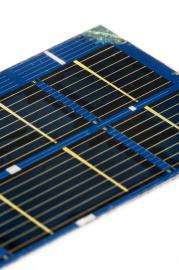
IMEC's mechanically stacked GaAs/Ge cell

Enlarge

IMEC's mechanically stacked GaAs/Ge cell

At the European Photovoltaic Solar Energy Conference (Hamburg, Germany), IMEC presents a mechanically-stacked GaAs/Ge multijunction solar cell. This is the first promising demonstrator of IMEC’s novel technology to produce mechanically stacked, high-efficiency multijunction solar cells, aiming at efficiencies above 40%.

At the top of the stack is a one-side contacted GaAs top cell that is only 4µm thick and that is transparent for . Its efficiency is 23.4%, which is close to the efficiency of standard GaAs cells. has succeeded in transferring this GaAs top cell onto a Ge bottom cell, creating a mechanical stack. In that stack, the Ge bottom cell is separately contacted. It has a potential efficiency of 3-3.5%, which is higher than Ge bottom cells in state-of-the-art monolithically stacked InGaP/(In)GaAs/Ge cells. Looking forward, Giovanni Flamand, team manager at IMEC, expects to show a first working triple-junction cell beginning of 2010.

This cell is a demonstrator of IMEC’s innovative technology to produce mechanically stacked, high-efficiency InGaP/GaAs/Ge triple-junction solar cells. This includes manufacturing world-class thin-film III-V cells and Ge bottom cells, and developing a technology to mechanically stack them. The expected conversion efficiencies are 1-2% higher than those obtained today with monolithic triple-junction solar cells (> 40% with concentrated illumination). In addition, the new cells show an enhanced spectral robustness. Stacked solar cells combine cells made from different materials to capture and converse a larger part of the light spectrum than is possible with a single material.

Dr. Jef Poortmans, IMEC’s Photovoltaics Program Director: “Mechanical stacks are more complex to handle and interconnect. But they definitely offer a way to increase the conversion efficiency and energy yield of high-efficiency . And they also enable an efficient way to try and use new combinations of materials. For this technology, we profit from IMEC’s expertise in 3D stacking, growing III-V layers, and solar cell processing.”

Source: IMEC


Rank 3 /5 (2 votes)
Relevant PhysicsForums posts
  • looking for LCD controller
    created6 hours ago
  • 1D wave simulation with absorbing BC
    created10 hours ago
  • Difference between Grid and Sub-station
    created10 hours ago
  • Mystery circuit needs solving!
    created12 hours ago
  • How do I relate flux equation to transformers?
    created15 hours ago
  • Noob needs help designing a simple on/off timing circuit
    created16 hours ago
  • More from Physics Forums - Electrical Engineering

More news stories

Google might launch Drive for cloud storage soon

(PhysOrg.com) -- Google's next big move, according to the Wall Street Journal, is a cloud storage service called Drive. Hardly first to the plate, Google is simply catching up to introducing its cloud reposi ...

Technology / Internet

created 10 hours ago | popularity 4.8 / 5 (5) | comments 4 | with audio podcast report

Iran blocks email, restricts net access: reports

Iran has further restricted access to the Internet and blocked popular email services for the past few days, in a move a top lawmaker said could "cost the regime dearly," media reports said on Sunday.

Technology / Internet

created 3 hours ago | popularity 5 / 5 (1) | comments 3

Love a click away in Indonesia's Twitter Republic

He was a geeky kid from Yogyakarta, she a glamorous city girl in Jakarta. In a country with one of the world's most vibrant social networking scenes they fell in love on Twitter.

Technology / Internet

created 11 hours ago | popularity 4 / 5 (1) | comments 0

Walney offshore wind farm is world's biggest (for now)

(PhysOrg.com) -- The Walney wind farm on the Irish Sea--characterized by high tides, waves and windy weather--officially opened this week. The farm is treated in the press as a very big deal as the Walney ...

Technology / Energy & Green Tech

created Feb 11, 2012 | popularity 4 / 5 (11) | comments 37 | with audio podcast weblog

Navy to begin tests on electromagnetic railgun prototype launcher

The Office of Naval Research (ONR)'s Electromagnetic (EM) Railgun program will take an important step forward in the coming weeks when the first industry railgun prototype launcher is tested at a facility ...

Technology / Engineering

created Feb 06, 2012 | popularity 4.5 / 5 (17) | comments 94 | with audio podcast


Scientists discover molecular secrets of 2,000-year-old Chinese herbal remedy

For roughly two thousand years, Chinese herbalists have treated Malaria using a root extract, commonly known as Chang Shan, from a type of hydrangea that grows in Tibet and Nepal. More recent studies suggest that halofuginone, ...

New method to examine batteries -- MRI from the inside

There is an ever-increasing need for advanced batteries for portable electronics, such as phones, cameras, and music players, but also to power electric vehicles and to facilitate the distribution and storage of energy derived ...

Lab study raises questions over nano-particle impact

Tests involving chickens have raised questions about the impact on health from engineered nano-particles, the ultra-fine grains commonly used in drugs and processed foods, scientists said on Sunday.

Injured boomers beware: Know when to see doctor

(AP) -- It happened to nurse Jane Byron years after an in-line skating fall, business owner Haralee Weintraub while doing "men's" push-ups, and avid cyclist Gene Wilberg while lifting a heavy box.

A mitosis mystery solved: How chromosomes align perfectly in a dividing cell

Although the process of mitotic cell division has been studied intensely for more than 50 years, Whitehead Institute researchers have only now solved the mystery of how cells correctly align their chromosomes during symmetric ...

Starve a virus, feed a cure? Findings show how some cells protect themselves against HIV

A protein that protects some of our immune cells from the most common and virulent form of HIV works by starving the virus of the molecular building blocks that it needs to replicate, according to research published online ...