Solar Home Built by Students

September 22, 2009 by Lin Edwards Solar Home Built by Students

Enlarge

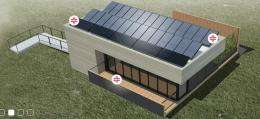
Curio House. Image from livecurio.us

(PhysOrg.com) -- Students from the Boston Architectural College (BAC) and Tufts University have submitted a completely solar-powered home, the Curio House, as New England's entry into the Solar Decathlon competition. The entry is one of 20 designs by teams of university students vying for this year's award for the best solar home design.

The solar home will be dismantled and reassembled on the National Mall in Washington, D.C., early next month, where it will be subjected to 10 days of judging. The student-designed home will be open to the public, and will be judged on factors such as attractiveness of the design, marketing viability, , and the amount of excess electricity the home generates.

The budget for the New England team's design for the 800 square foot one-story home came in at around $200,000, and they hope the sale price could be about the same figure, but for a reduced number of solar panels. The sale price would make the design far more marketable than the 2007 competition design by a German team, which would sell for $1.2 million.

The Boston students worked for nearly two years on the project. They reduced costs by purchasing widely available products from building supply stores, and by using a simple, modular design that could be constructed easily. The most expensive items were the bank of 28 top range SunPower photovoltaic panels and five solar thermal panels to heat the home and supply hot water.

Tufts student Matt Thoms, who served as project director for the Curio House engineering and , said the team wanted to build a house that could be available now, and not something that would not be available on the market for five to ten years.

The students also wanted to design a house that would be suitable for city and urban living, and not just for people in rural areas living off the grid. With this in mind, the house is designed for a couple with a small child, and it includes screens for the front deck and back porch that would provide privacy. The house has technologies expected in today's city homes, such as Ethernet, but it also has a small garden watered by captured storm water to encourage the occupants to grow some of their own food and live a more sustainable lifestyle.

The photovoltaic panels supply 6.4 kW, which is more than a home of the same size would need if connected to the grid, but for the competition the home must run for 10 days off the grid. A number of jobs must be completed, such as a movie night featuring the home's entertainment system, and washing 10 loads of laundry during the period. Batteries fed by the solar panels produce night time and cloudy day electricity supplies for the home.

The Curio House is well insulated to reduce heating and cooling needs, and is fitted with energy-efficient appliances and lights. It also has outdoor blinds on the southern side that can be adjusted to allow sunlight in for warmth and light. As a result of these features the students expect the electricity use to be around one third that of a typical American home of the same size.

The students focused on designing a home that is affordable enough for people to live in now, and they have already found a buyer, since the building will become the first in a "green community" planned for Cape Cod. The design can also be adapted for larger homes or apartments.

The Solar Decathlon is held every two years and is run by the U.S. Department of Energy.

More information: http://www.livecurio.us/

© 2009 PhysOrg.com


print this article email this article download pdf blog this article bookmark this article     Stumble it Digg this share on Facebook retweet share on Reddit add to delicious
Rate this story - 3.9 /5 (13 votes)

Rank Filter

Move the slider to adjust rank threshold, so that you can hide some of the comments.


Display comments: newest first

  • El_Nose - Sep 22, 2009
    • Rank: 3.7 / 5 (3)
    800 square feet and costs 200k --- that is a TINY house for that kind of money -- maybe people in NYC and California are used to those prices but the rest of America at least is priced a bit more resonably than $250 per square foot.

    But that is my only gripe -- so far
  • ECOnservative - Sep 22, 2009
    • Rank: 2.3 / 5 (3)
    Great for Boston climates but what about us folks in the sunny South? I spend less than 20% of my yearly energy on heating (Dallas) and 60% on cooling. I 've discussed this before and get responses like "open a window" - like *that* works when it's 105 outside and 50% humidity..

    Anyone working on serious efficiency improvements for residential AC? Cost of ground-loop AC is astronimical, any other options?
  • PPihkala - Sep 22, 2009
    • Rank: 5 / 5 (4)
    ECOnservative: Well insulated house will save energy at heating and with cooling. Seems that you already know that there are no magic technologies to help you keep your house cool.
  • jerryd - Sep 22, 2009
    • Rank: 2 / 5 (2)

    I agree with El Nose, it is way too much. The solar system is too big and should have included a wind generator which makes power at much lower costs.
    There is no reason this house should have cost over $100k. If I were to build it the cost would be about $60k.
  • jerryd - Sep 22, 2009
    • Rank: 5 / 5 (2)

    AC is done easily with such insulation it has. Done right a home should only need a small window AC. In my Fla home it costs at most $25/month to cool or heat my home.
    Paint your roof white can really help and shade your AC, put plastic storm windows up and seal doors, windows, etc really helps.
    Another partition your home and only heat/cool the part you actually use.
  • dirk_bruere - Sep 22, 2009
    • Rank: 1 / 5 (2)
    So where does the energy for cooking come from? That can eat up kWhrs rapidly.
  • jerryd - Sep 26, 2009
    • Rank: 5 / 5 (1)

    With the right equipment, cooking ne4eds little power. Using electric fry pans, insulated crockpot/fryer combo, convection and microwave ovens and rice cooker I can cook about anything under .5kw. Mostly I make batches of food with 5-10 servings at once then reheat them as needed. I don't even have a stove as it's too hot here in Fla.

    Another way would be making biogas from sewage and garbage.

    While you can waste energy cooking, you don't have to.

September 22, 2009 all stories

Comments: 7

3.9 /5 (13 votes)
  • Stumble this up

  • Digg this

  • share this

  • hide
  • Related Stories

  • Californians bask in solar energy
    created Jan 04, 2007 | popularity not rated yet | comments 0
  • Cheaper and smaller inverters for solar panels
    created Mar 29, 2006 | popularity not rated yet | comments 0
  • General Electric Plans Net-Zero Energy Home by 2015
    created Jul 16, 2009 | popularity not rated yet | comments 0
  • The 1930s semi goes green
    created Apr 22, 2008 | popularity not rated yet | comments 0
  • The future of solar-powered houses is clear
    created Apr 10, 2008 | popularity not rated yet | comments 0


  • hide
  • Relevant PhysicsForums posts

  • Control System
    created 21 hours ago
  • Base Isolation Systems in Skyscrapers?
    created Nov 23, 2009
  • Need to interview a Computer Hardware Engineer for school project
    created Nov 23, 2009
  • transient heat transfer
    created Nov 23, 2009
  • More from Physics Forums - General Engineering

Other News

Design chosen for British 1,000 mph car

Design chosen for British 1,000 mph car (w/ Video)

Technology / Engineering

created 1hour ago | popularity 5 / 5 (1) | comments 0

(PhysOrg.com) -- A British team hoping to be the first to get a car to 1,000 mph (1,610 km/h) has made its final design selection. The six-tonne car, known as the Bloodhound, will be powered by a Eurofighter ...


The number of text messages that a mobile user in S.Korea can send out a day has been restricted to 500, down from 1,000

S.Korea halves ceiling on text messages to fight spam

Technology / Telecom

created 4 hours ago | popularity not rated yet | comments 0

South Korean authorities on Wednesday halved the daily limit on text messages sent out by mobile phones as part of a campaign against spam, officials said.


AT&T and Verizon ads duel on airwaves and in court

Technology / Business

created 4 hours ago | popularity not rated yet | comments 0

(AP) -- What would the holidays be without bickering between siblings? AT&T and Verizon are swamping TV with ads attacking facets of each other's wireless networks. While the ads stick fairly close to the truth, there's ...


Selling chip makers on optical computing

Selling chip makers on optical computing

Technology / Semiconductors

created 18 hours ago | popularity 4.9 / 5 (8) | comments 1

(PhysOrg.com) -- Computer chips that transmit data with light instead of electricity consume much less power than conventional chips, but so far, they've remained laboratory curiosities. Professors Vladimir ...


Taking the drudgery out of software development

Taking the drudgery out of software development

Technology / Software

created 15 hours ago | popularity 3.8 / 5 (8) | comments 3

(PhysOrg.com) -- Software developers will no longer have to reinvent the wheel when writing new programs and applications thanks to a clever new set of tools and a central repository of 'building blocks'.