Hurricane frequency is up but not their strength, say researchers
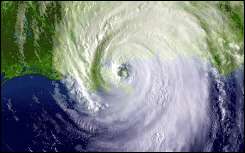
September 22, 2009 Hurricane Katrina

In a new study, Clemson University researchers have concluded that the number of hurricanes and tropical storms in the Atlantic Basin is increasing, but there is no evidence that their individual strengths are any greater than storms of the past or that the chances of a U.S. strike are up.

Robert Lund, professor of mathematical sciences at Clemson, along with colleagues Michael Robbins and Colin Gallagher of Clemson and QiQi Lu of Mississippi State University, studied changes in the tropical cycle record in the North Atlantic between 1851 and 2008.

"This is a hot button in the argument for global warming," said Lund. "Climatologists reporting to the U.S. Senate as recently as this summer testified to the exact opposite of what we find. Many researchers have maintained that warming waters of the Atlantic are increasing the strengths of these storms. We do not see evidence for this at all, however we do find that the number of storms has recently increased."

The study represents one of the first rigorous statistical assessments of the issue with uncertainty margins calculated in. For example, Lund says "there is less than a one in 100,000 chance of seeing this many storms occur since 1965 if in truth changes are not taking place."

He adds, "Hopefully such a rigorous assessment will clear up the controversy and the misinformation about what is truly happening with these storms."

The study, submitted to the Journal of the American Statistical Association, also found changes in pattern records starting around 1935. This was expected at the onset of aircraft reconnaissance, which allowed record-keepers to identify and document storms occurring in the open ocean.

While the study did conclude that more storms are being documented, researchers found no evidence of recent increases in U.S. landfall strike probability of the strongest of hurricanes. Lund notes that "because these types of storms are so uncommon, it will take many more years of data to reliably assess this issue."

Source: Clemson University (news : web)


print this article email this article download pdf blog this article bookmark this article     Stumble it Digg this share on Facebook retweet share on Reddit add to delicious
Rate this story - 4 /5 (2 votes)

Rank Filter

Move the slider to adjust rank threshold, so that you can hide some of the comments.


Display comments: newest first

  • GrayMouser - Sep 22, 2009
    • Rank: not rated yet
    or that the chances of a U.S. strike are up

    Prior to our modern space based detection of hurricanes the gold standard was them hitting the US coast and how strong they were when they hit the coast.
    If this isn't considered when doing historical comparisons it looks like we have more and stronger hurricanes (counting the maximum strength and those that don't hit land.) This is a form of cherry-picking if you want to lie with statistics.

September 22, 2009 all stories

Comments: 1

4 /5 (2 votes)
  • Stumble this up

  • Digg this

  • share this

  • hide
  • Related Stories

  • Researchers Say Outlook Indicates Active 2008 Hurricane Season
    created Apr 09, 2008 | popularity not rated yet | comments 0
  • Busy Atlantic storm season predicted
    created Aug 02, 2005 | popularity not rated yet | comments 0
  • Prediction of major hurricanes lowered
    created Aug 04, 2007 | popularity not rated yet | comments 0
  • Accuracy of past hurricane counts good
    created Nov 26, 2007 | popularity not rated yet | comments 0
  • Hurricanes: Category 6 listing possible
    created May 22, 2006 | popularity not rated yet | comments 0


  • hide
  • Relevant PhysicsForums posts

  • The IPCC and the term "most"
    created Nov 23, 2009
  • Is global warming a fact?
    created Nov 23, 2009
  • Random variability of wind patterns
    created Nov 23, 2009
  • Record precipitation in the UK
    created Nov 22, 2009
  • More from Physics Forums - Earth

Other News

NASA Aircraft Flies Calif. Wildfire Post-Burn Mission

Space & Earth / Environment

created 30 minutes ago | popularity not rated yet | comments 0

(PhysOrg.com) -- NASA's remotely piloted Predator B aircraft, named Ikhana, recently conducted post-burn assessments of two Southern California wildfire sites, the Piute Fire in Kern County and the Station Fire in the Angeles ...


Oceanic crust formation is dynamic after all

Oceanic crust formation is dynamic after all

Space & Earth / Earth Sciences

created 1hour ago | popularity 4 / 5 (1) | comments 0

Imagine the Earth's crust as the planet's skin: Some areas are old and wrinkled while others have a fresher, more youthful sheen, as if they had been regularly lathered with lotion.


Cosmic 'dig' reveals vestiges of the Milky Way's building blocks

Cosmic 'Dig' Reveals Vestiges of the Milky Way's Building Blocks

Space & Earth / Astronomy

created 2 hours ago | popularity 5 / 5 (6) | comments 0

(PhysOrg.com) -- Peering through the thick dust clouds of our galaxy's "bulge" (the myriads of stars surrounding its center), a team of astronomers has unveiled an unusual mix of stars in the stellar grouping ...


NASA's Aqua satellite sees Nida explode into a category 5 Super typhoon

NASA's Aqua satellite sees Nida explode into a category 5 Super typhoon

Space & Earth / Earth Sciences

created 1hour ago | popularity 5 / 5 (1) | comments 0

Typhoon Nida is in a favorable environment that has enabled it to intensify faster and stronger than previously forecast, and has now exploded into a Super typhoon. NASA's Aqua satellite passed over Nida and ...


Mars Reconnaissance Orbite

Mars Reconnaissance Orbite Team Plans Uplink of Protective Files

Space & Earth / Space Exploration

created 7 hours ago | popularity 5 / 5 (1) | comments 0

(PhysOrg.com) -- The team operating NASA's Mars Reconnaissance Orbiter plans to uplink protective files to the spacecraft next week as one step toward resuming the orbiter's research and relay activities.