New species of ghostshark from California and Baja California
September 22, 2009 New species of ghostshark from California and Baja California

Enlarge

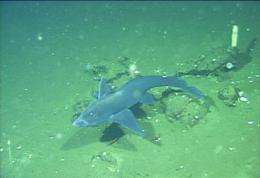
This is an Eastern Pacific black ghostshark (Hydrolagus melanophasma), a new species from California and Baja California. Credit: MBARI

New species are not just discovered in exotic locales -- even places as urban as California still yield discoveries of new plants and animals. Academy scientists recently named a new species of chimaera, an ancient and bizarre group of fishes distantly related to sharks, from the coast of Southern California and Baja California, Mexico.

The new species, the Eastern Pacific black ghostshark (Hydrolagus melanophasma), was described in the September issue of the international journal Zootaxa by a research team including Academy Research Associates David Ebert and Douglas J. Long. Additional co-authors included Kelsey James, a graduate student at Moss Landing Marine Laboratories, and Dominique Didier from Millersville University in Pennsylvania. This is the first new species of cartilaginous fish to be described from California waters since 1947.

Chimaeras, also called ratfish, rabbitfish, and ghostsharks, are perhaps the oldest and most enigmatic groups of fishes alive today. Their closest living relatives are sharks, but their evolutionary lineage branched off from sharks nearly 400 million years ago, and they have remained an isolated group ever since. Like sharks, chimaeras have skeletons composed of cartilage and the males have claspers for internal fertilization of females. Unlike sharks, male chimaeras also have retractable sexual appendages on the forehead and in front of the pelvic fins and a single pair of gills. Most species also have a mildly venomous spine in front of the dorsal fin. Chimaeras were once a very diverse and abundant group, as illustrated by their global presence in the fossil record. They survived through the age of dinosaurs mostly unchanged, but today these fishes are relatively scarce and are usually confined to deep ocean waters, where they have largely avoided the reach of explorers and remained poorly known to science.

This new species belongs to the genus Hydrolagus, Latin for 'water rabbit' because of its grinding tooth plates reminiscent of a rabbit's incisor teeth. This new species was originally collected as early as the mid 1960s, but went unnamed until this year because its taxonomic relationships were unclear. A large blackish-purple form, Hydrolagus melanophasma (melanophasma is Latin for 'black ghost'), is found in deep water from the coast of Southern California, along the western coast of Baja California, and into the Sea of Cortez (Gulf of California). This species is known from a total of nine preserved museum specimens, and from video footage taken of it alive by a deep-water submersible in the Sea of Cortez.

Renewed exploration of the world's deep oceans and more extensive taxonomic analysis of chimaera specimens in museum collections have led to a boom in the number of new chimaera species discovered worldwide in the last decade, including two species from the Galápagos Islands named by Didier, Ebert, and Long in 2006 that were originally collected by Academy scientist John McCosker. With further advances in research and discovery, perhaps more will be known about these living fossils and their diversity in the world's oceans.

Source: California Academy of Sciences


print this article email this article download pdf blog this article bookmark this article     Stumble it Digg this share on Facebook retweet share on Reddit add to delicious
Rate this story - 4.8 /5 (5 votes)


September 22, 2009 all stories

Comments: 0

4.8 /5 (5 votes)
  • Stumble this up

  • Digg this

  • share this

  • hide
  • Related Stories

  • Over 100 new sharks and rays classified
    created Sep 18, 2008 | popularity not rated yet | comments 0
  • Oldest fossil brain found in Kansas (Videos)
    created Mar 02, 2009 | popularity not rated yet | comments 0
  • Study: Oceans 70 percent shark-free
    created Feb 22, 2006 | popularity not rated yet | comments 0
  • Warming waters may make Antarctica hospitable to sharks, with potentially disastrous consequences
    created Feb 15, 2008 | popularity not rated yet | comments 0
  • Baby salmon sharks dying a strange death
    created Aug 12, 2007 | popularity not rated yet | comments 0


  • hide
  • Relevant PhysicsForums posts

  • Human Leukocyte Antigen (HLA) typing
    created 4 hours ago
  • Breeding program
    created Nov 20, 2009
  • How does a concentration gradient provide energy?
    created Nov 20, 2009
  • Eyesight and Neural Damage from Electronics
    created Nov 19, 2009
  • More from Physics Forums - Biology

Other News

The Monarchs' annual migration ritual has yet to be scientifically explained

Tree-eating bugs threaten Monarch butterfly in Mexico

Biology / Ecology

created 6 hours ago | popularity 4 / 5 (1) | comments 0

The mysterious Monarch butterfly, which migrates en masse annually between Canada and Mexico, is now facing a new peril: another insect thriving in Western Mexican forests.


Extinct goat Myotragus balearicus

Extinct goat was cold-blooded

Biology / Plants & Animals

created Nov 18, 2009 | popularity 4.9 / 5 (32) | comments 10

(PhysOrg.com) -- An extinct goat that lived on a barren Mediterranean island survived for millions of years by reducing in size and by becoming cold-blooded, which has never before been discovered in mammals.


Bigger not necessarily better, when it comes to brains

Bigger not necessarily better, when it comes to brains

Biology / Plants & Animals

created Nov 17, 2009 | popularity 4.5 / 5 (17) | comments 11

(PhysOrg.com) -- Tiny insects could be as intelligent as much bigger animals, despite only having a brain the size of a pinhead, say scientists at Queen Mary, University of London.


Right-handed chimpanzees provide clues to the origin of human language

Biology / Plants & Animals

created Nov 16, 2009 | popularity 3 / 5 (1) | comments 7

Most of the linguistic functions in humans are controlled by the left cerebral hemisphere. A study of captive chimpanzees at the Yerkes National Primate Research Center (Atlanta, Georgia), reported in the January 2010 issue ...


The creature was found at a depth of 161 metres

Japanese researchers film rare baby fish 'fossil'

Biology / Plants & Animals

created Nov 17, 2009 | popularity 4.7 / 5 (7) | comments 4

Japanese marine researchers said Tuesday they had found and successfully filmed a young coelacanth -- a rare type of fish known as "a living fossil" -- in deep water off Indonesia.