All tied up: Tethered protein provides long-sought answer
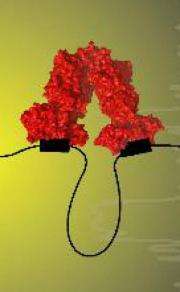
The tools of biochemistry have finally caught up with lactose repressor protein. Biologists from Rice University in Houston and the University of Florence in Italy this week published new results about "lac repressor," which was the first known genetic regulatory protein when discovered in 1966.
Using cutting-edge techniques, the scientists tied together two segments within individual molecules of lactose repressor protein. They then measured the ability of these tethered molecules to form DNA loops to determine how flexibility within the protein influences the extent to which these loops can form. The results appear online this week in the Proceedings of the National Academy of Sciences.
"It's become increasingly clear that many proteins are highly flexible and able to form different types of structures when they interact with something else, often another protein or DNA," said study co-author Kathleen Matthews, Rice's Stewart Memorial Professor of Biochemistry and Cell Biology, who began studying lactose repressor protein in 1970. "That's true for lactose repressor in binding to DNA, making it a good candidate to learn more about the process of DNA looping because it's a relatively simple and well-studied protein."
With proteins, it is impossible to separate form from function; they do what they do because of their shape. That said, it is also unusual for scientists to get a clear picture of what a protein looks like in its native environment. For example, the general structure of lactose repressor has been known for some time, but questions have remained about how it flexes and moves inside a living cell.
Lactose repressor is a V-shaped bacterial protein that has two arms connected by a central hinge. Each arm has a sticky tip that's designed to grab hold of DNA. When each arm "sticks" to a different site within a single DNA molecule, a loop forms, creating a "pinched-off" section of DNA. The combination of protein binding and the loop prevent the machinery that encodes proteins from copying the DNA, so in essence, lactose repressor "turns off" the nearby genes.
Lactose repressor draws its name from the genes that it blocks -- genes that encode enzymes used to transport and metabolize lactose in bacteria. If a bacterial cell happens to be where lactose is plentiful, lactose repressor binds to a derivative of lactose that prevents high-affinity binding of repressor to the DNA. The cell is then able to manufacture the enzymes needed to convert the lactose into food. If no lactose is present, the protein clamps onto the DNA and inactivates the process of copying the lactose genes so the cell doesn't waste energy making the enzyme.
In 2007, the University of Florence's Francesco Vanzi visited Matthews' lab to learn new techniques for purifying and assaying samples of lactose repressor. The protein has a limited shelf life, and Vanzi, who was preparing to do single-molecule studies on the protein, needed to find out how to make it on-site in his lab.
"While he was here, we talked about various ways to fix the two arms of the protein with cross-linkers," Matthews said. The idea was to bind the arms together with chemical manacles that would limit the movement around the hinge of the "V." Vanzi, Matthews and Rice postdoctoral fellow Hongli Zhan wound up using three sets of manacles, or tethers, including longer and shorter chemical tethers; they also used some reversible tethers to allow return to the protein's original state. The researchers chose two different binding sites, one that provided some degree of flexibility in opening the structure and one that kept the arms bound in the more-closed "V" position characteristic of the structure determined for the protein in crystals.
The team found that the more they restricted the flexibility of the arms, the less likely the protein was to create DNA loops by binding at two sites.
DNA looping was measured directly by employing single-molecule techniques in the biophysics laboratory at the European Laboratory for Nonlinear Spectroscopy (LENS). The LENS team was led by Francesco Pavone. Lab postdoctoral researcher Danielis Rutkauskas adapted the methods to optimally measure the looping behavior of lactose repressor with different degrees of structural constraint.
"Our findings are important, but there is clearly more work to be done," Vanzi said. "We've found that limiting flexibility indeed limits protein function in this case. Now we need to apply our methods more broadly to see if this applies in other cases as well. We are also very excited about the dawn of single-molecule biophysical methods being applied inside living cells. Interdisciplinary approaches at the edge between physics and biochemistry are proving very powerful, and the months I spent at Rice were a blast."
Source: Rice University (news : web)


