Biofuel from Corn Stover
September 22, 2009 by By Don Comis Biofuel from Corn Stover

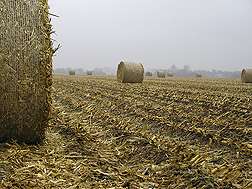
ARS research has shown that harvesting 40 percent of corn stover in fields of the northern Great Plains only increases soil erosion by 0.25 tons an acre per year.

(PhysOrg.com) -- How much corn crop residue, or stover, can be removed for biofuels without harming soil? An Agricultural Research Service (ARS) study of a 10-mile circle around the University of Minnesota’s Morris campus offers some clues.

Dave Archer, an agricultural scientist at the ARS Northern Great Plains Research Laboratory in Mandan, N.D., chose that circle area because of the university’s plans to heat its buildings with gas released by a controlled burning of corn stover -- a process called gasification.

Using the ARS Environmental Policy Integrated Climate (EPIC) model, Archer found that if farmers in that area harvested 40 percent of the stover, this would increase by only 0.25 tons an acre per year. Erosion levels could be minimized by harvesting stover from areas less susceptible to erosion, by removing stover at lower rates, and by using conservation tillage, diverse crop rotations, and other conservation cropping practices.

Archer used EPIC to estimate costs, including the expense of replacing nutrients lost from the stover removal.

The Morris study is part of the ARS Renewable Energy Assessment Project (REAP). ARS has scientists in 10 states involved in the project, in collaboration with universities participating in the Sun Grant Initiative funded by the U.S. departments of Transportation, Energy, and Agriculture.

Also participating in REAP is Archer’s colleague, Jane Johnson, an ARS soil scientist at Morris. Johnson and colleagues at Morris are studying whether returning the co-products of gasification to the can replace lost carbon and nutrients and help prevent erosion. If so, then additional stover could be harvested from soils treated with co-products.

Provided by USDA Agricultural Research Service


print this article email this article download pdf blog this article bookmark this article     Stumble it Digg this share on Facebook retweet share on Reddit add to delicious
Rate this story - not rated yet


September 22, 2009 all stories

Comments: 0

not rated yet
  • Stumble this up

  • Digg this

  • share this

  • hide
  • Related Stories

  • A model to measure soil health in the era of bioenergy
    created Nov 19, 2008 | popularity not rated yet | comments 0
  • Researchers study ground cover to reduce impact of biomass harvest
    created Jul 08, 2008 | popularity not rated yet | comments 0
  • Managing carbon loss
    created Dec 03, 2008 | popularity not rated yet | comments 0
  • Research aims for more efficiency in harvest and handling
    created Sep 27, 2006 | popularity not rated yet | comments 0
  • Organic corn: Increasing rotation complexity increases yields
    created May 28, 2008 | popularity not rated yet | comments 0


  • hide
  • Relevant PhysicsForums posts

  • The IPCC and the term "most"
    created 18 hours ago
  • Is global warming a fact?
    created 19 hours ago
  • Random variability of wind patterns
    created Nov 23, 2009
  • Record precipitation in the UK
    created Nov 22, 2009
  • More from Physics Forums - Earth

Other News

From Greenhouse to Icehouse

From Greenhouse to Icehouse

Space & Earth / Earth Sciences

created 2 hours ago | popularity 4 / 5 (2) | comments 4

A new study that reconstructed ocean temperatures from millions of years ago could provide new insight into how the Earth responds to climate change.


'Cosmic fruit machine' matches collisions

'Cosmic fruit machine' matches collisions

Space & Earth / Astronomy

created 4 hours ago | popularity 5 / 5 (1) | comments 1

(PhysOrg.com) -- A new website will give everyone the chance to contribute to science by playing a 'cosmic fruit machine' and compare images of colliding galaxies with millions of simulated images of galactic ...


Humanity would need five Earths to create the resources needed if everyone lived as like Americans, a report has stated

Mankind using Earth's resources at alarming rate

Space & Earth / Environment

created 2 hours ago | popularity 3 / 5 (4) | comments 6

Humanity would need five Earths to produce the resources needed if everyone lived as profligately as Americans, according to a report issued Tuesday.


Supervolcano eruption -- in Sumatra -- deforested India 73,000 years ago

Supervolcano eruption -- in Sumatra -- deforested India 73,000 years ago

Space & Earth / Earth Sciences

created 19 hours ago | popularity 4.4 / 5 (12) | comments 2

A new study provides "incontrovertible evidence" that the volcanic super-eruption of Toba on the island of Sumatra about 73,000 years ago deforested much of central India, some 3,000 miles from the epicenter, ...


New computer-developed map shows more extensive valley network on Mars

New computer-developed map shows more extensive valley network on Mars

Space & Earth / Space Exploration

created 18 hours ago | popularity 4.5 / 5 (8) | comments 0

New research adds to the growing body of evidence suggesting the Red Planet once had an ocean.