EVE: Measuring the Sun's hidden variability
September 22, 2009 EVE: Measuring the Sun's hidden variability

Enlarge

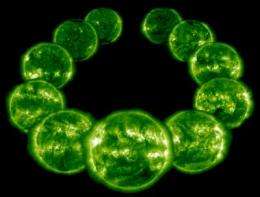
This is the extreme ultraviolet sun imaged by the Solar and Heliospheric Observatory over one complete solar cycle. The sun changes more at EUV wavelengths than it does in any other part of the electromagnetic spectrum. Credit: NASA/SOHO

Every 11 years, the sun undergoes a furious upheaval. Dark sunspots burst forth from beneath the sun's surface. Explosions as powerful as a billion atomic bombs spark intense flares of high-energy radiation. Clouds of gas big enough to swallow planets break away and billow into space. It's a flamboyant display of stellar power.

So why can't we see any of it?

Almost none of the drama of Solar Maximum is visible to the human eye. Look at the sun in the noontime sky and—ho-hum—it's the same old bland ball of light.

"The problem is, human eyes are tuned to the wrong wavelength," explains Tom Woods, a solar physicist at the University of Colorado in Boulder. "If you want to get a good look at , you need to look in the EUV."

EUV is short for "extreme ultraviolet," a high-energy form of ultraviolet radiation with wavelengths between 1 and 120 nanometers. EUV photons are much more energetic and dangerous than the ordinary UV rays that cause sunburns. Fortunately for humans, Earth's atmosphere blocks solar EUV; otherwise a day at the beach could be fatal.

When the sun is active, solar EUV emissions can rise and fall by factors of hundreds to thousands in just a matter of minutes. These surges heat Earth's upper atmosphere, puffing it up and increasing the air friction, or "drag," on satellites. EUV photons also break apart atoms and molecules, creating a layer of ions in the that can severely disturb radio signals.

To monitor these energetic photons, NASA is going to launch a sensor named "EVE," short for EUV Variability Experiment, onboard the Solar Dynamics Observatory this winter.

"EVE gives us the highest time resolution and the highest spectral resolution that we've ever had for measuring the sun, and we'll have it 24/7," says Woods, the lead scientist for EVE. "This is a huge improvement over past missions."

Although EVE is designed to study solar activity, its first order of business is to study solar inactivity. SDO is going to launch during the deepest solar minimum in almost 100 years. Sunspots, flares and CMEs are at a low ebb. That's okay with Woods. He considers solar minimum just as interesting as solar maximum.

"Solar minimum is a quiet time when we can establish a baseline for evaluating long-term trends," he explains. "All stars are variable at some level, and the sun is no exception. We want to compare the sun's brightness now to its brightness during previous minima and ask: is the sun getting brighter or dimmer?"

The answer seems to be dimmer. Measurements by a variety of spacecraft indicate a 12-year lessening of the sun's "irradiance" by about 0.02% at visible wavelengths and 6% at EUV wavelengths. These results, which compare the of 2008-09 to the previous minimum of 1996, are still very preliminary. EVE will improve confidence in the trend by pinning down the EUV spectrum with unprecedented accuracy.

The sun's variability and its potential for future changes are not fully understood—hence the need for EVE. "The EUV portion of the sun's spectrum is what changes most during a solar cycle," says Woods, "and that is the part of the spectrum we will be observing."

Woods gazes out his office window at the Colorado sun. It looks the same as usual. EVE, he knows, will have a different story to tell.

Source: NASA/Goddard Space Flight Center


print this article email this article download pdf blog this article bookmark this article     Stumble it Digg this share on Facebook retweet share on Reddit add to delicious
Rate this story - 4.1 /5 (7 votes)


September 22, 2009 all stories

Comments: 0

4.1 /5 (7 votes)
  • Stumble this up

  • Digg this

  • share this

  • hide
  • Related Stories

  • NIST assists in solar stake-out to improve space weather forecasts
    created Jul 10, 2008 | popularity not rated yet | comments 0
  • First Solar Dynamic Observatory Instrument Arrives at Goddard
    created Sep 07, 2007 | popularity not rated yet | comments 0
  • NASA prepares solar dynamic observatory
    created Sep 10, 2007 | popularity not rated yet | comments 0
  • The Sun Loses its Spots
    created Jul 24, 2007 | popularity not rated yet | comments 0
  • Satellite shows regional variation in warming from sun during solar cycle
    created Nov 13, 2007 | popularity not rated yet | comments 0


  • hide
  • Relevant PhysicsForums posts

  • Sideral question
    created 22 hours ago
  • Doppler shifted blackbody spectrum
    created Nov 21, 2009
  • Earth v. Moon
    created Nov 21, 2009
  • help me with coordinates and orbits
    created Nov 21, 2009
  • More from Physics Forums - General Astronomy

Other News

Baby can wait as expectant dad finishes spacewalk (AP)

Baby can wait as expectant dad finishes spacewalk

Space & Earth / Space Exploration

created 13 hours ago | popularity 3 / 5 (2) | comments 0

(AP) -- A spacewalking astronaut put aside the impending birth of his daughter and blazed through his first-ever venture outside the International Space Station on Saturday.


Unseasonably hot and dry weather combined with strong winds to fan scores of blazes in the country's southeastern states

Australia issues 'catastrophic' alerts as fires rage

Space & Earth / Environment

created 20 hours ago | popularity 4 / 5 (3) | comments 0

Australia has issued "catastrophic" alerts after record-breaking temperatures and wild lightning storms sparked more than 100 fires across the country, officials said Saturday.


Commuters wait on the platform shrouded by fog in London

Climate change not man-made, say majority of Britons: poll

Space & Earth / Environment

created Nov 15, 2009 | popularity 3.3 / 5 (15) | comments 46

Less than half of Britons believes that human activity is to blame for global warming, according to a poll carried out for The Times newspaper and published on Saturday.


Mysteriously warm times in Antarctica

Mysteriously warm times in Antarctica

Space & Earth / Earth Sciences

created Nov 18, 2009 | popularity 4.2 / 5 (21) | comments 28

(PhysOrg.com) -- A new study of Antarctica's past climate reveals that temperatures during the warm periods between ice ages (interglacials) may have been higher than previously thought. The latest analysis ...


UN: Fight climate change with free condoms (AP)

UN: Fight climate change with free condoms

Space & Earth / Environment

created Nov 18, 2009 | popularity 3.1 / 5 (11) | comments 25

(AP) -- The battle against global warming could be helped if the world slowed population growth by making free condoms and family planning advice more widely available, the U.N. Population Fund said Wednesday.