Fermi Large Area Telescope Reveals Pulsing Gamma-Ray Sources
September 22, 2009 Fermi Large Area Telescope Reveals Pulsing Gamma-Ray Sources

Enlarge

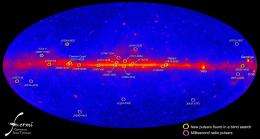
Image from the Fermi Gamma-ray Space Telescope displays newly found pulsars (circled in yellow) and millisecond pulsars (Circled in magenta). Source: NASA/DoE/Fermi LAT Collaboration

(PhysOrg.com) -- Scientists at the Naval Research Laboratory Space Science Division and a team of international researchers have positively identified cosmic sources of gamma-ray emissions through the discovery of 16 pulsating neutron stars.

Using the Large Area Telescope (LAT), the primary instrument on NASA's satellite, the discoveries were made by conducting blind frequency searches on the sparse photon data provided by the LAT. The photons had energies between 20 Mega-electron-volts (MeVs) and 300 Giga-electron-volts (GeVs)- tens of millions to hundreds of billions of times more energetic than the photons we see with the human eye.

A second study, published at the same time, announced the detection of gamma-ray pulsations from eight Galactic millisecond pulsars (MSPs). Millisecond pulsars spin hundreds of times per second, but have magnetic fields 10,000 times lower than normal pulsars. These discoveries confirm that they, too, can produce powerful gamma-ray emissions.

"Fermi has truly unprecedented power for discovering and studying gamma ray pulsars," said Paul Ray, astrophysicist, Naval Research Laboratory. "Since the demise of the Compton Gamma Ray Observatory a decade ago, we've wondered about the nature of unidentified gamma-ray sources it detected in our galaxy. These studies from Fermi lift the veil on many of them."
Fermi Large Area Telescope Reveals Pulsing Gamma-Ray Sources
Enlarge

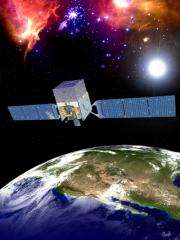
Artist rendition of the Fermi Gamma-ray Space Telescope satellite and Large Area Telescope (LAT). Source: NASA

Pulsars are rapidly rotating, highly magnetized that can emit radiation across the . Prior to the launch of Fermi, gamma-ray pulsations were only detected from pulsars previously discovered using radio or X-ray telescopes. Radio telescopes can detect pulsars only if one of the narrow radio beams is directly aimed at the telescope; otherwise the pulsar can remain hidden. The much broader gamma-ray beams allowed the new pulsars to be discovered as part of a comprehensive search for periodic gamma-ray emission using five months of Fermi LAT data and new computational techniques.

The newly discovered pulsars, with rotation periods that range from 48 to 444 milliseconds, help reveal the geometry of emission from rotation-powered pulsars and provide valuable information on population statistics, the energetics of pulsar wind nebulae and supernova remnants. A wide variety of astrophysical phenomena, such as pulsars, active galactic nuclei, gamma-ray bursts and some binary star systems are known to produce photons exceeding many MeVs.

"The Fermi LAT makes it possible for us to pinpoint neutron stars," said Eric Grove, astrophysicist and LAT Commissioner, NRL Space Science Division. "The combination of a very large collecting area, large field of view, and precision timing from an on-board Global Positioning System receiver enables the LAT to see sources that were far beyond the reach of previous gamma-ray telescopes."

Results of the two studies: "Detection of 16 gamma-ray pulsars through blind frequency searches using the Fermi LAT;" and "A population of gamma-ray millisecond pulsars seen with the Fermi " were published on July 2, 2009 in Science Express.

Provided by Naval Research Laboratory


print this article email this article download pdf blog this article bookmark this article     Stumble it Digg this share on Facebook retweet share on Reddit add to delicious
Rate this story - 4.7 /5 (6 votes)

Rank Filter

Move the slider to adjust rank threshold, so that you can hide some of the comments.


Display comments: newest first

  • omatumr - Sep 23, 2009
    • Rank: 1 / 5 (2)
    What Is Source of Pulsar Energy?

    Can we get a response from Dr. Eric Grove or other scientists associated with the Space Science Division of the Naval Research Laboratory?

    Thanks!
    Oliver K. Manuel

September 22, 2009 all stories

Comments: 1

4.7 /5 (6 votes)
  • Stumble this up

  • Digg this

  • share this

  • hide
  • Related Stories

  • Fermi Large Area Telescope reveals pulsing gamma-ray sources
    created Sep 09, 2009 | popularity not rated yet | comments 0
  • Fermi Telescope reveals a population of radio-quiet gamma-ray pulsars
    created Jul 02, 2009 | popularity not rated yet | comments 0
  • Fermi telescope unveils a dozen new pulsars
    created Jan 06, 2009 | popularity not rated yet | comments 0
  • First gamma-ray-only pulsar observation opens new window on stellar evolution
    created Oct 16, 2008 | popularity not rated yet | comments 0
  • Fermi telescope reveals best-ever view of the gamma-ray sky
    created Mar 11, 2009 | popularity not rated yet | comments 0


  • hide
  • Relevant PhysicsForums posts

  • Sideral question
    created 11 hours ago
  • Doppler shifted blackbody spectrum
    created 13 hours ago
  • Earth v. Moon
    created 16 hours ago
  • help me with coordinates and orbits
    created 16 hours ago
  • basic 'our universe' question..
    created Nov 20, 2009
  • deriving keplers law
    created Nov 19, 2009
  • More from Physics Forums - General Astronomy

Other News

Astronauts finish another spacewalk, still no baby (AP)

Astronauts finish another spacewalk, still no baby

Space & Earth / Space Exploration

created 2 hours ago | popularity 5 / 5 (1) | comments 0

(AP) -- A spacewalking astronaut put aside the impending birth of his daughter and blazed through his first-ever venture outside the International Space Station on Saturday.


Unseasonably hot and dry weather combined with strong winds to fan scores of blazes in the country's southeastern states

Australia issues 'catastrophic' alerts as fires rage

Space & Earth / Environment

created 8 hours ago | popularity 4 / 5 (1) | comments 0

Australia has issued "catastrophic" alerts after record-breaking temperatures and wild lightning storms sparked more than 100 fires across the country, officials said Saturday.


Commuters wait on the platform shrouded by fog in London

Climate change not man-made, say majority of Britons: poll

Space & Earth / Environment

created Nov 15, 2009 | popularity 3.3 / 5 (15) | comments 45

Less than half of Britons believes that human activity is to blame for global warming, according to a poll carried out for The Times newspaper and published on Saturday.


Mysteriously warm times in Antarctica

Mysteriously warm times in Antarctica

Space & Earth / Earth Sciences

created Nov 18, 2009 | popularity 4.3 / 5 (20) | comments 27

(PhysOrg.com) -- A new study of Antarctica's past climate reveals that temperatures during the warm periods between ice ages (interglacials) may have been higher than previously thought. The latest analysis ...


UN: Fight climate change with free condoms (AP)

UN: Fight climate change with free condoms

Space & Earth / Environment

created Nov 18, 2009 | popularity 3.1 / 5 (11) | comments 22

(AP) -- The battle against global warming could be helped if the world slowed population growth by making free condoms and family planning advice more widely available, the U.N. Population Fund said Wednesday.