High-School Student Discovers Strange Astronomical Object
September 22, 2009
High-School Student Discovers Strange Astronomical Object

Enlarge

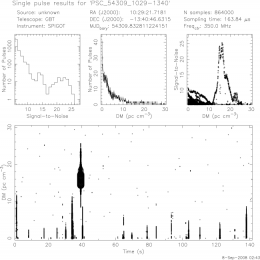
When Lucas Bolyard looked at the bottom plot, he noticed the thick, black blob left of the center. He saw that this signal was positioned on the graph where it indicated a non-zero "dispersion measure," or DM. Dispersion measure is used by astronomers as an indicator of cosmic distances. The non-zero DM value of this pulse is a clue that the signal came from space, not from Earth. The other blobs on the bottom of the graph are signals at a distance of zero-- that is from here on Earth. CREDIT: NRAO/AUI/NSF

(PhysOrg.com) -- A West Virginia high-school student analyzing data from a giant radio telescope has discovered a new astronomical object -- a strange type of neutron star called a rotating radio transient.

Lucas Bolyard, a sophomore at South Harrison High School in Clarksburg, WV, made the discovery while participating in a project in which students are trained to scrutinize data from the National Science Foundation's giant Robert C. Byrd Green Bank Telescope (GBT).

The project, called the Pulsar Search Collaboratory (PSC), is a joint project of the National Radio Astronomy Observatory (NRAO) and West Virginia University (WVU), funded by a grant from the National Science Foundation.

Bolyard made the discovery in March, after he already had studied more than 2,000 data plots from the GBT and found nothing.

"I was home on a weekend and had nothing to do, so I decided to look at some more plots from the GBT," he said. "I saw a plot with a pulse, but there was a lot of radio interference, too. The pulse almost got dismissed as interference," he added.

Nonetheless, he reported it, and it went on a list of candidates for West Virginia University astronomers Maura McLaughlin and Duncan Lorimer to re-examine, scheduling new observations of the region of sky from which the pulse came. Disappointingly, the follow-up observations showed nothing, indicating that the object was not a normal pulsar. However, the astronomers explained to Bolyard that his pulse still might have come from a rotating radio transient.

Confirmation didn't come until July. Bolyard was at the NRAO's Green Bank Observatory with fellow PSC students. The night before, the group had been observing with the GBT in the wee hours, and all were very tired. Then Lorimer showed Bolyard a new plot of his pulse, reprocessed from raw data, indicating that it is real, not interference, and that Bolyard is likely the discoverer of one of only about 30 rotating radio transients known.

Suddenly, Bolyard said, he wasn't tired anymore. "That news made me full of energy," he exclaimed.

Rotating radio transients are thought to be similar to pulsars, superdense neutron stars that are the corpses of massive stars that exploded as supernovae. Pulsars are known for their lighthouse-like beams of that sweep through space as the neutron star rotates, creating a pulse as the beam sweeps by a radio telescope. While pulsars emit these radio waves continuously, rotating radio transients emit only sporadically, one burst at a time, with as much as several hours between bursts. Because of this, they are difficult to discover and observe, with the first one only discovered in 2006.

"These objects are very interesting, both by themselves and for what they tell us about neutron stars and supernovae," McLaughlin said. "We don't know what makes them different from pulsars -- why they turn on and off. If we answer that question, it's likely to tell us something new about the environments of pulsars and how their radio waves are generated," she added.

"They also tell us there are more neutron stars than we knew about before, and that means there are more supernova explosions. In fact, we now almost have more than can be accounted for by the supernovae we can detect," McLaughlin explained.

The PSC, led by NRAO Education Officer Sue Ann Heatherly and Project Director Rachel Rosen, includes training for teachers and student leaders, and provides parcels of data from the GBT to student teams. The project involves teachers and students in helping astronomers analyze data from 1500 hours of observing with the GBT. The 120 terabytes of data were produced by 70,000 individual pointings of the giant, 17-million-pound telescope. Some 300 hours of the observing data were reserved for analysis by student teams.

The student teams use analysis software to reveal evidence of pulsars. Each portion of the data is analyzed by multiple teams. In addition to learning to use the analysis software, the student teams also must learn to recognize man-made radio interference that contaminates the data. The project will continue through 2011.

"The students get to actually look through data that has never been looked through before," Rosen said. From the training, she added, "the students get a wonderful grasp of what they're looking at, and they understand the science behind the plots that they're looking at."

For at least one , the PSC has brought to life the excitement of discovery. "Science is a lot more exciting for me now that I've made this discovery," Bolyard said. Scientific research, he learned, "is a lot of hard work, but it's worth it!"

A year ago, he said, he wouldn't have thought of astronomy as a career, but the experience of discovery made astronomy at least a possibility for him. However, he added, "I'm still hoping to be a doctor."

Provided by National Radio Astronomy Observatory (news : web)

4.6 /5 (21 votes)  

Filter


Move the slider to adjust rank threshold, so that you can hide some of the comments.


Display comments: newest first

omatumr
Sep 22, 2009

Rank: 4 / 5 (1)
Congratulations, Lucas!

In paying attention to detail, you have also discovered the key to a fulfilling career in science!

Best wishes,
Oliver K. Manuel
fsmith
Sep 22, 2009

Rank: 5 / 5 (1)
What Oliver Manuel said.

Well fielded, young man! A person your age doesn't catch a neutron star every day.
Husky
Sep 22, 2009

Rank: 5 / 5 (1)
perhaps starquakes on the surface as the neutronstar shell tries to reconfigure pack itselve?, causing magnetic reconnection event/bursts like sunspot mechanism on a grander scale, or perhaps even reconnection event of the neutron star reconnects/disconnects periodycally with the magnetic field of a closleby but not observed black hole, is there something therse radio transents have in common like diametre, density, bpart of inarysystem and sets them appart from the the common pulsars ???
Bob_Kob
Sep 23, 2009

Rank: not rated yet
So why didn't the professionals operating the radio telescope pick this up?
bluehigh
Sep 23, 2009

Rank: not rated yet
too busy with a bigger picture between puffs?
Shaffer
Sep 23, 2009

Rank: not rated yet
It's about time West Virgina get some recognition.

Great Find!
omatumr
Sep 23, 2009

Rank: 1 / 5 (1)
Common Features of the Sun and Pulsars

perhaps starquakes on the surface as the neutronstar shell tries to reconfigure pack itselve?, causing magnetic reconnection event/bursts like sunspot mechanism on a grander scale, or perhaps even . . . ???


You may be right, Husky!

Our Sun shares some common features with pulsars ["Is the Sun a pulsar?" Nature 270, 159 - 160 (10 November 1977); doi:10.1038/270159a0]

http://www.nature...9a0.html

Oliver K. Manuel
nkalanaga
Sep 23, 2009

Rank: 5 / 5 (1)
Bob Kob: I would imagine that the professionals are like those at most big optical observatories. They're trained to run the machines, and leave the data to the astronomers. At most major observatories, the astronomer schedules the observation, tells the observatory where to look and what instruments to use, then waits for the data to come back. The operators don't do any data analysis.
Rank 4.6 /5 (21 votes)
Related Stories
Relevant PhysicsForums posts
  • Never ending outer space.....
    created13 hours ago
  • Neutron Star fragments?
    created15 hours ago
  • stationary or not?
    created19 hours ago
  • Scale of the Universe
    createdFeb 10, 2012
  • Titan's lack of impact craters
    createdFeb 09, 2012
  • Real pictures of black hole eating a star?
    createdFeb 08, 2012
  • More from Physics Forums - General Astronomy

More news stories

Latin America mining boom clashes with conservation

Latin America is experiencing a mining boom as prices rise fuelled by a hike in global demand, but the region is also being hit by a wave of violent protests, strikes and rallies by environmentalists.

Space & Earth / Environment

created 6 hours ago | popularity not rated yet | comments 0

Political leaders play key role in how worried Americans are by climate change: study

More than extreme weather events and the work of scientists, it is national political leaders who influence how much Americans worry about the threat of climate change, new research finds.

Space & Earth / Environment

created Feb 06, 2012 | popularity 5 / 5 (6) | comments 72

NASA budget will axe Mars deal with Europe: scientists

US President Barack Obama's budget proposal to be submitted next week for 2013 will cut NASA's budget by 20 percent and eliminate a major partnership with Europe on Mars exploration, scientists said Thursday.

Space & Earth / Space Exploration

created Feb 10, 2012 | popularity 5 / 5 (3) | comments 55

Humans may have helped the decline of African rainforests 3000 years ago

(PhysOrg.com) -- Large areas of rainforests in Central Africa mysteriously disappeared over three thousand years ago, to be replaced by savannas. The prevailing theory has been that the cause was a change ...

Space & Earth / Environment

created Feb 10, 2012 | popularity 4.1 / 5 (14) | comments 20 | with audio podcast report

Study shows global glaciers, ice caps, shedding billions of tons of mass annually

Earth's glaciers and ice caps outside of the regions of Greenland and Antarctica are shedding roughly 150 billion tons of ice annually, according to a new study led by the University of Colorado Boulder.

Space & Earth / Earth Sciences

created Feb 08, 2012 | popularity 4.4 / 5 (9) | comments 14 | with audio podcast


Google might launch Drive for cloud storage soon

(PhysOrg.com) -- Google's next big move, according to the Wall Street Journal, is a cloud storage service called Drive. Hardly first to the plate, Google is simply catching up to introducing its cloud reposi ...

Love a click away in Indonesia's Twitter Republic

He was a geeky kid from Yogyakarta, she a glamorous city girl in Jakarta. In a country with one of the world's most vibrant social networking scenes they fell in love on Twitter.

Europeans protest controversial Internet pact

Tens of thousands of people marched in protests in more than a dozen European cities Saturday against a controversial anti-online piracy pact that critics say could curtail Internet freedom.

Walney offshore wind farm is world's biggest (for now)

(PhysOrg.com) -- The Walney wind farm on the Irish Sea--characterized by high tides, waves and windy weather--officially opened this week. The farm is treated in the press as a very big deal as the Walney ...

Navy to begin tests on electromagnetic railgun prototype launcher

The Office of Naval Research (ONR)'s Electromagnetic (EM) Railgun program will take an important step forward in the coming weeks when the first industry railgun prototype launcher is tested at a facility ...

Explained: Sigma

It's a question that arises with virtually every major new finding in science or medicine: What makes a result reliable enough to be taken seriously? The answer has to do with statistical significance -- but ...