A flash of light turns graphene into a biosensor
September 23, 2009
Graphene bolsters battery work, biosensors

Enlarge

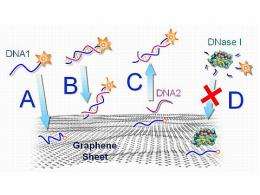
An illustration of how fluorescent-tagged DNA interacts with functionalized graphene. Both single-stranded DNA (A) and double-stranded DNA (B) are adsorbed onto a graphene surface, but the interaction is stronger with ssDNA, causing the fluorescence on the ssDNA to darken more. C) A complimentary DNA nears the ssDNA and causes the adsorbed ssDNA to detach from the graphene surface. D) DNA adsorbed onto graphene is protected from being broken down by enzymes.

(PhysOrg.com) -- Biomedical researchers suspect graphene, a novel nanomaterial made of sheets of single carbon atoms, would be useful in a variety of applications. But no one had studied the interaction between graphene and DNA, the building block of all living things. To learn more, PNNL's Zhiwen Tang, Yuehe Lin and colleagues from both PNNL and Princeton University built nanostructures of graphene and DNA.

They attached a fluorescent molecule to the to track the interaction. Tests showed that the fluorescence dimmed significantly when single-stranded DNA rested on graphene, but that double-stranded DNA only darkened slightly - an indication that single-stranded DNA had a stronger interaction with graphene than its double-stranded cousin.

The researchers then examined whether they could take advantage of the difference in fluorescence and binding. When they added complementary DNA to single-stranded DNA-graphene structures, they found the fluorescence glowed anew. This suggested the two DNAs intertwined and left the graphene surface as a new molecule.

DNA's ability to turns its fluorescent light switch on and off when near graphene could be used to create a , the researchers propose. Possible applications for a DNA-graphene biosensor include diagnosing diseases like cancer, detecting toxins in tainted food and detecting pathogens from biological weapons. Other tests also revealed that single-stranded DNA attached to graphene was less prone to being broken down by enzymes, which makes graphene-DNA structures especially stable. This could lead to for .

Tang will discuss this research and some of its possible applications in medicine, food safety and biodefense at the 2009 Micro Nano Breakthrough Conference, which runs Sept. 21-23 in Portland, Ore.

Source: Pacific Northwest National Laboratory (news : web)

Filter


Move the slider to adjust rank threshold, so that you can hide some of the comments.


Display comments: newest first

danman5000
Sep 23, 2009

Rank: 5 / 5 (1)
Seriously is there anything that carbon nanotubes / graphene can't do? Everywhere I look there are articles with incredible claims. Nanotubes cure cancer! Graphene teaches kids how to ride bikes! I'm becoming wary of all the magical things simple carbon is claimed to do.
vika_Tae
Sep 23, 2009

Rank: not rated yet
None of them are magical, and nanotubes cannot cure cancer, they can only aid the treatment of cancer.
NeilFarbstein
Sep 23, 2009

Rank: 3 / 5 (1)
Seriously is there anything that carbon nanotubes / graphene can't do? Everywhere I look there are articles with incredible claims. Nanotubes cure cancer! Graphene teaches kids how to ride bikes! I'm becoming wary of all the magical things simple carbon is claimed to do.


buckyfood for bucky people!
eat your buckytubes
Know what I mean? If buckytubes can do every thing in the future, we will have all of our bodily functions replaced by nanotubes!!!
I know a scientist named Nicholas Kotov who has worked on supplementing human bone with buckytubes to strengthen them. He's been featured in physorg.com news articles a couple of times.

Like i said "buckyfood for buckypeople!"
Rank 3 /5 (1 vote)
Related Stories
Relevant PhysicsForums posts
  • polymer nanocomposites
    created21 hours ago
  • Corrosion Tests on Magnesium
    createdFeb 09, 2012
  • polyethylene copper nanocomposite
    createdFeb 09, 2012
  • Output of xrd analysis
    createdFeb 08, 2012
  • Transport phenomena problem based on problems 18.B11 and 19B.6 from Bird, stewart, lw
    createdFeb 06, 2012
  • Help with material selection - Car Piston
    createdFeb 05, 2012
  • More from Physics Forums - Materials & Chemical Engineering

More news stories

What lies beneath: Mapping hidden nanostructures

The ability to diagnose and predict the properties of materials is vital, particularly in the expanding field of nanotechnology. Electron and atom-probe microscopy can categorize atoms in thin sheets of material, ...

Nanotechnology / Nanophysics

created 13 hours ago | popularity 5 / 5 (1) | comments 1

New kind of solar cell could capture significantly more energy than current cells

New solar cells could increase the maximum efficiency of solar panels by over 25%, according to scientists from the University of Cambridge.

Nanotechnology / Nanophysics

created Feb 08, 2012 | popularity 4.5 / 5 (12) | comments 14 | with audio podcast

Nanoshell whispering galleries improve thin solar panels

Visitors to Statuary Hall in the U.S. Capitol Building may have experienced a curious acoustic feature that allows a person to whisper softly at one side of the cavernous, half-domed room and for another on ...

Nanotechnology / Nanomaterials

created Feb 07, 2012 | popularity 4.3 / 5 (6) | comments 6 | with audio podcast

'Dark plasmons' transmit energy

Microscopic channels of gold nanoparticles have the ability to transmit electromagnetic energy that starts as light and propagates via "dark plasmons," according to researchers at Rice University.

Nanotechnology / Nanophysics

created Feb 09, 2012 | popularity 5 / 5 (6) | comments 1 | with audio podcast

Revealing how a battery material works

Since its discovery 15 years ago, lithium iron phosphate (LiFePO4) has become one of the most promising materials for rechargeable batteries because of its stability, durability, safety and ability to deliver ...

Nanotechnology / Nanomaterials

created Feb 08, 2012 | popularity 5 / 5 (5) | comments 0 | with audio podcast


Anonymous knocks CIA website offline (Update)

The website of the Central Intelligence Agency was inaccessible on Friday after the hacker group Anonymous claimed to have knocked it offline.

Google users warned of threat to smartphone wallets

Users of Google smartphone wallets were being warned on Friday that there is a way to crack pass codes intended to thwart thieves from going on illicit shopping sprees.

New error-correcting codes guarantee the fastest possible rate of data transmission

Error-correcting codes are one of the triumphs of the digital age. They’re a way of encoding information so that it can be transmitted across a communication channel — such as an optical fiber o ...

Complex wiring of the nervous system may rely on a just a handful of genes and proteins

Researchers at the Salk Institute have discovered a startling feature of early brain development that helps to explain how complex neuron wiring patterns are programmed using just a handful of critical genes. ...

Humans may have helped the decline of African rainforests 3000 years ago

(PhysOrg.com) -- Large areas of rainforests in Central Africa mysteriously disappeared over three thousand years ago, to be replaced by savannas. The prevailing theory has been that the cause was a change ...

The power of estrogen -- male snakes attract other males

A new study has shown that boosting the estrogen levels of male garter snakes causes them to secrete the same pheromones that females use to attract suitors, and turned the males into just about the sexiest ...