India launches seven satellites: space agency
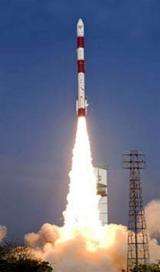
September 23, 2009 File photo shows the a satellite being launched in southern India

Enlarge

File photo shows a satellite being launched in southern India in January 2008. India successfully launched seven satellites including six from foreign countries, officials said, underlining the country's ambitions in the space business.

India successfully launched seven satellites including six from foreign countries on Wednesday, officials said, underlining the country's ambitions in the space business.

About a month after its first moon mission was aborted, the country's space agency announced that the seven satellites had been put into orbit about 720 kilometres (447 miles) above the Earth.

India will use one of the satellites, Oceansat-2, for monitoring ocean patterns and identifying fishing zones, enhancing the capability of the first Oceansat, which was launched in 1999, the agency said.

Of the six foreign satellites, there are four from Germany and one each from Switzerland and Turkey. They are university-funded payloads being used to test new technologies.

"Once again we have proved that we can do the job precisely. The satellites have been placed in the desired orbit at the exact time," said Indian Space Research Organisation (ISRO) chairman G. Madhavan Nair from the spaceport Sriharikota, about 80 kilometres northeast of Chennai.

The cost of the launch was two billion rupees (40 million dollars), including 1.3 billion rupees for the satellite and 700 million rupees for the rocket, ISRO director S. Satish said.

India began its space programme in 1963, developing its own satellites and launch vehicles to cut dependence on overseas agencies.

It first staked its claim to a share of the global commercial launch market by sending an Italian satellite into orbit in 2007 and is keen to use its cost advantage to garner further business.

The Indian satellite will study the role of oceans on the Earth's atmosphere and data beamed back will be used to identify fishing zones, as well as helping with coastal studies, weather forecasting and climate studies.

India put a probe on the moon's surface to great fanfare and national pride late last year, but controllers lost contact with the space vehicle last month and aborted the mission.

(c) 2009 AFP


Rate this story - 5 /5 (3 votes)


September 23, 2009 all stories

Comments: 0

5 /5 (3 votes)

  • hide
  • Related Stories

  • India launches first commercial rocket
    created Apr 23, 2007 | popularity not rated yet | comments 0
  • Europe, India Cooperate for India's Moon Mission
    created Mar 21, 2005 | popularity not rated yet | comments 0
  • India Reschedules INSAT-4A Launch Program
    created Jun 28, 2005 | popularity not rated yet | comments 0
  • India To Launch Exclusive Satellite To Track Natural Disasters
    created Nov 01, 2005 | popularity not rated yet | comments 0
  • India abandons satellite after losing contact
    created Aug 31, 2009 | popularity not rated yet | comments 0


  • hide
  • Relevant PhysicsForums posts

  • Spreading Life in the Universe
    created 10 hours ago
  • Force of Gravity in terms of Density
    created Feb 08, 2010
  • what is the relation between gravity and light?
    created Feb 08, 2010
  • Does the Thermoelectric effect apply in sun?
    created Feb 07, 2010
  • More from Physics Forums - General Astronomy

Other News

Rho Ophiuchus cloud

Professor: We have a 'moral obligation' to seed universe with life

Space & Earth / Astronomy

created 20 hours ago | popularity 3.1 / 5 (27) | comments 52 | with audio podcast report

(PhysOrg.com) -- Eventually, the day will come when life on Earth ends. Whether that’s tomorrow or five billion years from now, whether by nuclear war, climate change, or the Sun burning up its fuel, the last ...


Climate 'Tipping Points' May Arrive Without Warning, Says Top Forecaster

Space & Earth / Environment

created 9 hours ago | popularity 3 / 5 (8) | comments 6 | with audio podcast

(PhysOrg.com) -- A new University of California, Davis, study by a top ecological forecaster says it is harder than experts thought to predict when sudden shifts in Earth's natural systems will occur -- a worrisome finding ...


A new 3-D map of the interstellar gas within 300 parsecs from the sun

A new 3D map of the interstellar gas within 300 parsecs from the Sun

Space & Earth / Astronomy

created 12 hours ago | popularity 5 / 5 (4) | comments 0 | with audio podcast

(PhysOrg.com) -- Astronomy & Astrophysics is publishing new 3D maps of the interstellar gas in the local area around our Sun. A French-American team of astronomers presents new absorption measurements toward ...


38 percent of world's surface in danger of desertification

38 percent of world's surface in danger of desertification

Space & Earth / Environment

created 6 hours ago | popularity 2.3 / 5 (3) | comments 5

A team of Spanish researchers has measured the degradation of the planet's soil using the Life Cycle Assessment (LCA), a scientific methodology that analyses the environmental impact of human activities, and ...


Russian Soyuz TMA-17 rocket blasts off to the International Space Station

Russia wants to charge more for rides to space: report

Space & Earth / Space Exploration

created 23 hours ago | popularity 5 / 5 (3) | comments 5

Russia, which is set to hold a monopoly on flights to the international space station (ISS), wants to charge more for rides on its Soyuz rocket, the space agency head said Tuesday.