Article examines rare quantum physics effect
September 23, 2009
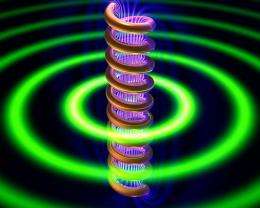
Electron waves being shot past a tiny toroidal magnet.
(PhysOrg.com) -- There's nothing University of Nebraska-Lincoln physicist Herman Batelaan likes more than a challenge. And there are few areas of science more challenging than working at the sub-atomic, or quantum, world, where the laws of physics are different from those of our macro world.
For the last four years, a little-known area within that field has captured his attention -- the Aharonov-Bohm effect. Predicted by theorists Yakir Aharonov and David Bohm in 1959, the effect is a phenomenon where electrons can be affected by electromagnetic potentials without coming in contact with actual force fields.
"It's what is called 'action-at-distance,'" said Batelaan, an associate professor of physics and astronomy. "An example of action-at-a-distance would be that you push with your finger in mid-air one foot above your table and a book that is lying on the desk moves. That would be weird -- and so is any action-at-a-distance phenomenon."
Aharanov and Bohm's prediction was originally received with skepticism, but many questions were answered by experiments in Japan and at UNL in which electron waves were shot past tiny toroidal magnets (wires rolled up in long spirals with current running through them). A 1986 experiment led by Akira Tonomura at Hitachi Ltd. and the RIKEN Frontier Research System in Japan, showed the action-at-a-distance effect is real; and a 2007 experiment by Batelaan's group at UNL showed that there is no force acting on the electrons.
That work is highlighted on the cover of the September issue of Physics Today, the journal of the American Institute of Physics, along with a feature article by Batelaan and Tonomura reviewing research into the little-understood phenomenon that among other things shows that some aspects of classical physics such as Newton's third law -- every action has an equal and opposite reaction -- don't always apply at the quantum level. But Batelaan and Tonomura are in good company. Even Nobel laureate Richard Feynman (1918-88), thought by many to be the greatest American physicist, pointed out in his "Lectures on Physics" that Newton's third law does not always hold.
"I feel that I'm lucky that we can tinker with physical realizations of the theoretical systems that Feyman was considering," Batelaan said.
Another puzzling thing about the Aharonov-Bohm effect, Batelaan said, is that while knowledge of the effect has been around for a half-century and is a modern cornerstone of quantum mechanics, it has not led to technological progress in developing nanometer-size devices.
"On the one hand, I have the feeling that there's something that's not quite understood there, and on the other hand, I feel there must be something we can do with this," Batelaan said. "But isn't that the heart of science, that you're at the limit of your knowledge and you're wondering what's going one there? If we knew where it was going, then it wouldn't be for me. I'm looking for fundamental stuff. I would rather open the route to something new. To me, that's very exciting and with this (Physics Today) article, Tonomura and I wanted to send a message to young researchers that a lot of things are still unknown and mysterious."
-
Proving an aspect of the AB effect: when Newton's Third Law doesn't work
Dec 04, 2007 |
not rated yet |
0
-
Laser-created temporal lens could lead to movies of molecular processes
Jun 29, 2009 |
not rated yet |
0
-
Quantum Computer Scientist Profiled In Nature In Connection With Einstein Centenary
Jan 11, 2005 |
not rated yet |
0
-
Physicists demonstrate quantum mechanical nature of heat flow
Apr 15, 2005 |
not rated yet |
0
-
Tunneling Across a Ferroelectric
Jul 14, 2006 |
not rated yet |
0
-
Engineers build first sub-10-nm carbon nanotube transistor
Feb 01, 2012 |
4.9 / 5 (31) |
30
-
Something old, something new: Evolution and the structural divergence of duplicate genes
Jan 31, 2012 |
4.6 / 5 (7) |
1
-
The hidden nanoworld of ice crystals: Revealing the dynamic behavior of quasi-liquid layers
Jan 30, 2012 |
5 / 5 (3) |
1
-
Stock market network reveals investor clustering
Jan 27, 2012 |
3.9 / 5 (23) |
8
-
Of microchemistry and molecules: Electronic microfluidic device synthesizes biocompatible probes
Jan 26, 2012 |
5 / 5 (1) |
0
-
Magnet in a AC current solenoid
1 hour ago
-
Maxwell's equations outside electrodynamics?
2 hours ago
-
Force and Surface Charge on Sphere
8 hours ago
-
Trajectory Path from 2 Distance Sensors
9 hours ago
-
Conceptual issue with rolling sphere and friction.
12 hours ago
-
Conservation of momentum/energy
14 hours ago
- More from Physics Forums - Classical Physics
More news stories
Putting the squeeze on planets outside our solar system
(PhysOrg.com) -- Using high-powered lasers, scientists at Lawrence Livermore National Laboratory and collaborators discovered that molten magnesium silicate undergoes a phase change in the liquid state, abruptly ...
10 hours ago |
4.3 / 5 (7) |
0
|
Hovering not hard if you're top-heavy, researchers find
Top-heavy structures are more likely to maintain their balance while hovering in the air than are those that bear a lower center of gravity, researchers at New York University's Courant Institute of Mathematical Sciences ...
11 hours ago |
5 / 5 (1) |
1
|
SLAC, Stanford team focuses on high-energy electrons to treat cancer
Accelerator physicists at SLAC and cancer specialists from Stanford are working on a new technology that could dramatically reduce the time needed for cancer radiation treatments. The team ran an initial experiment ...
14 hours ago |
5 / 5 (2) |
0
Measurements from high-energy collisions lead to better understanding of why meson particles disappear
For several years, physicists at the Relativistic Heavy Ion Collider (RHIC) at Brookhaven National Laboratory (BNL), USA, have studied an unusual state of matter called the quarkgluon plasma, which they ...
15 hours ago |
4.5 / 5 (4) |
0
Explained: Sigma
It's a question that arises with virtually every major new finding in science or medicine: What makes a result reliable enough to be taken seriously? The answer has to do with statistical significance -- but ...
Feb 09, 2012 |
5 / 5 (16) |
53
Google users warned of threat to smartphone wallets
Users of Google smartphone wallets were being warned on Friday that there is a way to crack pass codes intended to thwart thieves from going on illicit shopping sprees.
Anonymous knocks CIA website offline (Update)
The website of the Central Intelligence Agency was inaccessible on Friday after the hacker group Anonymous claimed to have knocked it offline.
New error-correcting codes guarantee the fastest possible rate of data transmission
Error-correcting codes are one of the triumphs of the digital age. Theyre a way of encoding information so that it can be transmitted across a communication channel such as an optical fiber o ...
Humans may have helped the decline of African rainforests 3000 years ago
(PhysOrg.com) -- Large areas of rainforests in Central Africa mysteriously disappeared over three thousand years ago, to be replaced by savannas. The prevailing theory has been that the cause was a change ...
Complex wiring of the nervous system may rely on a just a handful of genes and proteins
Researchers at the Salk Institute have discovered a startling feature of early brain development that helps to explain how complex neuron wiring patterns are programmed using just a handful of critical genes. ...
New power source discovered
(PhysOrg.com) -- Researchers at the Massachusetts Institute of Technology (MIT) and RMIT University have made a breakthrough in energy storage and power generation.
Sep 24, 2009
Rank: 3 / 5 (1)
Is science not grounded by cause and effect anymore? Or are we now to accept tales of magic power?
Sep 24, 2009
Rank: 2.3 / 5 (3)
Sep 24, 2009
Rank: not rated yet
That is not QM. It is nonsense.
Sep 24, 2009
Rank: 5 / 5 (1)
Sep 24, 2009
Rank: 5 / 5 (1)
Yeah,especially in the picture. I believe in understanding this effect its better to picture a "perfect" coil in which the magnetic field is confined to the inside of the coil. The field still acts on the electron even though the electron doesn't pass through the coil. This has been shown experimentally with diffraction patterns.
Sep 24, 2009
Rank: 5 / 5 (1)
Sep 24, 2009
Rank: not rated yet
In QM an electron is supposed to be everywhere with varying amounts of probability. So to say that an electron, or whatever, is in an area where the field is zero is a classical description. Is the mixing up of classical descriptions with QM in the same statement what is causing the oddity?
The electron in QM will come into contact with the non-zero field in some of its superimposed states with some non-zero probabilities. So the effect has a cause after all.
A similar oddity is in the recent random walk article in these web pages, where a solitary electron, or whatever, seems to interect with itself and position itself in a bimodal situation. Kind of repelling itself across an enclosure. No other force present except the quantum vacuum.
(Hope this is OK though I am not a physicist.)
Sep 25, 2009
Rank: not rated yet