Stimulating sight: New retinal implant developed
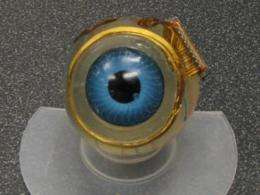
(PhysOrg.com) -- Inspired by the success of cochlear implants that can restore hearing to some deaf people, researchers at MIT are working on a retinal implant that could one day help blind people regain a useful level of vision.
Inspired by the success of cochlear implants that can restore hearing to some deaf people, researchers at MIT are working on a retinal implant that could one day help blind people regain a useful level of vision.
The eye implant is designed for people who have lost their vision from retinitis pigmentosa or age-related macular degeneration, two of the leading causes of blindness. The retinal prosthesis would take over the function of lost retinal cells by electrically stimulating the nerve cells that normally carry visual input from the retina to the brain.
Such a chip would not restore normal vision but it could help blind people more easily navigate a room or walk down a sidewalk.
"Anything that could help them see a little better and let them identify objects and move around a room would be an enormous help," says Shawn Kelly, a researcher in MIT's Research Laboratory for Electronics and member of the Boston Retinal Implant Project.
The research team, which includes scientists, engineers and ophthalmologists from Massachusetts Eye and Ear Infirmary, the Boston VA Medical Center and Cornell as well as MIT, has been working on the retinal implant for 20 years. The research is funded by the VA Center for Innovative Visual Rehabilitation, the National Institutes of Health, the National Science Foundation, the Catalyst Foundation and the MOSIS microchip fabrication service.
Led by John Wyatt, MIT professor of electrical engineering, the team recently reported a new prototype that they hope to start testing in blind patients within the next three years.
Electrical stimulation
Patients who received the implant would wear a pair of glasses with a camera that sends images to a microchip attached to the eyeball. The glasses also contain a coil that wirelessly transmits power to receiving coils surrounding the eyeball.
When the microchip receives visual information, it activates electrodes that stimulate nerve cells in the areas of the retina corresponding to the features of the visual scene. The electrodes directly activate optical nerves that carry signals to the brain, bypassing the damaged layers of retina.
One question that remains is what kind of vision this direct electrical stimulation actually produces. About 10 years ago, the research team started to answer that by attaching electrodes to the retinas of six blind patients for several hours.
When the electrodes were activated, patients reported seeing a small number of "clouds" or "drops of blood" in their field of vision, and the number of clouds or blood drops they reported corresponded to the number of electrodes that were stimulated. When there was no stimulus, patients accurately reported seeing nothing. Those tests confirmed that retinal stimulation can produce some kind of organized vision in blind patients, though further testing is needed to determine how useful that vision can be.
After those initial tests, with grants from the Boston Veteran's Administration Medical Center and the National Institutes of Health, the researchers started to build an implantable chip, which would allow them to do more long-term tests. Their goal is to produce a chip that can be implanted for at least 10 years.
One of the biggest challenges the researchers face is designing a surgical procedure and implant that won't damage the eye. In their initial prototypes, the electrodes were attached directly atop the retina from inside the eye, which carries more risk of damaging the delicate retina. In the latest version, described in the October issue of IEEE Transactions on Biomedical Engineering, the implant is attached to the outside of the eye, and the electrodes are implanted behind the retina.
That subretinal location, which reduces the risk of tearing the retina and requires a less invasive surgical procedure, is one of the key differences between the MIT implant and retinal prostheses being developed by other research groups.
Another feature of the new MIT prototype is that the chip is now contained in a hermetically sealed titanium case. Previous versions were encased in silicone, which would eventually allow water to seep in and damage the circuitry.
While they have not yet begun any long-term tests on humans, the researchers have tested the device in Yucatan miniature pigs, which have roughly the same size eyeballs as humans. Those tests are only meant to determine whether the implants remain functional and safe and are not designed to observe whether the pigs respond to stimuli to their optic nerves.
So far, the prototypes have been successfully implanted in pigs for up to 10 months, but further safety refinements need to be made before clinical trials in humans can begin.
Wyatt and Kelly say they hope that once human trials begin and blind patients can offer feedback on what they're seeing, they will learn much more about how to configure the algorithm implemented by the chip to produce useful vision.
Patients have told them that what they would like most is the ability to recognize faces. "If they can recognize faces of people in a room, that brings them into the social environment as opposed to sitting there waiting for someone to talk to them," says Kelly.
More information: “Development and Implantation of a Minimally Invasive Wireless Subretinal Neurostimulator,” Douglas Shire, Joseph Rizzo, et al. IEEE Transactions on Biomedical Engineering, October 2009
Provided by Massachusetts Institute of Technology (news : web)


