Research team finds first evolutionary branching for bilateral animals
September 23, 2009 Research team finds first evolutionary branching for bilateral animals

Enlarge

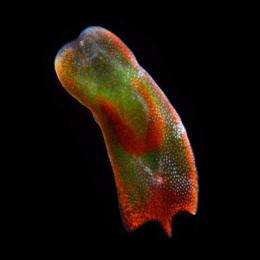
An international research team led by Brown University has determined that the flatworm Acoelomorpha belongs as a sister clade to other bilateral animals. The finding means the worm is a product of the deepest split within the bilateral animals, the first evolutionary divergence within the group. Credit: Eric Rottinger/Kahikai.org

When it comes to understanding a critical junction in animal evolution, some short, simple flatworms have been a real thorn in scientists' sides. Specialists have jousted over the proper taxonomic placement of a group of worms called Acoelomorpha. This collection of worms, which comprises roughly 350 species, is part of a much larger group called bilateral animals, organisms that have symmetrical body forms, including humans, insects and worms. The question about acoelomorpha, was: Where do they fit in?

To scientists, acoelomorpha, has been enigmatic, a "rogue animal," said Casey Dunn, an at Brown University. "It has been wandering throughout the animal tree of life."

The worm wanders no more. Through a laborious genetic sequencing analysis, Dunn and an international team of scientists have settled the long-standing debate and determined that acoelomorpha belongs as a sister clade to other bilateral animals. The finding is significant, Dunn said, because it shows the worm is a product of the deepest split within the bilateral animals, the first evolutionary divergence within the group. Because of that, scientists have gained a key insight into the most recent to bilaterians, a species that remains unknown.

The worm is "as distant as an animal can be in bilateria and still be a bilaterian," said Dunn, assistant professor of biology. "So, now we have two perspectives to (find out about) this common ancestor, the acoelomorphs and all the other bilateral animals."

The results appear online this week in the .

The team, composed of 17 scientists from the United States, France Germany, Sweden, Spain and the United Kingdom, had two more interesting findings:

  • The debate appears to be over for Xenoturbella, a type of marine worm whose ancestral affiliation had been tossed between worms and mollusks. The researchers reported their shows diminishing evidence for placing xenoturbella within Deuterostomia, one of the major groups within the animal kingdom. Coincidentally, it also shows that xenoturbella may be a close relative to acoelomorpha.
  • Cycliophora, a single species discovered in 1994 that lives on the bristles surrounding the mouth of the Norway lobster Nephrops norvegicus, has found a home with Entoprocta and Ectoprocta. The researchers base their findings on an analysis that reached further into the genetic makeup of cycliophora than previous studies had done.
The team used a genetic sequencing technique called expressed sequence tags to carry out the phylogenetic studies. The aim of this approach, discusssed in a study led by Dunn that appeared in Nature last year, is to analyze a large number of genes from a large number of animals. For this paper, the researchers looked at 1,487 genes, a 10-fold increase in the number of genes analyzed in previous studies. In all, the researchers logged 2.25 million processor hours on a supercomputer in California to obtain the results. Dunn called the effort the most computationally intensive phylogenetic analysis to date.

Source: Brown University (news : web)


print this article email this article download pdf blog this article bookmark this article     Stumble it Digg this share on Facebook retweet share on Reddit add to delicious
Rate this story - 3.8 /5 (5 votes)


September 23, 2009 all stories

Comments: 0

3.8 /5 (5 votes)
  • Stumble this up

  • Digg this

  • share this

  • hide
  • Related Stories


  • hide
  • Relevant PhysicsForums posts

  • Human Leukocyte Antigen (HLA) typing
    created 1hour ago
  • Breeding program
    created Nov 20, 2009
  • How does a concentration gradient provide energy?
    created Nov 20, 2009
  • Eyesight and Neural Damage from Electronics
    created Nov 19, 2009
  • More from Physics Forums - Biology

Other News

The Monarchs' annual migration ritual has yet to be scientifically explained

Tree-eating bugs threaten Monarch butterfly in Mexico

Biology / Ecology

created 3 hours ago | popularity not rated yet | comments 0

The mysterious Monarch butterfly, which migrates en masse annually between Canada and Mexico, is now facing a new peril: another insect thriving in Western Mexican forests.


Extinct goat Myotragus balearicus

Extinct goat was cold-blooded

Biology / Plants & Animals

created Nov 18, 2009 | popularity 4.9 / 5 (30) | comments 10

(PhysOrg.com) -- An extinct goat that lived on a barren Mediterranean island survived for millions of years by reducing in size and by becoming cold-blooded, which has never before been discovered in mammals.


Bigger not necessarily better, when it comes to brains

Bigger not necessarily better, when it comes to brains

Biology / Plants & Animals

created Nov 17, 2009 | popularity 4.5 / 5 (17) | comments 11

(PhysOrg.com) -- Tiny insects could be as intelligent as much bigger animals, despite only having a brain the size of a pinhead, say scientists at Queen Mary, University of London.


Right-handed chimpanzees provide clues to the origin of human language

Biology / Plants & Animals

created Nov 16, 2009 | popularity 3 / 5 (1) | comments 7

Most of the linguistic functions in humans are controlled by the left cerebral hemisphere. A study of captive chimpanzees at the Yerkes National Primate Research Center (Atlanta, Georgia), reported in the January 2010 issue ...


The creature was found at a depth of 161 metres

Japanese researchers film rare baby fish 'fossil'

Biology / Plants & Animals

created Nov 17, 2009 | popularity 4.7 / 5 (7) | comments 4

Japanese marine researchers said Tuesday they had found and successfully filmed a young coelacanth -- a rare type of fish known as "a living fossil" -- in deep water off Indonesia.