Peruvian glacial retreats linked to European events of Little Ice Age
(PhysOrg.com) -- A new study that reports precise ages for glacial moraines in southern Peru links climate swings in the tropics to those of Europe and North America during the Little Ice Age approximately 150 to 350 years ago. The study, published this week in the journal Science, "brings us one step closer to understanding global-scale patterns of glacier activity and climate during the Little Ice Age," says lead author Joe Licciardi, associate professor of Earth sciences at the University of New Hampshire. "The more we know about our recent climate past, the better we can understand our modern and future climate."
The study, "Holocene glacier fluctuations in the Peruvian Andes indicate northern climate linkages," was borne of a convergence of a methodological breakthrough in geochronological techniques and Licciardi's chance encounter with well-preserved glacial moraines in Peru.
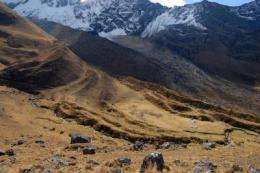
On vacation in 2003, Licciardi was hiking near the well-known Inca Trail when he noticed massive, well-preserved glacial moraines - ridges of dirt and rocks left behind when glaciers recede -- along the way, about 25 kilometers from the ruins of Machu Picchu. "They very clearly mark the outlines of formerly expanded valley glaciers at various distinct times in the recent past," he says. But Licciardi, who had no geologic tools with him at the time, did not take any samples.
Two years later, coauthor David Lund, assistant professor of geology at the University of Michigan and a friend of Licciardi's from graduate school, was in the same region and offered to chisel off some samples of the salt-and-pepper colored granitic rock. "Dave also recognized the potential of this site and shared my enthusiasm for initiating a study," says Licciardi. "That was the catalyst for turning our ideas into an actual project." Licciardi returned in 2006 to the slopes of Nevado Salcantay, a 20,000-foot-plus peak that is the highest in the Cordillera Vilcabamba range. Over the next two years, he and his graduate student Jean Taggart, also a coauthor, collected more rock samples from the moraines.
The researchers analyzed the samples using a surface exposure dating technique -- measuring the tiny amounts of the chemical isotope beryllium-10 that is formed as cosmic rays bombard exposed surfaces -- to place very precise dates on these relatively young glacial fluctuations. Licciardi and Taggart, who received a master's degree from UNH last month, worked with coauthor Joerg Schaefer, a geochemist at Columbia University's Lamont-Doherty Earth Observatory, to produce some of the youngest ages ever obtained from the beryllium isotope dating method.
"The ability to measure such young and precise ages with this method provides us with an exciting new way to establish the timing of recent glacier fluctuations in places far afield from where we have historical records," says Licciardi. Because the Little Ice Age - from about 1300 AD to 1860 AD -- coincides with historical accounts and climate observations in Europe and North America, the event is well documented in the Northern Hemisphere. In remote and sparsely inhabited areas like the Peruvian Andes, however, chronologies of Little Ice Age glacial events are very scarce.
A key finding of the study is that while glaciers in southern Peru moved at similar times as glaciers in Europe, the Peruvian record differs from the timing of glacier fluctuations in New Zealand's Southern Alps during the last millennium, as reported in another recent study in Science led by Schaefer.
"This finding helps identify interhemispheric linkages between glacial signals around the world. It increases our understanding of what climate was like during the Little Ice Age, which will in turn help us understand climate drivers," says Taggart.
"If the current dramatic warming projections are correct, we have to face the possibility that the glaciers may soon disappear," adds Schaefer.
Licciardi and his colleagues will continue working in Peru toward a more complete understanding of glacial expansion during the Little Ice Age - and their subsequent retreat. "Our new results point to likely climate processes that can explain why these glaciers expanded and retreated when they did, but there are still many open questions," he says. "For example, what's the relative importance of temperature change versus precipitation change on the health of these glaciers?" The research team plans to explore this question using coupled climate-glacier models that evaluate the sensitivity of glaciers in southern Peru to the two main factors that drive glacier expansion - cold temperatures and abundant snowfall.
Provided by University of New Hampshire (news : web)


