Global warming may dent El Nino's protective shield from Atlantic hurricanes, increase droughts
September 23, 2009 Global warming may dent El Nino's protective shield from Atlantic hurricanes, increase droughts

Enlarge

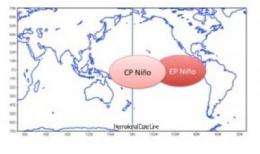
El Niño, the periodic eastern Pacific phenomenon credited with shielding the United States and Caribbean from severe hurricane seasons, may be overshadowed by its brother in the central Pacific due to global warming, according to an article in the journal Nature. Credit: Ben Kirtman/UM

(PhysOrg.com) -- El Niño, the periodic eastern Pacific phenomenon credited with shielding the United States and Caribbean from severe hurricane seasons, may be overshadowed by its brother in the central Pacific due to global warming, according to an article in the September 24 issue of the journal Nature.

"There are two El Niños, or flavors of El Niño," said Ben Kirtman, co-author of the study and professor of meteorology and physical oceanography at the University of Miami's Rosentstiel School of Marine and Atmospheric Science. "In addition to the eastern Pacific El Niño which we know and love, a second El Niño in the central Pacific is on the increase."

El Niño is a recurring warm water current along the in the that affects weather circulation patterns in the tropics. The eastern El Niño increases wind sheer in the Atlantic that may hamper the development of major hurricanes there. The central Pacific El Niño, near the International Dateline, has been blamed for worsening drought conditions in Australia and India as well as minimizing the effects of its beneficial brother to the east.

Led by Sang-Wook Yeh of the Korea Ocean Research & Development Institute, a team of scientists applied Pacific Ocean sea surface temperature data from the past 150 years to 11 models developed by the Intergovernmental Panel on Climate Change. Eight of the models showed that global warming conditions will increase the incidence of the central Pacific El Niño. Over the past 20 years, according to the data, the frequency of an El Niño event in the central Pacific has increased from one out of every five to half of all El Niño occurrences.

"The results described in this paper indicate that the global impacts of El Niño may significantly change as the climate warms," said Yeh.

Though the centers of the central and eastern areas are roughly 4,100 miles apart, El Niños historically have not simultaneously occurred in both places. An increase in central Pacific El Niño events may reduce the hurricane-shielding effects of the eastern Pacific event.

"Currently, we are in the middle of a developing eastern Pacific El Niño event," said Kirtman, "which is part of why we're experiencing such a mild hurricane season in the Atlantic. We also anticipate the southern United States to have a fairly wet winter, and the northeast may be dry and warm."

Kirtman expects the current El Niño event to end next spring, perhaps followed by a La Niña, which he expects may bode for a more intense Atlantic season in 2010.

Growing up in southern California, Kirtman frequently had to man the sump pump in his family's basement during the rainy season, which he learned later was caused by El Niño.

"We're finally learning about how ocean current flows and increases in sea surface temperature influence weather patterns, which affect every one of us, including the kid manning the sump pump," he said. "I have devoted much of my career to studying El Niño because of how it affects people and their lives."

Kirtman works with various meteorological organizations around the world to help developing countries respond to climate extremes.

"We provide them with the forecasts," he said, "and the countries use the results to develop their response."

Provided by University of Miami (news : web)


print this article email this article download pdf blog this article bookmark this article     Stumble it Digg this share on Facebook retweet share on Reddit add to delicious
Rate this story - 3.1 /5 (12 votes)

Rank Filter

Move the slider to adjust rank threshold, so that you can hide some of the comments.


Display comments: newest first

  • 3432682 - Sep 23, 2009
    • Rank: 3.5 / 5 (8)
    Q: Why the constant drumbeat of global warming possible effects?
    A: Because all the previous predictions have petered out, and they need new ones.
  • Shootist - Sep 23, 2009
    • Rank: 3.7 / 5 (6)
    What about the coming Ice Age?
  • Sean_W - Sep 23, 2009
    • Rank: 3.9 / 5 (7)
    Global warming may also cause farm animals to become homosexual which means we can't breed them and we will all have to become vegans.

    Global warming may cause pollen grains to evolve into bigger and more alergenic forms resulting in more deadly cases of hay fever.

    Global warming may cause bats' echo location to move into the audible range and become deafeningly loud.

    Don't say you weren't warned.
  • Velanarris - Sep 23, 2009
    • Rank: 4.2 / 5 (5)
    Typically when any and all natural events can be tied to your theory, or your theory can be evidenced by any and all natural events you have one of two things:

    1) An air tight theory of everything
    2) Nothing

September 23, 2009 all stories

Comments: 4

3.1 /5 (12 votes)
  • Stumble this up

  • Digg this

  • share this

  • hide
  • Related Stories

  • Forecasters say El Nino may be developing
    created Jun 08, 2009 | popularity not rated yet | comments 0
  • 'El Nino' arrives in Pacific for a months-long stay
    created Jul 09, 2009 | popularity not rated yet | comments 0
  • New type of El Nino could mean more hurricanes make landfall
    created Jul 02, 2009 | popularity not rated yet | comments 0
  • El Nino may calm 2006 hurricane season
    created Sep 07, 2006 | popularity not rated yet | comments 0
  • El Nino To Affect Weather In Colorado And Western U.S.
    created Dec 01, 2006 | popularity not rated yet | comments 0


  • hide
  • Relevant PhysicsForums posts

  • Which countries around the world cause the most destruction to the rain forest
    created 7 hours ago
  • HadleyCru data hacked
    created Nov 20, 2009
  • Younger Dryas Caused by Ice Dam Collapse?
    created Nov 17, 2009
  • Modeling rainfall and flooding
    created Nov 15, 2009
  • More from Physics Forums - Earth

Other News

Astronauts finish another spacewalk, still no baby (AP)

Astronauts finish another spacewalk, still no baby

Space & Earth / Space Exploration

created 6 hours ago | popularity 3 / 5 (2) | comments 0

(AP) -- A spacewalking astronaut put aside the impending birth of his daughter and blazed through his first-ever venture outside the International Space Station on Saturday.


Unseasonably hot and dry weather combined with strong winds to fan scores of blazes in the country's southeastern states

Australia issues 'catastrophic' alerts as fires rage

Space & Earth / Environment

created 12 hours ago | popularity 4.5 / 5 (2) | comments 0

Australia has issued "catastrophic" alerts after record-breaking temperatures and wild lightning storms sparked more than 100 fires across the country, officials said Saturday.


Commuters wait on the platform shrouded by fog in London

Climate change not man-made, say majority of Britons: poll

Space & Earth / Environment

created Nov 15, 2009 | popularity 3.3 / 5 (15) | comments 45

Less than half of Britons believes that human activity is to blame for global warming, according to a poll carried out for The Times newspaper and published on Saturday.


Mysteriously warm times in Antarctica

Mysteriously warm times in Antarctica

Space & Earth / Earth Sciences

created Nov 18, 2009 | popularity 4.2 / 5 (21) | comments 28

(PhysOrg.com) -- A new study of Antarctica's past climate reveals that temperatures during the warm periods between ice ages (interglacials) may have been higher than previously thought. The latest analysis ...


UN: Fight climate change with free condoms (AP)

UN: Fight climate change with free condoms

Space & Earth / Environment

created Nov 18, 2009 | popularity 3.1 / 5 (11) | comments 23

(AP) -- The battle against global warming could be helped if the world slowed population growth by making free condoms and family planning advice more widely available, the U.N. Population Fund said Wednesday.