Tennessee foresters helping to return chestnuts to American forests
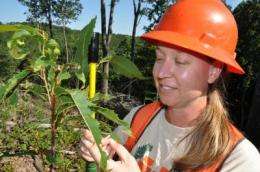
The American chestnut was a dominant species in eastern U.S.'s forests before a blight wiped it out in the early 1900s. Today it's being returned to the landscape thanks in part to work by a University of Tennessee Forestry alumna and the UT Tree Improvement Program (UT TIP).
Once used extensively for building, for tanning leather, as an important source of food for humans and wildlife, and even as nutritious fodder for hogs, the American chestnut seemed destined to be a memory—a line in a Christmas song. In a few years, the public should be able to once again enjoy the benefits of the forest giant.
UT alumna Stacy Clark, lead researcher with the U.S. Forest Service restoration project, believes the chestnut's revival will become one of the great stories of American conservation. Her work in cooperation with The American Chestnut Foundation (TACF) and the UT TIP has resulted in test plantings of blight-resistant trees in three southern National Forests. Planted over the winter, the young trees are 94 percent pure American chestnuts. But the remaining 6 percent has blight resistance derived from the Chinese chestnut tree.
Simply planting a Chinese chestnut wouldn't solve the problem, Clark said.
"The American chestnut grows straight and tall, is highly valuable, and has highly flavored edible nuts," she said. "All that differs from the Chinese. We want the trees to look and act like an American chestnut. But they have to have the resistance genes from Chinese chestnut. That's the only way they're going to survive."
The young trees appear healthy and are growing well, but results from tree experiments come slowly, even for a fast-growth tree like the chestnut.
"We'll know in about five years whether or not the trees will be successful in early establishment," she said. "In 10 to 15 years we will know about blight resistance. It takes 10 to 15 years to get significant mast and another 15 years to get harvestable wood."
Making the resistant tree available to the public will take longer still.
"These plantings are not the final answer. We need several more experiments to really test the Foundation's breeding lines and blight resistance."
TACF, which provided the hybrid stock, has produced multiple lines of blight-resistant seedlings. In 2010, partners will plant an additional 900 to 1,000 seedlings of the American chestnut in national forests in Tennessee and Virginia. Plantings will include all generations of the American chestnut—approximately 700 will be blight-resistant.
"We really want to test which are the best families. All that will take many, many years. I'll be retired, probably, before that is done."
Clark works closely with Dr. Scott Schlarbaum, director of UT's 50-year-old Tree Improvement Program. UT TIP provided the necessary infrastructure for the Forestry Service to implement nursery and field studies of chestnut material. UT TIP has provided technical assistance to develop the experimental designs for testing, and they will assist the Forest Service in monitoring the research. They have also provided an avenue for partnerships with state forestry divisions for nursery research.
"Keeping track of the genetic identity of a tree from nursery into the field is a tremendous task," Clark said. "UT has a well-developed program in hardwood seedling restoration. We can tap into that expertise."
Though her work will help re-establish a tree with significant forest and economic potential for Tennessee and other southern states, the long-term influence will go much further.
"The biggest impact is to provide a road map for other species. Many trees have exotic pest concerns. This project provides hope for those other species. If we are successful, this will be one of the greatest triumphs in the history of forest conservation."
Source: University of Tennessee at Knoxville


