Paper battery may power electronics in clothing and packaging material
September 23, 2009
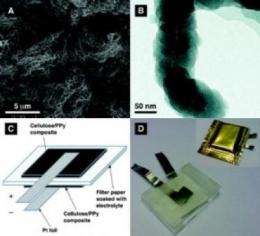
Batteries made of paper may power electronics in the future, researchers say. Shown are images from an experimental paper-based battery. Credit: The American Chemical Society
Imagine a gift wrapped in paper you really do treasure and want to carefully fold and save. That's because the wrapping paper lights up with words like "Happy Birthday" or "Happy Holidays," thanks to a built in battery -- an amazing battery made out of paper. That's one potential application of a new battery made of cellulose, the stuff of paper, being described in the October 14 issue of ACS' Nano Letters.
Albert Mihranyan and colleagues note in the report that scientists are trying to develop light, ecofriendly, inexpensive batteries consisting entirely of nonmetal parts. The most promising materials include so-called conductive polymers or "plastic electronics."
One conductive polymer, polypyrrole (PPy), shows promise, but was often regarded as too inefficient for commercial batteries. The scientists realized, however, that by coating PPy on a large surface area substrate and carefully tailoring the thickness of the PPy coating, both the charging capacity and the charging (discharging) rates can be drastically improved.
The secret behind the performance of this battery is the presence of the homogeneous, uninterrupted, nano-thin coating — about 1/50,000th the thickness of a human hair — of PPy on individual cellulose fibers which in turn can be molded into paper sheets of exceptionally high internal porosity. It was special cellulose, extracted from a certain species of green algae, with 100 times the surface area of cellulose found in paper. That surface area was key to allowing the new device to hold and discharge electricity very efficiently.
The innovative design of the battery cell was surprisingly simple yet very elegant since both of the electrodes consist of identical pieces of the composite paper separated by an ordinary filter paper soaked with sodium chloride serving as the electrolyte. The potential difference is solely due to differences between the oxidized and reduced forms of the functional PPy layer. The battery recharged faster than conventional rechargeable batteries and appears well-suited for applications involving flexible electronics, such as clothing and packaging, the scientists say. Alternatively, low-cost very large energy storage devices having electrodes of several square yards in size could potentially be made in the future.
More information: "Ultrafast All-Polymer Paper-Based Batteries", Nano Letters. DOI: 10.1021/nl901852h
-
Troublesome green algae serve as coating substrate in record-setting battery
Sep 10, 2009 |
not rated yet |
0
-
Salt and Paper Battery May One Day Replace Lithium Batteries
Sep 15, 2009 |
not rated yet |
0
-
Battery Wrapped in Solar Cells Recharges in the Sun
Mar 02, 2009 |
not rated yet |
0
-
Flower-shaped nanoparticles may lead to better batteries for portable electronics
Sep 15, 2008 |
not rated yet |
0
-
Flexible battery power
Mar 19, 2007 |
not rated yet |
0
-
Fast photon control brings quantum photonic technologies closer
10 hours ago |
5 / 5 (4) |
0
-
Engineers build first sub-10-nm carbon nanotube transistor
Feb 01, 2012 |
4.9 / 5 (33) |
30
-
Something old, something new: Evolution and the structural divergence of duplicate genes
Jan 31, 2012 |
4.6 / 5 (7) |
1
-
The hidden nanoworld of ice crystals: Revealing the dynamic behavior of quasi-liquid layers
Jan 30, 2012 |
5 / 5 (5) |
1
-
Stock market network reveals investor clustering
Jan 27, 2012 |
3.9 / 5 (23) |
8
-
polymer nanocomposites
Feb 10, 2012
-
Corrosion Tests on Magnesium
Feb 09, 2012
-
polyethylene copper nanocomposite
Feb 09, 2012
-
Output of xrd analysis
Feb 08, 2012
-
Transport phenomena problem based on problems 18.B11 and 19B.6 from Bird, stewart, lw
Feb 06, 2012
-
Help with material selection - Car Piston
Feb 05, 2012
- More from Physics Forums - Materials & Chemical Engineering
More news stories
ORNL microscopy explores nanowires' weakest link
Individual atoms can make or break electronic properties in one of the world's smallest known conductorsquantum nanowires. Microscopic analysis at the Department of Energy's Oak Ridge National Laboratory ...
5 hours ago |
5 / 5 (2) |
0
|
Nanostructured electrodes for rechargeable sodium-Ion batteries
Highly efficient 3V cathodes for rechargeable sodium-ion batteries have been developed by users from Argonne National Laboratory's Materials Science, Chemical Sciences & Engineering, and X-ray Sciences Divisions, ...
Nanotechnology / Nanomaterials
10 hours ago |
5 / 5 (2) |
0
|
'Smart' microcapsules in a single step
(PhysOrg.com) -- A new, single-step method of fabricating microcapsules, which have potential commercial applications in industries including medicine, agriculture and diagnostics, has been developed by researchers ...
Nanotechnology / Nanomaterials
10 hours ago |
5 / 5 (2) |
1
|
NDSU nano research could impact flexible electronic devices
A discovery by a research team at NDSU and the National Institute of Standards and Technology shows the flexibility and durability of carbon nanotube films and coatings are intimately linked to their electronic properties. ...
Nanotechnology / Nanomaterials
11 hours ago |
5 / 5 (1) |
0
New kind of solar cell could capture significantly more energy than current cells
New solar cells could increase the maximum efficiency of solar panels by over 25%, according to scientists from the University of Cambridge.
Feb 08, 2012 |
4.3 / 5 (14) |
14
|
First-of-its-kind stem cell study re-grows healthy heart muscle in heart attack patients
Results from a Cedars-Sinai Heart Institute clinical trial show that treating heart attack patients with an infusion of their own heart-derived cells helps damaged hearts re-grow healthy muscle.
Sensing self and non-self: New research into immune tolerance
At the most basic level, the immune system must distinguish self from non-self, that is, it must discriminate between the molecular signatures of invading pathogens (non-self antigens) and cellular constituents that usually ...
Missing dark matter located: Intergalactic space is filled with dark matter
Researchers at the University of Tokyos Institute for the Physics and Mathematics of the Universe (IPMU) and Nagoya University used large-scale computer simulations and recent observational data of gravitational ...
Scientists discover reason for Mt. Hood's non-explosive nature
(PhysOrg.com) -- For a half-million years, Mount Hood has towered over the landscape, but unlike some of its cousins in Oregons Cascade Mountains and many other volcanoes around the Pacific Rim ...
Discovery paves way for salmonella vaccine
(Medical Xpress) -- An international research team led by a University of California, Davis, immunologist has taken an important step toward an effective vaccine against salmonella, a group of increasingly antibiotic-resistant ...
Time of year important in projections of climate change effects on ecosystems
(PhysOrg.com) -- Does it matter whether long periods of hot weather, such as last year's heat wave that gripped the U.S. Midwest, happen in June or July, August or September?