International scientists set boundaries for survival
September 23, 2009
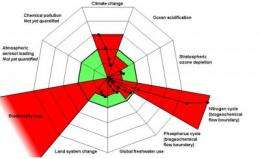
These are estimates of how the different control variables for seven planetary boundaries have changed from 1950 to present. The green shaded polygon represents the safe operating space. Human activities have already pushed the Earth system beyond three of the planet's biophysical thresholds, with consequences that are detrimental or even catastrophic for large parts of the world; six others may well be crossed in the next decades, conclude 29 European, Australian and US scientists in an article in the September 24 issue of the scientific journal Nature. Credit: Image courtesy of Courtesy of Stockholm Resilience Centre
Human activities have already pushed the Earth system beyond three of the planet's biophysical thresholds, with consequences that are detrimental or even catastrophic for large parts of the world; six others may well be crossed in the next decades, conclude 29 European, Australian and U.S. scientists in an article in the Sept. 24 issue of the scientific journal Nature.
Scientists have been warning for decades that the explosion of human activity since the industrial revolution is pushing the Earth's resources and natural systems to their limits. The data confirm that 6 billion people are capable of generating a global geophysical force the equivalent to some of the great forces of nature - just by going about their daily lives.
This force has given rise to a new era - Anthropocene - in which human actions have become the main driver of global environmental change.
"On a finite planet, at some point, we will tip the vital resources we rely upon into irreversible decline if our consumption is not balanced with regenerative and sustainable activity," says co-author Sander van der Leeuw who directs the School of Human Evolution and Social Change at Arizona State University. Van der Leeuw is an archaeologist and anthropologist specializing in the long term impacts of human activity on the landscape. He also co-directs ASU's Complex Adaptive Systems Initiative that focuses ASU's interdisciplinary strength on large-scale problems where an integrated effort is essential to finding solutions.
Defining planetary boundaries
It started with a fairly simple question: How much pressure can the Earth system take before it begins to crash?
"Until now, the scientific community has not attempted to determine the limits of the Earth system's stability in so many dimensions and make a proposal such as this. We are sending these ideas out through the Nature article to be vetted by the scientific community at large," explains van der Leeuw, whose experience includes leading interdisciplinary initiatives in ASU's College of Liberal Arts and Sciences.
"We expect the debate on global warming to shift as a result, because it is not only greenhouse gas emissions that threaten our planet's equilibrium. There are many other systems and they all interact, so that crossing one boundary may make others even more destabilized," he warns.
Nine boundaries were identified, including climate change, stratospheric ozone, land use change, freshwater use, biological diversity, ocean acidification, nitrogen and phosphorus inputs to the biosphere and oceans, aerosol loading and chemical pollution. The study suggests that three of these boundaries -climate change, biological diversity and nitrogen input to the biosphere - may already have been transgressed.
"We must make these complicated ideas clear in such a way that they can be widely applied. The threats are so enormous that it is too late to be a pessimist," says van der Leeuw.
"A safe operating space for humanity"
Using an interdisciplinary approach, the researchers looked at the data for each of the nine vital processes in the Earth system and identified a critical control variable. Take biodiversity loss, for example, the control variable is the species extinction rate, which is expressed in extinctions per million species per year.
They then explored how the boundaries interact. Here, loss of biodiversity impacts carbon storage (climate change), freshwater, nitrogen and phosphorous cycles, and land systems.
In the Nature report titled "A safe operating space for humanity," the scientists propose bold move: A limit for each boundary that would maintain the conditions for a livable world. For biodiversity, that would be less than 10 extinctions per million species per year. The current status is greater than 100 species per million lost per year, whereas the pre-industrial value was 0.1-1.
The researchers stress that their approach does not offer a complete roadmap for sustainable development, but does provide an important element by identifying critical planetary boundaries.
"Human pressure on the Earth system has reached a scale where abrupt global environmental change can no longer be excluded. To continue to live and operate safely, humanity has to stay away from critical 'hard-wired' thresholds in Earth's environment, and respect the nature of planet's climatic, geophysical, atmospheric and ecological processes," says lead author Professor Johan Rockström, director of the Stockholm Resilience Centre at Stockholm University. "Transgressing planetary boundaries may be devastating for humanity, but if we respect them we have a bright future for centuries ahead," he continues.
Alarm bells for Arizona
"Our attempt to identify planetary boundaries that, if crossed, could have serious environmental and social consequences has a special resonance in the southwest where pressures on biodiversity, land use, and water are likely to intersect with climate change to create tremendous challenges for landscapes and livelihoods," explains co-author Diana Liverman, a professor of geography and development at the University of Arizona.
Liverman, who also is professor of environmental science and a senior fellow of Oxford University's Environmental Change Institute, is currently attending an international climate conference at Oxford, United Kingdom. Participants are discussing the implications for humans and Earth ecosystems of a 4 degree Centigrade global temperature rise.
She adds: "Three of the boundaries we identify - 350 parts per million of atmospheric carbon dioxide, biodiversity extinction rates more than 10 times the background rate, and no more than 35 million tons of nitrogen pollution per year - have already been exceeded with fossil fuel use, land use change, and agricultural pollution, driving us to unsustainable levels that are producing real risks to our survival."
-
Scientists outline planetary boundaries: A safe operating space for humanity
Sep 23, 2009 |
not rated yet |
0
-
Global warming may bring mass species loss
Apr 11, 2006 |
not rated yet |
0
-
Extinction risk to plant biodiversity may occur at lower levels of atmospheric CO2 than previously considered
Jun 29, 2009 |
not rated yet |
0
-
Study finds future 'battlegrounds' for conservation very different to those in past
Feb 28, 2008 |
not rated yet |
0
-
'New' Science Gleans Knowledge From Ancient Lands And Societies
Nov 09, 2005 |
not rated yet |
0
-
Engineers build first sub-10-nm carbon nanotube transistor
Feb 01, 2012 |
4.9 / 5 (31) |
30
-
Something old, something new: Evolution and the structural divergence of duplicate genes
Jan 31, 2012 |
4.6 / 5 (7) |
1
-
The hidden nanoworld of ice crystals: Revealing the dynamic behavior of quasi-liquid layers
Jan 30, 2012 |
5 / 5 (3) |
1
-
Stock market network reveals investor clustering
Jan 27, 2012 |
3.9 / 5 (23) |
8
-
Of microchemistry and molecules: Electronic microfluidic device synthesizes biocompatible probes
Jan 26, 2012 |
5 / 5 (1) |
0
-
Discrepancy between oxygen and carbon-dioxide levels
18 hours ago
-
where gems are found in the world
21 hours ago
-
Wind Waves in Reservoir ~ Wind run-up and Wind set-up
Feb 08, 2012
-
Balance of oxygen in the atmosphere
Feb 01, 2012
-
The case for a methanol-based economy
Jan 30, 2012
-
Weather in a rotating cylinder
Jan 25, 2012
- More from Physics Forums - Earth
More news stories
Humans may have helped the decline of African rainforests 3000 years ago
(PhysOrg.com) -- Large areas of rainforests in Central Africa mysteriously disappeared over three thousand years ago, to be replaced by savannas. The prevailing theory has been that the cause was a change ...
Could Venus be shifting gear?
(PhysOrg.com) -- ESAs Venus Express spacecraft has discovered that our cloud-covered neighbour spins a little slower than previously measured. Peering through the dense atmosphere in the infrared, the ...
Space & Earth / Space Exploration
6 hours ago |
5 / 5 (5) |
7
|
Mars Science Laboratory computer issue resolved
(PhysOrg.com) -- Engineers have found the root cause of a computer reset that occurred two months ago on NASA's Mars Science Laboratory and have determined how to correct it.
Space & Earth / Space Exploration
7 hours ago |
5 / 5 (5) |
3
|
Clam fields found at deep, low-temperature Mariana vents
(PhysOrg.com) -- Scientists have marveled at the unusual life forms thriving at high temperature hydrothermal vents of the deep ocean.
Space & Earth / Earth Sciences
7 hours ago |
not rated yet |
0
|
Two new moons for Jupiter
Advances in technology have lead to the discovery of new planets outside of our Solar System, and now even new moons in our own backyard.
Space & Earth / Space Exploration
6 hours ago |
not rated yet |
4
Complex wiring of the nervous system may rely on a just a handful of genes and proteins
Researchers at the Salk Institute have discovered a startling feature of early brain development that helps to explain how complex neuron wiring patterns are programmed using just a handful of critical genes. ...
The power of estrogen -- male snakes attract other males
A new study has shown that boosting the estrogen levels of male garter snakes causes them to secrete the same pheromones that females use to attract suitors, and turned the males into just about the sexiest ...
Human cognitive performance suffers following natural disasters, researchers find
Not surprisingly, victims of a natural disaster can experience stress and anxiety, but a new study indicates that it might also cause them to make more errors - some serious - in their daily lives. In their upcoming Human Fa ...
New error-correcting codes guarantee the fastest possible rate of data transmission
Error-correcting codes are one of the triumphs of the digital age. Theyre a way of encoding information so that it can be transmitted across a communication channel such as an optical fiber o ...
Both maternal and paternal age linked to autism
Older maternal and paternal age are jointly associated with having a child with autism, according to a recently published study led by researchers at The University of Texas Health Science Center at Houston (UTHealth).
Curry spice component may help slow prostate tumor growth
Curcumin, an active component of the Indian curry spice turmeric, may help slow down tumor growth in castration-resistant prostate cancer patients on androgen deprivation therapy (ADT), a study from researchers ...
Sep 23, 2009
Rank: 2.6 / 5 (10)
lets make up boundaries, set them back, and call doomsday...
whats the solution? well its always the same solution, which is why i stopped buying this kind of crap a long time ago. bigger government and more state power... its the only thing that can avert the never ending james bond quality disasters sans villians...
Sep 23, 2009
Rank: 2.7 / 5 (7)
Sep 24, 2009
Rank: 3.9 / 5 (7)
A reading of the full article in NATURE mag will yield better judgment.
Scientists are the only ones qualified to make such bold assessments and an overall picture is easier for the masses to digest than the raw data. Sure the information given here is far reaching and generalized, but you may be surprised to learn how much we do understand about this planet.
Sep 24, 2009
Rank: 2.5 / 5 (6)
give me one answer to one question and i may entertain things. just remember that how much work you put into something is MEANINGLESS. only communists think that the amount of work you do is related to its value... its value is a separate issue, so a great deal of anything going into something doesnt mean that its valid. a great deal of bad research goes into astrology, huge shelves of libraries devoted to it. and yet, its meaningless other than entertainment value.
let me know how much diversity is just right for goldilocks scientists...
diversity is a arbitrary number. if the world is more diverse, darwininan development slows as there are fewer niches one can safely go into. which is why all the stuff on different continents is different. when you mix two of these worlds, the first thing that happens is that they have to re-align... and so diversity goes down... however in another half million years there will be new species.
comment limits suck
Sep 24, 2009
Rank: 2.4 / 5 (7)
We're currently living in one of the periods of highest biodiversity that the planet has ever seen.
How exactly would our biodiversity loss, while still being the most diverse, be a tipping point?
The single question I've posed is enough to toss that entire chart in the bin.
Sep 24, 2009
Rank: 3.9 / 5 (7)
How much you choose to care about an outcome is of course your individual political right.
The topic is an extremely difficult and complex space with quite a bit of active research.
If your not willing to even try to make a commensurately vigorous showing in evidence for your position you should expect others to ignore your opinions outright as they are in fact meaningless. Reading the full article is an important first step.
Sep 24, 2009
Rank: 3 / 5 (4)
Then why would you listen to the Stockholm Resilience Centre, (http://www.stockh...nce.org/ ), a politically funded and motivated group, or anything they have to say about the issue? They are the ones who generated this graph and report.
Reading the full article is an important first step. Especially the captions and credits.
Sep 24, 2009
Rank: 5 / 5 (1)
I just want evidence to be concidered on its own merits. I realize everyones time is valuable and some may rightfully pass on reading based on the publishers. It is their right but at the same time this does not detract from any underlying evidence supplied by the paper.
There is human bias everywhere (especially in interest group funded studies) so one must always be careful to let the evidence speak rather than conclusions of the authors.
All in all the 28 page "scientific" article includes a 5 1/2 page citation index. At the very least there are some interesting ideas included and source material seems to be readily available.
Sep 24, 2009
Rank: 2 / 5 (1)
That and your statement on the rights of holding a political opinion, well, I'm just not sure what you're trying to prove here.
Sep 27, 2009
Rank: 2.3 / 5 (3)
"Then" the argument goes, "disprove my theory with one of your own. And if you can't cite as many articles as I can, my theory is better than yours".
Well, perhaps, but this is NOT science.
Unlike in the 'hard sciences', you don't have a controlled environment which you can use to test your theories, and so you must always use the appropriate statistical arguments, IF YOU CAN.
Too often these theories rely on extremely small samples of long-dead flora or fauna, yet the final conclusion is (or is allowed to be) couched in fatalistic tones, implying a scientific rigour that cannot be justified.
If we took into account all the statistics involved and did the sums, I wonder what would be the final probability of the conclusions being right?
Hmmm? Some honesty please...
Sep 27, 2009
Rank: 2.3 / 5 (3)
I do not agree with the methods and the desires of those who appear to be pulling the strings behind the scenes, with regard of the emergence of a world wide level of interconnected national socialism as it stands today.
Nor do I agree with the small minded selfishness and nearsightedness of the average proponent of religiously backed freedom to destroy -as the given capitalistically oriented monkey penis tends to desire.
Nor do I disagree with the need to do something.
There is also the point that there is no time to spend arguing it and to find ourselves over cliffs before noting their approach.
More than anything, we need to get the corporate monstrosity that each be -- off our backs and stop limiting our access to advanced technology through force and secrecy.
Sep 27, 2009
Rank: 5 / 5 (2)
I do know this, where I live the environment is freaky healthy. I have never seen the High Plains with such abundance of wildlife in my over 50 years here.
Sep 28, 2009
Rank: not rated yet
correction, the media selecting who will get heard and who will not get heard skews the researchers to do work that will be heard and not punished. they acheive social success at the expense of scientific validity.
we should start a new award...
call it the "lysenko award for scientific truth"
it could stand there with the igNobel, and the Darwin Awards...
Sep 28, 2009
Rank: 5 / 5 (1)
I didn't see mentioned that, enlarging the graph, two of the vectors read "not yet quantified". I.e., if we choose to take the study at its face value, the Earth could be beyond the safe level in 5 of 7 categories, not just 3. I.e., way, way out of control.
Oct 06, 2009
Rank: 5 / 5 (1)
Oct 07, 2009
Rank: 1 / 5 (2)
Hence the popularity of the AGW hypothesis.