Expert: Lift taboo on Earth engineering
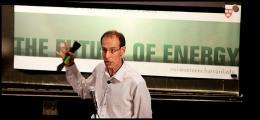
(PhysOrg.com) -- The effects of climate change are so uncertain and potentially long-lasting that policymakers should begin examining options that include geoengineering, an area that has so far been off-limits, according to a former Harvard researcher who is now a professor at the University of Calgary, Canada.
David Keith, Canada Research Chair in Energy and the Environment and director of Calgary’s Energy and Environmental Systems Group, said last evening that fear of sapping momentum from efforts to reduce global carbon output has so far kept talk to a minimum about using large-scale geoengineering to mitigate the effects of climate change. Though some nations are beginning to investigate geoengineering options, more should follow suit, he said.
One common geoengineering strategy mentioned in reference to climate change includes several techniques that would make the Earth more reflective, bouncing more of the sun’s rays back into space and cooling the planet. Injecting sulfur high in the atmosphere — most likely by dumping it from an airplane — would mimic the cooling effect experienced after major volcanic eruptions.
Volcanoes have long been known to have far-reaching ramifications, caused by the spread of dust and sulfur dioxide from their plumes high in the atmosphere around the globe. Keith mentioned the 1991 eruption of Mount Pinatubo, in the Philippines, which is believed to have cooled global temperatures by roughly half a degree Celsius. Among other efforts, Keith recommended that preparations be made to thoroughly study the next major volcanic eruption to see what lessons could be learned that could be applied to future geoengineering attempts.
Keith was the first speaker in the Harvard University Center for the Environment’s (HUCE) Future of Energy speaker series this year. He was introduced by HUCE Director Daniel Schrag, Hooper Professor of Geology and professor of Earth and planetary sciences. Schrag described Keith as a “thought leader” on the question of how to deal with climate change.
Keith, who got his doctorate from the Massachusetts Institute of Technology in 1991 and worked as a research scientist in Harvard’s Department of Earth and Planetary Sciences from 1993 to 1999, spoke before a packed Science Center lecture hall audience.
In framing his talk, Keith said he doesn’t believe the world is in danger of running out of energy, mainly because industry has gotten so good at extracting fossil fuels. He estimated that there’s enough fossil fuel available to run the world’s economy at higher rates than today for more than 200 years. That having been said, there are major issues beyond the carbon content of fuel to consider. Energy security and energy’s role in geopolitics are also important, as are issues of energy equality and the lack of access for a billion of the world’s poorest residents.
When considering changing the world’s energy mix, Keith said, trade-offs are unavoidable. In assessing those trade-offs, however, Keith said policymakers today are not giving enough consideration to the uncertainty inherent in data about different options they’re being given. In some cases, such as the potential costs of increasing the use of nuclear power or the potential cost decline as solar power generation is scaled up, the uncertainties are significant and could impact decisions.
“There’s just no way to look at that data and say you know the cost of nuclear,” Keith said about one graph he displayed.
Still, Keith struck an optimistic note when discussing the future of the energy system. He believes the power system could be reformed to reduce its carbon output by increasing wind, nuclear, and solar power and by employing coal-fired plants with carbon capture and sequestration technology. The cost, he estimated, would be a few percent of GDP, much less than what the United States spends on health care and about what we spend on the military.
To get there, though, policy decisions have to be made despite the uncertainties that remain. Though it is right that the major focus should be on reducing the amount of carbon in the energy we use, Keith said because carbon dioxide in the atmosphere can last thousands of years, the effects of reductions we make now won’t be felt for some time.
In addition, he said, uncertainty remains about how the climate system will respond as carbon dioxide levels rise. Because of that uncertainty, it would be wise to plan for a worst-case scenario.
In that worst case, Keith said, nations might be prompted to quickly deploy geoengineered solutions without fully understanding their potential consequences. It would be wiser, he said, to begin research now — on a fairly small scale initially — to understand and test various solutions.
Geoengineered solutions to climate change fall into roughly two categories, Keith said. The first, carbon cycle engineering, includes slower and more expensive solutions that offer long-term fixes by removing carbon from the environment. It includes things like adding iron to the ocean, which would trigger large-scale plankton blooms that remove carbon from the environment, adding alkalinity to land and sea, and locking up carbon in biochar.
The second category, solar radiation management, includes shorter-term fixes that block sunlight from reaching the Earth and then getting trapped by greenhouse gases. These solutions include changing the planet’s reflectivity in one way or another, including the injection of sulfates or engineered particles into the atmosphere. Their advantage, Keith said, is that they’re relatively cheap and easy to do.
These solutions, however, have potential side effects, such as changing rainfall patterns and reducing atmospheric ozone. That’s why, Keith said, research should begin to understand their potential effects — both good and bad — so that wise choices can be made.
“We need to understand how this might not work, as well as how it might work,” Keith said. “We have to bring this out in the open and talk about it.”
Provided by Harvard University (news : web)


