Female monarch butterflies on 30-year decline in eastern North America
September 23, 2009 Female monarch butterflies on 30-year decline in eastern North America

Enlarge

(PhysOrg.com) -- Female monarch butterflies in eastern North America have significantly declined over the past 30 years, a new study by a University of Georgia researcher reveals.

Andy Davis, a Ph.D. candidate in the Warnell School of Forestry and Natural Resources, analyzed published overwintering and migratory data for the insect from 1976 to the present, discovering that the female to male ratio for the east of the Rockies has gradually been changing. In the late 1970s, Davis said, females made up around 53 percent of the monarch butterfly population that migrated to for the winter. Today, that number has dropped to about 43 percent which paints a dire picture for population recruitment. Davis outlines his findings in a new paper co-authored with Eduardo Rendón-Salinas of World Wildlife Fund-Mexico. The paper appears in Biology Letters.

“I nearly fell over when I saw the trend,” said Davis. It was an unintentional but extremely important finding.”

The monarch butterfly, one of the most well-known and widely-recognized in the world, is a flagship species for conservation. North American Monarchs can migrate more than 2,000 miles as they fly to Mexico from Canada and the U.S. for the winter. “The implications of this decline are huge,” Davis said. “Female monarchs can lay as many as 400 eggs over their lifetime, which is why the species is so resilient.”

But Davis said that as the monarch population continues to struggle because of breeding habitat loss, widespread pesticide use, and deforestation of the overwintering sites, losing a significant number of females could seriously hinder the population’s ability to rebound after periodic crashes. Davis, who studies monarchs in addition to his doctoral work, said that news of the decline has gone unnoticed until now “because no one’s ever looked at the data like this. For years, scientists have been collecting male and female monarchs at the overwintering sites and during the fall migration. When we compiled the numbers from these collections, along with the year they were made, the trend was obvious.”

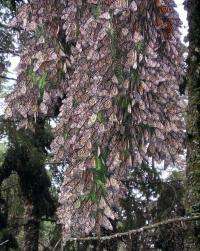
At their wintering sites, monarchs cluster on trees and form massive colonies that can number in the millions. Illegal logging of these trees is a serious threat to their wintering stage, but the threats they face in their breeding range in the United States and Canada are just as important. Further, because the decline in females is also present in the fall migration, Davis says, it means that whatever is causing this decrease is happening during the breeding season in the U.S. and Canada.

“That tells us we need to look here to see what the cause is,” he said. Whatever it is, Davis explained, “it must be something that affects females more so than males. This will be the challenge for future studies to sort out. We’ll also need to monitor the numbers of females in the population closely over the next few years, at all stages of their life cycle.

This discovery just goes to show how new insights can be gained from critical re-examination of published studies, and more generally, how much we still need to learn about this amazing insect before it is too late.”

Provided by University of Georgia (news : web)


Rate this story - 5 /5 (1 vote)

Rank Filter

Move the slider to adjust rank threshold, so that you can hide some of the comments.


Display comments: newest first

  • evolx10 - Sep 23, 2009
    • Rank: 5 / 5 (1)
    One small step could be taken by the DOT to stop mowing the fields of tall grass and Milkweed. Milkweed being the plant Monarchs need for reproduction.
    Imagine a large area bordering a roadway , filled with natural meadow-like plants including Milkweed. Monarchs lay eggs week after week, the caterpillars hatch and are growing swiftly. Then a huge DOT tractor mower comes along and chops all the plants and caterpillars to mulch.
    The milkweed recovers from its lowcut stalk and undamaged roots, and the field is back to full height in about a month. But for the monarchs its too late, and any eggs laid now, will not develop enough before fall/winter temperatures.
  • supn9 - Sep 24, 2009
    • Rank: not rated yet
    One small step could be taken by the DOT to stop mowing the fields of tall grass and Milkweed. Milkweed being the plant Monarchs need for reproduction.
    Imagine a large area bordering a roadway , filled with natural meadow-like plants including Milkweed. Monarchs lay eggs week after week, the caterpillars hatch and are growing swiftly. Then a huge DOT tractor mower comes along and chops all the plants and caterpillars to mulch.
    The milkweed recovers from its lowcut stalk and undamaged roots, and the field is back to full height in about a month. But for the monarchs its too late, and any eggs laid now, will not develop enough before fall/winter temperatures.


    Good tip. Now how to address this?

September 23, 2009 all stories

Comments: 2

5 /5 (1 vote)

  • hide
  • Related Stories

  • Continental plan to protect the monarch's migratory journey
    created Jun 28, 2008 | popularity not rated yet | comments 0
  • Monarchs fly south for the winter
    created Sep 12, 2005 | popularity not rated yet | comments 0
  • Monarch butterflies help explain why parasites harm hosts
    created May 14, 2008 | popularity not rated yet | comments 0
  • Booming Monarch Butterfly Population Faces Obstacles, Expert Says
    created Sep 06, 2006 | popularity not rated yet | comments 0
  • Where Have All the Butterflies Gone?
    created May 08, 2006 | popularity not rated yet | comments 0


  • hide
  • Relevant PhysicsForums posts

Other News

Cells can read damaged DNA without missing a beat

Biology / Cell & Microbiology

created 5 hours ago | popularity 5 / 5 (1) | comments 0 | with audio podcast

Scientists have shown that cells' DNA-reading machinery can skim through certain kinds of damaged DNA without skipping any letters in the genetic "text." The studies, performed in bacteria, suggest a new mechanism that can ...


Great tits: birds with character

Great tits: birds with character

Biology / Plants & Animals

created 6 hours ago | popularity 5 / 5 (2) | comments 3 | with audio podcast

(PhysOrg.com) -- In humans and animals alike, individuals differ in sets of traits that we usually refer to as personality. An important part of the individual difference in personality is due to variation ...


Researchers find genes that 'tune' flower fragrances

Biology / Biotechnology

created 9 hours ago | popularity not rated yet | comments 0 | with audio podcast

(PhysOrg.com) -- Shakespeare famously wrote, "That which we call a rose by any other name would smell as sweet." With all due respect to the Bard, University of Florida researchers may have to disagree: no matter what you ...


Researchers map all the fragile sites of the yeast Saccharomyces cerevisiae's genome

Biology / Cell & Microbiology

created 9 hours ago | popularity not rated yet | comments 0 | with audio podcast

The research group of Dr. François Robert, a researcher at the Institut de recherches cliniques de Montréal (IRCM), in collaboration with the team of Dr. Daniel Durocher (Samuel Lunenfeld Research Institute and University ...


Study carried out into biological risks of eating reptiles

Study carried out into biological risks of eating reptiles

Biology / Cell & Microbiology

created 8 hours ago | popularity 5 / 5 (1) | comments 3

Reptiles are bred in captivity primarily for their skins, but some restaurants and population groups also want them for their meat. A study shows that eating these animals can have side effects that call into ...