A world first: Vaccine helps prevent HIV infection
September 24, 2009
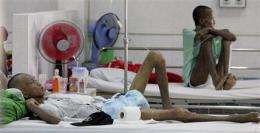
FILE -In this May 15, 2006 file photo, AIDS/HIV patients spend a quiet afternoon at Wat Phrabatnampo AIDS hospice , in Lopburi, Thailand. Researchers in Thailand reported for the first time, an experimental vaccine has prevented infection with the AIDS virus, a watershed event in the deadly epidemic and a surprising result. The vaccine cut the risk of becoming infected with HIV by more than 31 percent in the world's largest AIDS vaccine trial of more than 16,000 volunteers in Thailand, researchers announced Thursday, Sept. 24, 2009 in Bangkok. (AP Photo/David Longstreath, File)
(PhysOrg.com) -- In an encouraging development, an investigational vaccine regimen has been shown to be well-tolerated and to have a modest effect in preventing HIV infection in a clinical trial involving more than 16,000 adult participants in Thailand. Following a final analysis of the trial data, the Surgeon General of the U.S. Army, the trial sponsor, announced today that the prime-boost investigational vaccine regimen was safe and 31 percent effective in preventing HIV infection.
"These new findings represent an important step forward in HIV vaccine research," says Anthony S. Fauci, M.D., director of the National Institute of Allergy and Infectious Diseases (NIAID), part of the NIH, which provided major funding and other support for the study. "For the first time, an investigational HIV vaccine has demonstrated some ability to prevent HIV infection among vaccinated individuals. Additional research is needed to better understand how this vaccine regimen reduced the risk of HIV infection, but certainly this is an encouraging advance for the HIV vaccine field."
"We thank the trial staff in Thailand and the United States for their years of effort in successfully conducting this study and the study participants and the people of Thailand for their long-standing support of HIV vaccine research," Dr. Fauci adds.
The Thai Phase III HIV vaccine study, also known as RV144, opened in October 2003. The placebo-controlled trial tested the safety and effectiveness of a prime-boost regimen of two vaccines: ALVAC-HIV vaccine (the primer dose), a modified canarypox vaccine developed by Sanofi Pasteur, based in Lyon, France, and AIDSVAX B/E vaccine (the booster dose), a glycoprotein 120 vaccine developed by Vaxgen Inc., and now licensed to Global Solutions for Infectious Diseases (GSID), based in South San Francisco, Calif. The vaccines are based on the subtype B and E HIV strains that commonly circulate in Thailand. The subtype B HIV strain is the one most commonly found in the United States.
Led by principal investigator Supachai Rerks-Ngarm, M.D., of the Thai Ministry of Public Health’s Department of Disease Control, the study was sponsored by the U.S. Army in collaboration with NIAID, Sanofi Pasteur and GSID. The trial, conducted in the Rayong and Chon Buri provinces of Thailand, enrolled 16,402 men and women ages 18 to 30 years old at various levels of risk for HIV infection. Study participants received the ALVAC HIV vaccine or placebo at enrollment and again after 1 month, 3 months, and 6 months. The AIDSVAX B/E vaccine or placebo was given to participants at 3 and 6 months. Participants were tested for HIV infection every 6 months for 3 years. During each clinic visit, they were counseled on how to avoid becoming infected with HIV.
In the final analysis, 74 of 8,198 placebo recipients became infected with HIV compared with 51 of 8,197 participants who received the vaccine regimen. This level of effectiveness in preventing HIV infection was found to be statistically significant. The vaccine regimen had no effect, however, on the amount of virus in the blood of volunteers who acquired HIV infection during the study.
"The Thai study demonstrates why the HIV vaccine field must take a balanced approach to conducting both the basic research needed to discover and design new HIV vaccines and, when appropriate, testing candidate vaccines in people," says Margaret I. Johnston, Ph.D., director of NIAID’s Vaccine Research Program within the Division of AIDS. "Both avenues provide critical information that will continue to help us better understand what is needed to develop a fully protective HIV vaccine."
NIAID and the collaborating partners are working with other scientific experts to determine next steps, including additional research of the RV144 vaccine regimen and the need to consider the impact of these new findings on other HIV vaccine candidates.
Individuals who acquired HIV infection while participating in the Thai trial have been provided access to HIV care and treatment, including highly active antiretroviral therapy based on the guidelines of the Thai Ministry of Public Health.
For more information about the Thai Phase III HIV vaccine trial, please see: http://www.hivresearch.org
Provided by National Institutes of Health
-
Puzzling results from HIV vaccine trial
Dec 03, 2007 |
not rated yet |
0
-
AIDS experts go back to basics
Mar 27, 2008 |
not rated yet |
0
-
AIDS vaccine trial exceeds expectations
Sep 23, 2005 |
not rated yet |
0
-
AIDS: No vaccine after 25 years
Jul 17, 2006 |
not rated yet |
0
-
How HIV vaccine might have increased odds of infection
Nov 03, 2008 |
not rated yet |
0
-
Engineers build first sub-10-nm carbon nanotube transistor
Feb 01, 2012 |
4.9 / 5 (30) |
30
-
Something old, something new: Evolution and the structural divergence of duplicate genes
Jan 31, 2012 |
4.6 / 5 (7) |
1
-
The hidden nanoworld of ice crystals: Revealing the dynamic behavior of quasi-liquid layers
Jan 30, 2012 |
5 / 5 (3) |
1
-
Stock market network reveals investor clustering
Jan 27, 2012 |
3.9 / 5 (23) |
8
-
Of microchemistry and molecules: Electronic microfluidic device synthesizes biocompatible probes
Jan 26, 2012 |
5 / 5 (1) |
0
-
Classical and Quantum Mechanics via Lie algebras
Apr 15, 2011
- More from Physics Forums - Independent Research
More news stories
Neurologic improvement detected in rats receiving stem cell transplant
In a study to be presented today at the Society for Maternal-Fetal Medicine's annual meeting, The Pregnancy Meeting, in Dallas, Texas, researchers will report that early transplantation of human placenta-derived mesenchymal ...
24 minutes ago |
not rated yet |
0
Sleep breathing machine shows clear benefits in children with sleep apnea
Children and adolescents with obstructive sleep apnea had substantial improvements in attention, anxiety and quality of life after treatment with positive airway pressure (PAP)a nighttime therapy in which a machine ...
34 minutes ago |
not rated yet |
0
Researchers show benefits of local anesthesia after knee replacement surgery
Researchers at the Rothman Institute at Jefferson have shown that local anesthesia delivered through a catheter in the joint, intraarticularly, may be more beneficial than traditional opioids such as morphine and Oxycontin ...
54 minutes ago |
not rated yet |
0
Study finds preterm labor diagnostic markers not universal, diagnosis and interventions should not be generalized
In a study to be presented today at the Society for Maternal-Fetal Medicine's annual meeting, The Pregnancy Meeting, in Dallas, Texas, researchers will report findings that indicate that preterm birth interventions should ...
1 hour ago |
not rated yet |
0
Study finds massively parallel sequencing can detect fetal aneuploidies, including Down syndrome
In a study to be presented today at the Society for Maternal-Fetal Medicine's annual meeting, The Pregnancy Meeting, in Dallas, Texas, researchers will report findings that indicate that massively parallel sequencing can ...
44 minutes ago |
not rated yet |
0
Humans may have helped the decline of African rainforests 3000 years ago
(PhysOrg.com) -- Large areas of rainforests in Central Africa mysteriously disappeared over three thousand years ago, to be replaced by savannas. The prevailing theory has been that the cause was a change ...
Japan scientist makes 'Avatar' robot
A Japanese-developed robot that mimics the movements of its human controller is bringing the Hollywood blockbuster "Avatar" one step closer to reality.
Protein libraries in a snap
(PhysOrg.com) -- A Rice University undergraduate will depart with not only a degree but also a possible patent for his invention of an efficient way to create protein libraries, an important component of biomolecular ...
Miami battling invasion of giant African snails
No one knows how they got there. But an invasion of African giant snails has southern Florida in a panic over potential crop damage, disease and general yuckiness surrounding the slimy gastropods.
NASA budget will axe Mars deal with Europe: scientists
US President Barack Obama's budget proposal to be submitted next week for 2013 will cut NASA's budget by 20 percent and eliminate a major partnership with Europe on Mars exploration, scientists said Thursday.
Zynga partners with toy maker Hasbro
Old school toy maker Hasbro and online social game star Zynga on Thursday announced a partnership to mesh the Internet firm's hits with real-world products.
Sep 24, 2009
Rank: 5 / 5 (4)
Sep 24, 2009
Rank: 2.5 / 5 (6)
Sep 24, 2009
Rank: 5 / 5 (1)
I'm sure you wouldn't have many volunteers for a trial where part of the control was infecting the volunteer with a known strain of AIDS, however, the vaccines' efficacy is indeterminable in a study that doesn't do exactly that.
Sep 24, 2009
Rank: 3.7 / 5 (3)
Sep 24, 2009
Rank: 2.3 / 5 (3)
Sep 24, 2009
Rank: 2.8 / 5 (6)
This study has no credibility. It must have been done by someone who used to work as a private investigator with the same accuracy and credibility in information.
Sep 25, 2009
Rank: not rated yet
The results are presented accurately at 31% Both the odds ratio and relative risk are approx .68 (they approach each other when outcome is rare)