Cockroaches Control Their Breathing to Save Water
September 24, 2009 by Lin Edwards Cockroach Mom

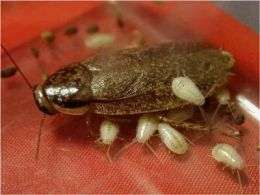
A cockroach mom shelters her newborn babies. Credit: by Allen Moore

(PhysOrg.com) -- Many insects have been known for decades to hold their breath when resting, but the reasons have not been well understood. A new study on cockroaches suggests the insects reduce their breathing to conserve moisture.

Cockroaches can hold their breath for up to seven minutes. Their is highly efficient but there are no lungs. Instead, the insects draw in air through external valves called spiracles and transport the air directly to the cells via tubes called trachea. To stop breathing, they simply close the spiracles.

The new study, reported in the Journal of Experimental Biology tested the major hypotheses put forward to explain the practice of holding the breath for long periods. One hypothesis is that the insects are trying to build up the carbon dioxide produced during respiration, which makes it easier to expel from the body. Another idea is that they stop breathing to protect themselves from high oxygen concentrations (which can be toxic). The third hypothesis is that the practice aims to regulate water loss.

One of the scientists, Dr Craig White, an animal physiologist at the University of Queensland, explained that the trachea do not just carry air inwards to the cells, they also carry water out of the cells. The hypothesis is that when they are resting and have a lower oxygen requirement, they close the spiracles to conserve water.

The Australian team of scientists tested the hypotheses by monitoring the breathing of cockroaches over four weeks and under different conditions of humidity, and oxygen and levels, so some cockroaches spent the four weeks in high humidity, others in low humidity, some with humidity constant but oxygen levels low or high, and so on.

The study found that in low humidity the cockroaches held their breath longer, which confirms these adapt to dry environments by adjusting their behavior. This ability to adapt to the conditions may be one reason why cockroaches are such a successful group, and why they have survived for so long.

More information: Cockroaches breathe discontinuously to reduce respiratory water loss, 212, 2773-2780 (2009); doi: 10.1242/jeb.031310

© 2009 PhysOrg.com


print this article email this article download pdf blog this article bookmark this article     Stumble it Digg this share on Facebook retweet share on Reddit add to delicious
Rate this story - 5 /5 (2 votes)


September 24, 2009 all stories

Comments: 0

5 /5 (2 votes)
  • Stumble this up

  • Digg this

  • share this

  • hide
  • Related Stories


  • hide
  • Relevant PhysicsForums posts

  • Is there a gay gene?
    created 15 hours ago
  • Super quick question about Starling forces?
    created Nov 22, 2009
  • Questions about diffusion
    created Nov 22, 2009
  • Human Leukocyte Antigen (HLA) typing
    created Nov 21, 2009
  • More from Physics Forums - Biology

Other News

Computational microscope peers into the working ribosome

Computational microscope peers into the working ribosome (w/ Video)

Biology / Cell & Microbiology

created 10 hours ago | popularity 4.8 / 5 (5) | comments 0

Two new studies reveal in unprecedented detail how the ribosome interacts with other molecules to assemble new proteins and guide them toward their destination in biological cells. The studies used molecular ...


Spider secrets decoded in world-first database

Biology / Plants & Animals

created 4 hours ago | popularity not rated yet | comments 0

(PhysOrg.com) -- Queensland scientists have developed a world-first database that catalogues the venom components from hundreds of spiders.


Bioengineers succeed in producing plastic without the use of fossil fuels

Biology / Biotechnology

created 17 hours ago | popularity 4.8 / 5 (11) | comments 0

A team of pioneering South Korean scientists have succeeded in producing the polymers used for everyday plastics through bioengineering, rather than through the use of fossil fuel based chemicals. This groundbreaking research, ...


New chameleon species discovered in East Africa

New chameleon species discovered in East Africa (w/ Podcast)

Biology / Plants & Animals

created 12 hours ago | popularity 5 / 5 (1) | comments 0

A new species of chameleon has been discovered in Tanzania by a team of scientists.


A year after discovery, Congo's 'mother lode' of gorillas remains vulnerable

A year after discovery, Congo's 'mother lode' of gorillas remains vulnerable

Biology / Plants & Animals

created 8 hours ago | popularity not rated yet | comments 0

A new study by the Wildlife Conservation Society says that western lowland gorillas living in a large swamp in the Republic of Congo—part of the "mother lode" of more than 125,000 gorillas discovered last ...