A Change for the better: Improving properties of enzymes
September 24, 2009 A Change for the better

Enlarge

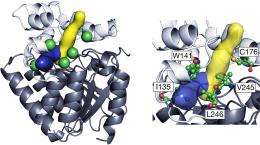
Hot spot residues lining the access tunnels selected for mutagenesis by computer simulations. Left: Cartoon model of wild-type DhaA. Gray, main domain; white, cap domain; yellow, product release pathway corresponding to the main tunnel; blue, product release pathway corresponding to the slot tunnel; green, residues selected for mutagenesis. Right: Ball and stick model of the residues selected for mutagenesis. (Image: Masaryk University)

An international team of scientists from the Czech Republic, Germany and Japan have developed a new method for improving the properties of enzymes. The method has potential for wide application in the chemical, medicinal and food industries. The research has been published in Nature Chemical Biology.

The modified enzymes can be used, for example, for disposal of highly harmful chemical substances which enter into the environment as a result of human activity and can have a very negative influence on human and animal health. Nature cannot degrade many of these chemicals but, in this work, the scientists have developed an approach that can be applied to remove them efficiently from the environment.

The principle of the discovery is based on genetic manipulation of the which is starting and accelerating the chemical reaction. "Now we can use genetic modifications for changing the properties of the enzymes so they can faster and more easily dispose of harmful substances in the environment," says Jiri Damborsky, leader of the Protein Engineering Group at the Institute of Experimental Biology, Faculty of Science, Masaryk University.

Up to now, the scientists had focused during the modification of an enzyme’s properties on the site in its structure where the chemical reaction happens, the active site. The new method is based on the modification of so-called access tunnels that connect the active site with the surface of the enzyme. "Specialized computational techniques guided the experimental work to engineer these tunnels to alter their accessibility to the degraded substances," notes Rebecca Wade, leader of the Molecular and Cellular Modeling Group at EML Research in Heidelberg.

The scientists applied the approach by modifying an enzyme to degrade the highly toxic substance, trichloropropane (TCP). This colourless liquid is a secondary product of chemical production. It can reside in the soil and groundwater for over 100 years, can contaminate drinking water and is a carcinogen. Using the new approach, the protein engineers developed a modified enzyme capable of degrading this substance 32 times faster than the original enzyme.

But the method has much wider scope for application than just in the fight against harmful substances and in environmental protection. The targeted modification of the tunnels in enzymes can be utilized in different application areas, including biomedicine, and the chemical and food industries.

More information: http://www.nature.com/nchembio/journal/v5/n10/abs/nchembio.205.html

Source: European Media Laboratory (EML), via AlphaGalileo


print this article email this article download pdf blog this article bookmark this article     Stumble it Digg this share on Facebook retweet share on Reddit add to delicious
Rate this story - not rated yet


September 24, 2009 all stories

Comments: 0

not rated yet
  • Stumble this up

  • Digg this

  • share this

  • hide
  • Related Stories

  • Unlocking the function of enzymes
    created Nov 06, 2007 | popularity not rated yet | comments 0
  • Birth of an enzyme
    created Mar 24, 2008 | popularity not rated yet | comments 0
  • Enzyme Detectives Uncover New Reactions, Products
    created Sep 08, 2008 | popularity not rated yet | comments 0
  • Researchers describe new way to identify, evolve novel enzymes
    created Aug 15, 2007 | popularity not rated yet | comments 0
  • Iowa State researcher studies how enzymes break down cellulose
    created Jan 30, 2008 | popularity not rated yet | comments 0


  • hide
  • Relevant PhysicsForums posts

  • Putting every element in a box
    created 17 hours ago
  • a question in Lewis structure???
    created Nov 25, 2009
  • Paint Technology
    created Nov 24, 2009
  • About pH, Metallic electrodes
    created Nov 24, 2009
  • More from Physics Forums - Chemistry

Other News

Blocking biofilms: Alzheimer's research sheds light on potential treatments for urinary tract infections

Chemistry / Biochemistry

created 22 hours ago | popularity 5 / 5 (1) | comments 0

(PhysOrg.com) -- Research into Alzheimer's disease seems an unlikely approach to yield a better way to fight urinary tract infections (UTIs), but that's what scientists at Washington University School of Medicine in St. Louis ...


Chemists get custom-designed microscopic particles to self-assemble in liquid crystal

Chemists get custom-designed microscopic particles to self-assemble in liquid crystal

Chemistry / Materials Science

created 22 hours ago | popularity 5 / 5 (5) | comments 0

(PhysOrg.com) -- The scientists anticipate their "LithoParticles" will have significant applications in photonics, optical communications and other areas.


Sandia CR5

Machine Converts CO2 into Gasoline, Diesel, and Jet Fuel

Chemistry / Biochemistry

created Nov 23, 2009 | popularity 4.6 / 5 (30) | comments 19

(PhysOrg.com) -- Researchers at Sandia National Laboratories have built a machine that uses the sun's energy to convert carbon dioxide waste from power plants into transportation fuels such as gasoline, diesel, ...


New hydrogen-storage method discovered

New hydrogen-storage method discovered

Chemistry / Materials Science

created Nov 22, 2009 | popularity 4.3 / 5 (42) | comments 15

Scientists at the Carnegie Institution have found for the first time that high pressure can be used to make a unique hydrogen-storage material. The discovery paves the way for an entirely new way to approach ...


New on-off 'switch' triggers and reverses paralysis in animals with a beam of light

New on-off 'switch' triggers and reverses paralysis in animals with a beam of light (w/ Video)

Chemistry / Biochemistry

created Nov 18, 2009 | popularity 4.8 / 5 (5) | comments 4

In an advance with overtones of Star Trek phasers and other sci-fi ray guns, scientists in Canada are reporting development of an internal on-off "switch" that paralyzes animals when exposed to a beam of ultraviolet ...