Scientists map potato genome, hope to improve crop yield
September 24, 2009 Scientists map potato genome, hope to improve crop yield

Enlarge

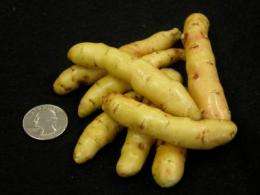
These are fingerling potatoes from one of the genomic lines sequenced by researchers. Credit: Photo by Dave Douches

It's been cultivated for at least 7,000 years and spread from South America to grow on every continent except Antarctica. Now the humble potato has had its genome sequenced.

"The potato is the most important vegetable worldwide," said Robin Buell, an MSU associate professor of plant biology. She was part of the consortium that released the first draft sequence of the potato genome. "This first draft that is being released will help breeders improve yield, quality, disease resistance and nutritional value."

The Potato Genome Sequencing Consortium, an international team of 39 scientists from 14 countries, began work on the potato genome project in 2006. The complete sequence is estimated to be 840 million base pairs, about one-quarter the size of the human genome. The draft sequence, which covers 95 percent of potato genes, is available at http://www.potatogenome.net and will be updated over the next six months.

Scientists map potato genome, hope to improve crop yield
Enlarge

This Michigan State University crop and soil sciences professor Dave Douches. Credit: Photo by Kurt Stepnitz

Potatoes are members of the Solanaceae family, as are tomatoes, peppers, eggplant, petunias and tobacco. Buell, along with Dave Douches, an MSU crop and soil sciences professor, is leading a $5.4 million U.S. Department of Agriculture grant research project to improve the quality, yield, and disease resistance of potatoes and tomatoes. Known as the SolCAP project, the research aims to use emerging DNA sequence knowledge with basic research data to improve tomato and potato varieties.

"The timing of the release of the potato draft sequence is nice for the SolCAP project," Douches said. "We're combining genetics and breeding, so having a draft of the genome will help us find genetic markers for desirable traits in potatoes, which will make breeding more precise."

Buell is determining which genes are expressed in specific potato to better understand the tuber's growth and development.

Buell's potato genome sequencing research is funded by the National Science Foundation and was done in collaboration with Chris Town, of the J. Craig Venter Institute, and Jiming Jiang, of the University of Wisconsin. The research of Buell and Douches also is funded by the Michigan Agricultural Experiment Station.

In 2007, more than 309 million tons of potatoes were produced around the world. China is the top global potato market, consuming about 47.5 million tons of potatoes in 2005. Belarusians are the leaders when it comes to savoring spuds, each eating an average of nearly 400 pounds of potatoes per year. The United States consumed slight more than 17 million tons of potatoes in 2005, which makes it the world's fourth largest consumer. Each person in the United States eats more than 119 pounds of potatoes per year.

Source: Michigan State University (news : web)


print this article email this article download pdf blog this article bookmark this article     Stumble it Digg this share on Facebook retweet share on Reddit add to delicious
Rate this story - 5 /5 (1 vote)


September 24, 2009 all stories

Comments: 0

5 /5 (1 vote)
  • Stumble this up

  • Digg this

  • share this

  • hide
  • Related Stories

  • Spud origin controversy solved
    created May 15, 2007 | popularity not rated yet | comments 0
  • Finding rewrites the evolutionary history of the origin of potatoes
    created Oct 04, 2005 | popularity not rated yet | comments 0
  • Using DNA, scientists hunt for the roots of the modern potato
    created Jan 29, 2008 | popularity not rated yet | comments 0
  • Disease Causing Irish Potato Famine Came From South America, Scientist Says
    created Feb 28, 2007 | popularity not rated yet | comments 0
  • New research to decode the genetic secrets of prolific potato pest
    created Nov 27, 2007 | popularity not rated yet | comments 0


  • hide
  • Relevant PhysicsForums posts

  • What is transpulmonary pressure?
    created Nov 24, 2009
  • Is there a gay gene?
    created Nov 23, 2009
  • Super quick question about Starling forces?
    created Nov 22, 2009
  • Questions about diffusion
    created Nov 22, 2009
  • Human Leukocyte Antigen (HLA) typing
    created Nov 21, 2009
  • Breeding program
    created Nov 20, 2009
  • More from Physics Forums - Biology

Other News

Sustainable Corn Production Supports Advanced Biofuel Feedstocks

Sustainable Corn Production Supports Advanced Biofuel Feedstocks

Biology / Biotechnology

created 2 minutes ago | popularity not rated yet | comments 0

(PhysOrg.com) -- Researchers worldwide are trying to economically convert cellulosic biomass such as corn stover into "cellulosic ethanol." But Agricultural Research Service (ARS) scientists have found that ...


Redback spiders were first spotted in Japan in 1995

Venomous Aussie redback spiders invading Japan

Biology / Ecology

created 3 hours ago | popularity not rated yet | comments 0

Australia's venomous redback spiders are on the march in Japan, where they are believed to have arrived years ago as stowaways on cargo ships, a wildlife expert warned Wednesday.


Study explores violent world of raptors

Biology / Plants & Animals

created 3 hours ago | popularity not rated yet | comments 0

A journey that started with a box of bird feet carried three Montana State University graduate students into the gruesome world of raptors and led to their findings being published in a prominent journal.


Asian carp may have breached barrier protecting Lake Michigan

Biology / Ecology

created 11 hours ago | popularity 5 / 5 (4) | comments 0

Two feared species of Asian carp have zoomed beyond the $9 million electric barriers built to keep them out of Lake Michigan. Now, the only thing left between the carp and the Great Lakes is a lock and dam in southern Chicago.


Got a pain? -- Have a cup of Brazilian mint

Biology / Plants & Animals

created 13 hours ago | popularity 4.6 / 5 (7) | comments 0

For thousands of years it has been prescribed by traditional healers in Brazil to treat a range of ailments from headaches and stomach pain to fever and flu.