New INL project tackles nuclear fuel recycling science
(PhysOrg.com) -- A new research project at Idaho National Laboratory and Argonne National Laboratory will use an innovative approach to learn how to get more use from nuclear fuel.
INL has won a competitive research grant that could help nuclear fuel be recycled or used for longer periods of time to produce more energy. The INL team in Idaho will collaborate with scientists at the Argonne Tandem Linac Accelerator System (ATLAS) user facility in Illinois.
The project demonstrates the U.S. Department of Energy's commitment to conduct more basic research on nuclear fuel recycling. Thanks to $2 million in funding from DOE's Office of Science, INL researcher Gilles Youinou aims to give nuclear scientists a better understanding of how elements within fuel rods respond to neutron irradiation.
"If we're going to recycle nuclear fuel or burn it longer, we need a clearer understanding of how the daughter products respond to neutron irradiation," said Youinou.
During the fission process, uranium emits neutrons as it splits into daughter atoms. Within the fuel rods, those neutrons will interact to produce either more fissions or heavier elements (i.e., "actinides" such as neptunium, plutonium or americium). As nuclear scientists consider recycling nuclear fuel to use more of the fissionable uranium, they would like more information about how prolonged neutron bombardment affects such actinide elements.
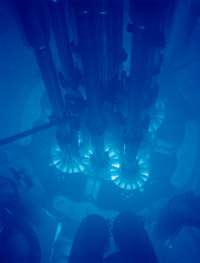
That's where INL's new project comes in. Youinou and his team propose putting pure samples of common actinides — neptunium, americium and curium — into INL's Advanced Test Reactor. The ATR lets researchers subject materials to concentrated neutron irradiation in relatively short periods of time.
After a mere 20 to 40 days in the ATR, the samples will be removed and sent to the ATLAS facility for analysis. Argonne collaborators Filip Kondev and Richard Pardo will oversee accelerator mass spectroscopy analysis at ATLAS, which will be able to detect miniscule amounts of material within a small sample size.
The analysis will provide precise measurements of rare isotopes that build up during the irradiation process, which allows researchers to infer fundamental nuclear characteristics of these elements. This is the first time post-irradiation work has been done using this approach or the ATLAS facility.
The project, originally conceived several years ago by senior advisor Massimo Salvatores, has several advantages. It uses a unique combination of expertise to offer quick and low-cost irradiation, high precision and fewer uncertainties than similar experiments have achieved.
This high-quality actinide data will enable more precise nuclear reactor simulations than are possible with current data. This type of information is required to reliably assess fuel performance in advanced nuclear systems. Such systems, which minimize waste and reduce proliferation risk, will be a fundamental asset of future sustainable nuclear energy development.
This project is one of two INL proposals funded by DOE's Office of Science.
The two grant awards represent a unique accomplishment for INL, which receives the bulk of its research funding for applied engineering work rather than basic research projects such as these. Further, the two projects together received about $3 million, meaning that INL received 10 percent of the funds the Office of Science estimates will be available in this round of Recovery Act funding.
"INL is using a science-based approach to obtain better data and to better design future reactors," said Phillip Finck, INL associate laboratory director for Nuclear Science & Technology. "Basically, we're using scientific tools to get better engineering data."
Both projects will start operations Oct. 1.
Source: Idaho National Laboratory


