Schrodinger's Cat Experiment Proposed
September 24, 2009 by Sheeraz M. Hyder
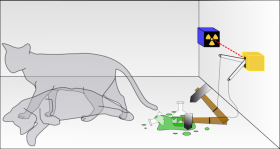
Schrodinger's cat. Image by Dhatfield, Wikimedia Commons.
(PhysOrg.com) -- One of the classical problems in quantum mechanics concerns a man and his feline companion. The man has placed his cat in an opaque tank and is slowing pumping it full of poison. Now until the man opens the tank and looks inside, he cannot be sure whether the cat is dead or alive. That is to say, the cat is both dead and alive at the same time. Impossible but such is the nature of the problem that faced this man. The man's name is Erwin Schrodinger and the problem is that of his Uncertainty Principle.
For nearly a century, his problem has remained a quixotic quest for physicists. Particle physics has always held that matter can only exist at one state in one time. That is why particles are classified as moving with an up or down spin but nothing in between. In recent years that rule has been bent with the superposition of atoms and other nonliving things. Superposition is the term for an object that is not being observed that exists as both possibilities: up and down, dead and alive. This allows physicists to observe the matter in two different states at the same time. However, thus far it has only been done with non-living things. A life-form has never been superimposed. Now, one physicist says he may have an answer.
Oriol Romero-Isart is at the Max Planck Institute for Quantum Physics in Garching in Germany. Along with his team he is proposing a "Schrodinger's virus" experiment that would follow the same general principles of Schrodinger's Cat. Using an electromagnetic field created by a laser, the virus would be trapped in a vacuum. Then, using another laser, the virus will be slowed down until it lies motionless in its lowest possible energy state.
Now that the virus is fixed, a single photon is used to put the virus into a superposition of two states, moving and non-moving. Up until the point is measured it is in both states. Only after a measurement is it found to be in one state and one alone. The team has suggested that the tobacco mosaic virus be used. The virus is rod-shaped and measures 50 nanometers wide and approximately 1 micrometer long. There is debate however, whether the virus can truly be classified as "alive." However the scientists are confident that the treatment could be extended to tiny micro-organisms such as tardigrades who can survive in vacuum for days, making them suitable for the "Schrodinger treatment."
However, physicists are doubtful about the experiment's results. Martin Plenio of Imperial College in London says that there is little reason that a virus would behave any differently than a similarly-sized inanimate object. However, there are possibilities in testing large objects such as viruses and molecules. This is because quantum mechanics says that macroscopic objects can enter superposition however, it has never happened. Through these studies, Plenio believes that we will finally be able to bridge the divide between the quantum world and our own macroscopic world.
More information:
• Towards Quantum Superposition of Living Organisms, arxiv.org/abs/0909.1469
• Schrödinger's cat on Wikipedia.
© 2009 PhysOrg.com


That is to say, the cat is both dead and alive at the same time. - Wrong.
That is to say, the cat is EITHER dead OR alive at ANY GIVEN time.
No that would depend on the interpretation, and there are several. That one would be the Copenhagen interpretation, I think. The dead and alive states exist at the same time and only when the box is opened does the wave function collapse into one of the two. It's flawed, granted, but I wouldn't say wrong. It's "interesting" :P
To tell me that this cannot be seen because once I have a look the wave function collapses into one of the preferred states is (as davesmith suggests)pseuso-science or more accurately nonsense. Many respectable scientists (including) the venerable Einstein objected to the Copenhagen interpretation and chastised schrodingbat - was it not this context that brought forth the famous quote - God does not play dice with the universe.
And i too thought someone would be killing cats in boxes with poison - ahh practical science is much more fun!
"The idea of actually performing the experiment is ludicrous. This guy Romero-Isart may or may not put his virus into a superposition of states but, as others have pointed out, there is no way to prove that the virus was ever in a superposition of both states!"
Do you agree smaller objects ranging from photons to molecules have been shown to exist in superposition? If so, where do you draw the line before reaching the size of a virus? If you disagree, then I should first point to specific experiments which demonstrate superposition. Or is it that you agree the virus would be in superposition, but this particular experiment does not show it? The physorg article does not explain that. See the original article "Towards Quantum Superposition of Living Organisms" as well "Towards quantum superpositions of a mirror"
"Can this article be for real?"
You mean the physorg article and not the article which it is discussing?
That's just bogus. The very point of the experiment is that once an observation is made, there is only one state. Before that, it's not illogical, or counter-intuitive, to assume that you don't really know what's in the box, so the contents could vary wildly.
If you close your eyes, cover your ears and pretty much cut off all your sensory capacities, as far you're concerned, the world may not exist.
As far as marketing potential goes, Schrodinger really hit the jackpot with this one. The same is true for the potential for misunderstanding, unfortunately.
From a mathematical standpoint, yes it makes sense to say both exist to mathematically come to a statistical probability solution.
But too many even in the 'scientific' community is really taking this 'both exist' too literally.
Particles traveling ALL paths in space?
Infinite universes?
Drop the pipe, and step back into reality please.
It's not even meaningful on the microscope scale, it was designed to express certain problems of quantum mechanics in a more intuitive format.
But:
She does! 'statistical chance' is a foundation of QM, no?
and as i recall, wasn't Shrodinger's formulation made to mock QM, not to support it?
As for Einstein's quote, it's just his opinion, not something scientifically demonstrated. QM talks about the statistical chance of measurement results, not of the actual events being measured.
Cats seem too big and delicate to use. We cannot project cats at large double slits and hope to look for an interference pattern where they hit the screen.
Though it would be a tempting idea to project camels at needles to test the old idea of not fitting a camel through the eye of a needle? They could only pass through the eye while in a QM superposition of states? Or perhaps not even then?
1) Erwin Schrödinger not Erwin Schrodinger.
2) Schrödinger was an opponent of the QM, not a proponent, thus this mockery experiment.
3) The uncertainty principle was formulated by Werner Heisenberg.
4) The fact that the cat is in a superposition is yet to be proven, because of its macroscopic scale thus (also the cat can be collapsing the state itself alone, which ofcourse doesn't mean it controls the outcome).
5) This experiment will try to - as NeuroPulse was trying to point out - determine if at least the viruses are also in this state or not => where is the border => what causes the collapse of the quantum state => it can be indeed very important experiment.
also:
6) to kasen: viruses not virii ;)
Well, we could try. Actually, it'd be best to drop them on a double slit. The interference patterns should be made up of cats landing on their feet and cats landing on their backs.
My knowledge of this is that radioactive decay (as in the picture) controls when the poison is released. Because that decay can not be predicted, the dead/alive state of the cat can also not be predicted.
Carbon-60 molecules
http://physicswor...ews/2952
Tetraphenylporphyrin molecules
http://physicswor...ws/18187
Schrodinger designed the 'cat' experiment to show how ludicrous the Bohr/Heisenberg model was. There are many other such 'thought expirements that are not cartoonish. The double-slit quantum eraser, Bohm-EPR, Mach-Zehnder interferometer, Elitzur-Vaidman bomb test, etc.
But if one partner electron annihilates with a third electron, where does that leave the unobserved singleton electron with respect to its quantum states? Presumably not entangled. Similarly, if one electron is observed then its unobserved partner's QM states will collapse.
I can't see anything wrong with the idea that bits of a cat exist in QM entangled states. But the idea that the whole cat is entangled is too statistically remote.
There is always a danger in using labels ('cat') that we treat the whole as one when it is made of many parts. There is a similar problem in refusing to believe that a bee can stop a 'train' in a head-on collision. A bee can stop the 'train' ... but not all of the train, of course, just a bit of it.
Why not start with cats for the experiment? Gas them and see what happens at the quantum level? Would the particle be both decayed and undecayed?
Here is Schroedinger's original paper on "Schroedinger's Cat".
http://www.tu-har...ml#sect5
I've linked the section specifically discussing the Cat. This "problem" did not vex Schroedinger. The whole point of his "cat paradox" is to ridicule the interpretation of his theory giving rise to it. He never accepted this interpretation of the theory. He never thought it a problem at all. He thought it much pseudo-scientific ado about nothing. His point is that we can actually perform the experiment, and we do actually perform similar experiments every day, but no one imagines half dead cats behind closed doors.
And it's Heisenberg's Uncertainty Principle, not Schroedinger's.
- -
Is the implication that the frozen virus is in only one possible QM state, or none, (or?). So the one photon associated with it carries the all the degrees of freedom for the virus/photon system?
In http://www.physor...562.html I asked whether, when the universe runs down, with entropy at its maximum, will there be no available QM states left in the universe. If this is the case, freezing the virus is in effect removing all the QM states from it? Just as it would if fully measuring/observing all of its elementary particles?
Continued ....
Can the experiment about the virus/photon system give much more information than an experiment on the single photon, because the virus contributes nothing to the QM states? The article actually says that there are two states left so maybe the virus cannot be reduced all the way to a zero QM state. But I am not clear . But how can a QM experiment say much about a virus which is virtually QM-free? Or am I misreading it?
I think it explains what the experiment is about a bit better. If I understand correctly, the virus gets cooled to nearly 0 K, where it's in its lowest possible vibrational energy state. The photon can either be absorbed by it and push it up in its next level of energy, which corresponds to a new quantum state, or not. As such, the 'quantumness' of the photon infects the virus, so to speak, which is put in a superposition of energy states.
The experiment would prove that stuff bigger than molecules can be put in superposition. Not sure how they detect that, though. The virus's wavefunction probably gets correlated with that of the photon, which is known, so a series of experiments should show certain statistically significant results. Or something. Way out of my league.
I have been wondering about the permanency of the quantum collapse of superimposed states. The cause of quantum collapse seems to be murky and I cannot believe it requires sentient observers. The inverse of quantum collapse is (say) quantum superposition formation. But can 'not observing' a system cause quantum superposition formation? I doubt it as it would imply collapse would be very fleeting.
Will the virus be 'infected' by the photon's QM superimposed state? Or will it still be a QM-inert virus with a photon associated with it? The question is: can we really make a quantum superimposition formation? We can collapse (completely for the virus) but can we really create?
Alternatively one state may not be reactive while the other is. If you had 100 virii in superposition and exposed them to a reagent, you might expect that the products would be split 50-50.
Just thinking out aloud.
The technology for this experiment is wonderful but the assumptions in it about QM are just assumptions, I think. The experiment cannot fail in QM terms, only fail in the technology.
A photon is to be fired at a translucent virus at zero deg Absolute. Somewhere in the virus, an electron in an atom will be lifted up by one notch in its energy level.
So this requires knowledge of what absolute zero temperature is with respect to QM. Does abs zero imply zero QM states? Does abs zero temperature imply all particles have an attribute (say position) known to within one Planck's length? Is that just the electrons in the shells, or the nucleii too? What is the commonsense interpretation of an electron (in a shell?) with position known so exactly? Is knowing an electon has in some way stopped moving less knowledge than knowing its position exactly? Are we sure there are no QM states left to observe in the frozen virus?
IMHO, superpositions and probabilities are tools for working with incomplete information, not a basis for multiple realities.
- - - - - - -
If they are not multiple realities, a lot of mainstream physicists are wasting their time trying to construct a quantum computer? As a quantum computer will need all those multuple realities?
"The complex shape of a vibrating guitar string is a superposition of simpler shapes, the sines and cosines of the Fourier expansion of the shape of the string"
- - - - -
Yes, but is this a series rather than a sequence? Ie an infinite sum rather than an infinite set of separate states? (Though I agree that classical systems ought to show QM states except for the statistical improbability of simultaneous preservation of a large collection of QM states.)
Whether or not there are multiple realities is practically a matter of metaphysics. There are many interpretations of quantum theory, but the maths is the same for all of them and, most importantly, it works. That's all an engineer needs in order to make use of it in practical applications.
The first flying machines and steam engines weren't based on complete theories, either.