Twin Keck telescopes probe dual dust disks
September 24, 2009
Twin Keck telescopes probe dual dust disks

Enlarge

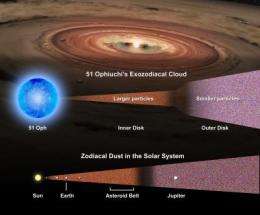
This diagram compares 51 Ophiuchi and its dust disks to the sun, planets and zodiacal dust in the solar system. Zones with larger dust grains are red; those with smaller grains are blue. Planet sizes are not to scale. Credit: NASA/GSFC/Marc Kuchner and Francis Reddy

Astronomers using the twin 10-meter telescopes at the W. M. Keck Observatory in Hawaii have explored one of the most compact dust disks ever resolved around another star. If placed in our own solar system, the disk would span about four times Earth's distance from the sun, reaching nearly to Jupiter's orbit. The compact inner disk is accompanied by an outer disk that extends hundreds of times farther.

The centerpiece of the study is the Keck Interferometer Nuller (KIN), a device that combines light captured by both of the giant telescopes in a way that allows researchers to study faint objects otherwise lost in a star's brilliant glare. "This is the first compact disk detected by the KIN, and a demonstration of its ability to detect dust clouds a hundred times smaller than a conventional telescope can see," said Christopher Stark, an astronomer at NASA's Goddard Space Flight Center in Greenbelt, Md., who led the research team.

By merging the beams from both telescopes in a particular way, the KIN essentially creates a precise blind spot that blocks unwanted starlight but allows faint adjacent signals - such as the light from dusty disks surrounding the star - to pass through.

In April 2007, the team targeted 51 Ophiuchi, a young, hot, B-type star about 410 light-years away in the constellation Ophiuchus. Astronomers suspect the star and its disks represent a rare, nearby example of a young planetary system just entering the last phase of planet formation, although it is not yet known whether planets have formed there.

"Our new observations suggest 51 Ophiuchi is a beautiful protoplanetary system with a cloud of dust from comets and asteroids extremely close to its ," said Marc Kuchner, an astronomer at Goddard and a member of the research team.

Planetary systems are surprisingly dusty places. Much of the dust in our forms inward of Jupiter's orbit, as comets crumble near the sun and asteroids of all sizes collide. This dust reflects sunlight and sometimes can be seen as a wedge-shaped sky glow - called the zodiacal light - before sunrise or after sunset.

Dusty disks around other stars that arise through the same processes are called "exozodiacal" clouds. "Our study shows that 51 Ophiuchi's disk is more than 100,000 times denser than the zodiacal dust in the solar system," explained Stark." This suggests that the system is still relatively young, with many colliding bodies producing vast amounts of dust."

To decipher the structure and make-up of the star's dust clouds, the team combined KIN observations at multiple wavelengths with previous studies from NASA's Spitzer Space Telescope and the European Southern Observatory's Very Large Telescope Interferometer in Chile.

The inner disk extends about 4 Astronomical Units (AU) from the star and rapidly tapers off. (One AU is Earth's average distance from the sun, or 93 million miles.) The disk's infrared color indicates that it mainly harbors particles with sizes of 10 micrometers - smaller than a grain of fine sand - and larger.

The outer disk begins roughly where the inner disk ends and reaches about 1,200 AU. Its infrared signature shows that it mainly holds grains just one percent the size of those in the inner disk - similar in size to the particles in smoke. Another difference: The outer disk appears more puffed up, extending farther away from its orbital plane than the inner disk.

"We suspect that the inner disk gives rise to the outer disk," explained Kuchner. As and collisions produce dust, the larger particles naturally spiral toward the star. But pressure from the star's light pushes smaller particles out of the system. This process, which occurs in our own solar system, likely operates even better around 51 Ophiuchi, a star 260 times more luminous than the sun.

The findings appear in the October 1 issue of The Astrophysical Journal.

Source: NASA/Goddard Space Flight Center

4.7 /5 (6 votes)  

Filter


Move the slider to adjust rank threshold, so that you can hide some of the comments.


Display comments: newest first

omatumr
Sep 25, 2009

Rank: 2 / 5 (2)
Intriguing Discovery; Next Questions:

1. Is the inner disk made of Fe, Si, O, Ni and S like here in the solar system?

2. Is the outer disk made of lightweight elements (H, He, C, and N) like here?

With kind regards,
Oliver K. Manuel
Rank 4.7 /5 (6 votes)
Relevant PhysicsForums posts
  • Never ending outer space.....
    created13 hours ago
  • Neutron Star fragments?
    created15 hours ago
  • stationary or not?
    created19 hours ago
  • Scale of the Universe
    createdFeb 10, 2012
  • Titan's lack of impact craters
    createdFeb 09, 2012
  • Real pictures of black hole eating a star?
    createdFeb 08, 2012
  • More from Physics Forums - General Astronomy

More news stories

Latin America mining boom clashes with conservation

Latin America is experiencing a mining boom as prices rise fuelled by a hike in global demand, but the region is also being hit by a wave of violent protests, strikes and rallies by environmentalists.

Space & Earth / Environment

created 6 hours ago | popularity not rated yet | comments 0

Political leaders play key role in how worried Americans are by climate change: study

More than extreme weather events and the work of scientists, it is national political leaders who influence how much Americans worry about the threat of climate change, new research finds.

Space & Earth / Environment

created Feb 06, 2012 | popularity 5 / 5 (6) | comments 72

NASA budget will axe Mars deal with Europe: scientists

US President Barack Obama's budget proposal to be submitted next week for 2013 will cut NASA's budget by 20 percent and eliminate a major partnership with Europe on Mars exploration, scientists said Thursday.

Space & Earth / Space Exploration

created Feb 10, 2012 | popularity 5 / 5 (3) | comments 55

Humans may have helped the decline of African rainforests 3000 years ago

(PhysOrg.com) -- Large areas of rainforests in Central Africa mysteriously disappeared over three thousand years ago, to be replaced by savannas. The prevailing theory has been that the cause was a change ...

Space & Earth / Environment

created Feb 10, 2012 | popularity 4.1 / 5 (14) | comments 20 | with audio podcast report

Study shows global glaciers, ice caps, shedding billions of tons of mass annually

Earth's glaciers and ice caps outside of the regions of Greenland and Antarctica are shedding roughly 150 billion tons of ice annually, according to a new study led by the University of Colorado Boulder.

Space & Earth / Earth Sciences

created Feb 08, 2012 | popularity 4.4 / 5 (9) | comments 14 | with audio podcast


Google might launch Drive for cloud storage soon

(PhysOrg.com) -- Google's next big move, according to the Wall Street Journal, is a cloud storage service called Drive. Hardly first to the plate, Google is simply catching up to introducing its cloud reposi ...

Love a click away in Indonesia's Twitter Republic

He was a geeky kid from Yogyakarta, she a glamorous city girl in Jakarta. In a country with one of the world's most vibrant social networking scenes they fell in love on Twitter.

Europeans protest controversial Internet pact

Tens of thousands of people marched in protests in more than a dozen European cities Saturday against a controversial anti-online piracy pact that critics say could curtail Internet freedom.

Walney offshore wind farm is world's biggest (for now)

(PhysOrg.com) -- The Walney wind farm on the Irish Sea--characterized by high tides, waves and windy weather--officially opened this week. The farm is treated in the press as a very big deal as the Walney ...

Navy to begin tests on electromagnetic railgun prototype launcher

The Office of Naval Research (ONR)'s Electromagnetic (EM) Railgun program will take an important step forward in the coming weeks when the first industry railgun prototype launcher is tested at a facility ...

Explained: Sigma

It's a question that arises with virtually every major new finding in science or medicine: What makes a result reliable enough to be taken seriously? The answer has to do with statistical significance -- but ...