Gulf fritillary is back
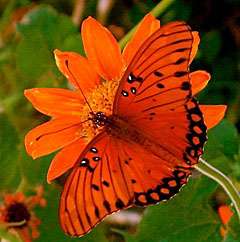
(PhysOrg.com) -- A showy butterfly with bright orange-red wings and a 4-inch wingspan is back in the Sacramento metropolitan area after a four-decade absence and in the Davis area after 30 years.
"The Gulf fritillary has returned, and it's even breeding in midtown Sacramento," said Arthur Shapiro, a professor and butterfly expert at the University of California, Davis.
The Gulf fritillary (Agraulis vanilla) is one of the showiest butterflies in California, he said. "It has long, narrow bright orange-red wings with black spots on the upper surface. But it's the underside that shines: it's spangled in iridescent silver. Nothing else in the region looks like it."
Entomologist Lynn Kimsey, director of the Bohart Museum of Entomology and professor and vice chair of the UC Davis Department of Entomology, remembers collecting it as a child growing up in the Bay Area.
"I also collected it in the Ragged Island in the Bahamas, off the coast of Cuba, and have seen it in the southern United States."
The Bohart Museum, 1124 Academic Surge, UC Davis, is home to some 7 million insect specimens, including several Gulf frits.
"The Gulf fritillary is a tropical and subtropical butterfly, whose range extends from the southern United States all the way to central Argentina," said Shapiro, a professor of evolution and ecology. "As a spiny orange-and-black caterpillar, it feeds only on passion flower leaves, eating many but not all species of the genus Passiflora. There are no native members of this genus in the state of California, but several are widely cultivated in gardens."
The butterfly can breed where there is a "critical mass" of these plants in a town or neighborhood, he said.
Retired attorney and amateur photographer Estelita Levy photographed the Gulf frit (see photo) on Sept. 14 in midtown Sacramento. It was nectaring a Mexican sunflower (Tithonia rotundifolia) in her yard.
"The Gulf frits love it (Tithonia),” said Levy, a founder of the Friends of the Riverbanks, an organization that guides children and others on nature walks along the American River banks. "I have decided that maybe it is a love thing because they and the flowers are the very same shade of deep bright orange. There are often several of them on the plant at one time."
"We don’t know how the Gulf fritillary got into California," Shapiro said, "but it was already in the San Diego area by about 1875. The first record in the San Francisco Bay Area was around 1908, but the species does not seem to have become solidly established before the early 1950s, when it was breeding in Berkeley and Hayward. It is still a common sight in the East and parts of the South Bay, and occasionally elsewhere in the Bay Area. It has bred in Fairfield on a few occasions since the 1970s."
Inland, it somehow colonized both South Sacramento and the Winding Way-Auburn Boulevard area and bred for a while in the 1960s, but was apparently extinct or nearly so when Shapiro moved to the area in 1971. "I had one record in Davis and one in North Sacramento in the early 1970s, and then no more," he said.
Then, about five years ago, singletons began cropping up in eastern Sacramento County, usually in suburban neighborhoods but also along the American River Parkway. Numbers exploded in late summer 2008, with caterpillars reported in a variety of locations. By October it was confirmed in Folsom, Rancho Cordova, Citrus Heights, Fair Oaks, Carmichael and Arden Arcade and had crossed the county line into Roseville.
And then on Oct. 7, 2008 — Davis resident Gary Zamzow discovered it at the West Davis Pond — it made its first spontaneous Davis occurrence in about 30 years. It’s been seen at least once in Davis in 2009, Shapiro said.
On Aug. 24 of this year, Shapiro recorded his first Gulf fritillary in North Sacramento since 1973. Also on Aug. 24, botanist and Midtown resident Carol Witham caught one in her garden near 37th and J streets.
Shapiro set up an e-mail network among friends in the area, and “sightings have been pouring in ever since,” he said. Shapiro sighted three different individuals along the American River Parkway near Gold River on Sept. 15. “This is significant because there are no host plants along the parkway, so seeing this many in one day there implies significant garden breeding in the nearby neighborhood of Gold River.”
The Gulf fritillary probably is inedible to birds and is easy to approach, photograph and even capture by hand, Shapiro said. Females are larger than males and duller in color above. Adults live for several weeks and breeding occurs year-round. As a tropical species, this butterfly has no true winter dormancy and will be eradicated if the temperature falls to about 22° Fahrenheit, Shapiro said. "It has managed to survive several severe freezes in the Bay Area, but must be regarded as in constant jeopardy of being frozen out of its Central Valley outposts."
The eggs are laid close together and the caterpillars feed more or less communally, Shapiro said. "They make no effort to hide and are presumably distasteful." They are orange with slate-gray markings and black branching spines. The pupa, or chrysalis, is very long and narrow and hangs upside-down by its tail. It wiggles violently if disturbed. A generation takes five or six weeks in warm weather. The adults visit butterfly bush (Buddleia davidii), lantana (genus Lantana) and other good nectar sources in the garden.
The Gulf fritillary is one of several species being mass-reared commercially for release at outdoor events like weddings and garden parties. "The recent invasion of the Sacramento area may have been triggered by such releases, but we know it came once before when that practice had not been invented yet," Shapiro said. "It is a harmless and esthetically pleasing addition to the urban and suburban environment, and comes at a time when many of our native butterflies are disappearing."
Provided by University of California


