Getting a leg up on whale and dolphin evolution
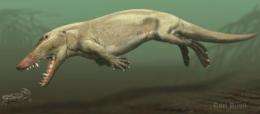
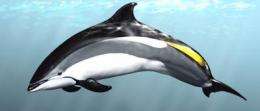
When the ancestors of living cetaceans—whales, dolphins and porpoises—first dipped their toes into water, a series of evolutionary changes were sparked that ultimately nestled these swimming mammals into the larger hoofed animal group. But what happened first, a change from a plant-based diet to a carnivorous diet, or the loss of their ability to walk?
A new paper published this week in PLoS One resolves this debate using a massive data set of the morphology, behavior, and genetics of living and fossil relatives. Cetacean ancestors probably moved into water before changing their diet (and their teeth) to include carnivory; Indohyus, a 48-million year-old semi-aquatic herbivore, and hippos fall closest to cetaceans when the evolutionary relationships of the larger group are reconstructed.
"If you only had living taxa to figure out relationships within this group of animals, you would miss a large amount of diversity and part of the picture of what is going on," says Michelle Spaulding, lead author of the study and a graduate student affiliated with the American Museum of Natural History. "Indohyus is interesting because this fossil combines an herbivore's dentition with adaptations such as ear bones that are adapted for hearing under water and are traditionally associated with whales only."
The origin of whales, dolphins, and porpoises—with their highly modified legs and lack of hair—has long been a quandary for mammalogists. About 60 years ago, researchers first suggested that cetaceans were related to plant-eating ungulates, specifically to even-toed, artiodactyl mammals like sheep, antelope and pigs. In other words, carnivorous killer whales and fish-eating dolphins were argued to fit close to the herbivorous hoofed animal group. More recent genetic research found that among artiodactyls, hippos are the cetaceans' closest living relatives.
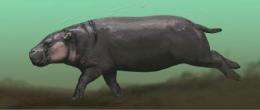
Because no one would ever link hippos and whales based on their appearance, fossil evidence became an important way to determine the precise evolutionary steps that cetacean ancestors took. Traditionally, the origin of whales was linked to the mesonychids, an extinct group of carnivores that had singly-hoofed toes. The recent discovery of Indohyus, a clearly water-adapted herbivore, complicates this picture (as new fossils often do) because of ear bones similar to those of modern cetaceans, which are theorized to help the animal have heard better while under the water.
To tease apart different potential evolutionary histories (whether carnivory or water adaptations occurred first; the mesonychid or Indohyus relatedness ideas), Spaulding and colleagues mapped the evolutionary relationships among more than 80 living and fossil taxa (in other words, species and/or genera). These taxa were scored for 661 morphological and behavioral characters (such as presence of hair or the shape of and ankle bone). Forty-nine new DNA sequences from five nuclear genes were also added to the mix of more than 47,000 characters; both morphological and genetic data build on previous analyses by authors Maureen O'Leary of Stony Brook University and John Gatesy of University of California at Riverside. In addition, Indohyus, carnivores (dogs and cats), and an archaic group of meat-eating mammals called creodonts were included.
The team found that the least complex evolutionary tree places Indohyus and similar fossils close to whales, while mesonychids are more distantly related. Hippos remain the closest living relatives. These results suggest that cetacean ancestors transitioned to water before becoming carnivorous but that the meat-eating diet developed while these ancestors could still walk on land.
"How do you put flesh and movement onto a fossil?" asks author O'Leary. "The earliest stem whale probably ate prey in water while still being able to walk on land. Indohyus has some adaptations for hearing under water but also ate plants, while Ambulocetus (a walking whale that lived about 50 million years ago) seems to have been carnivorous."
"There is deep conflict in the evolutionary tree," says Spaulding. "The backbone of the tree is robust and stable, but you have these fairly large clades that move around relative to this backbone(Indohyus and mesonychids) We need to really re-examine characters carefully and see what suite of traits are the truly derived in different taxa to fully resolve this tree."
Source: American Museum of Natural History


