New model suggests how the brain might stay in balance
September 24, 2009 Brain

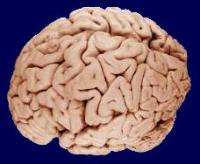
Image source: University of Wisconsin and Michigan State Comparative Mammalian Brain Collections and the National Museum of Health and Medicine.

(PhysOrg.com) -- Physicists have theorized for decades about how neural networks might be able to accomplish the incredibly complex calculations the human brain performs all the time. But simply stabilizing such a powerful organic computer made up of 100 billion neurons and trillions of interconnections is no small matter. A new model proposes that the brain could use about half of its connections just to maintain a delicate balance of excitation and inhibition. And keep from going haywire.

The human is made up of 100 billion — live wires that must be kept in delicate balance to stabilize the world’s most magnificent computing organ. Too much excitement and the network will slip into an apoplectic, uncomprehending chaos. Too much inhibition and it will flatline. A new describes how the trillions of interconnections among neurons could maintain a stable but dynamic relationship that leaves the brain sensitive enough to respond to stimulation without veering into a blind seizure.

Marcelo O. Magnasco, head of the Laboratory of Mathematical Physics at The Rockefeller University, and his colleagues developed the model to address how such a massively complex and responsive network such as the brain can balance the opposing forces of excitation and inhibition. His model’s key assumption: Neurons function together in localized groups to preserve stability. “The defining characteristic of our system is that the unit of behavior is not the individual neuron or a local but rather groups of neurons that can oscillate in synchrony,” Magnasco says. “The result is that the system is much more tolerant to faults: Individual neurons may or may not fire, individual connections may or may not transmit information to the next neuron, but the system keeps going.”

Magnasco’s model differs from traditional models of neural networks, which assume that each time a neuron fires and stimulates an adjoining neuron, the strength of the connection between the two increases. This is called the Hebbian theory of synaptic plasticity and is the classical model for learning. “But our system is anti-Hebbian,” Magnasco says. “If the connections among any groups of neurons are strongly oscillating together, they are weakened because they threaten homeostasis. Instead of trying to learn, our neurons are trying to forget.” One advantage of this anti-Hebbian model is that it balances a network with a much larger number of degrees of freedom than classical models can accommodate, a flexibility that is likely required by a computer as complex as the brain.

In work published this summer in Physical Review Letters, Magnasco theorizes that the connections that balance excitation and inhibition are continually flirting with instability. He likens the behavior to an indefinitely large number of public address systems tweaked to that critical point at which a flick of the microphone brings on a screech of feedback that then fades to quiet with time.

This model of a balanced neural network is abstract — it does not try to recreate any specific neural function such as learning. But it requires only half of the network connections to establish the homeostatic balance of exhibition and inhibition crucial to all other brain activity. The other half of the network could be used for other functions that may be compatible with more traditional models of , including Hebbian learning, Magnasco says.

Developing a systematic theory of how neurons communicate could provide a key to some of the basic questions that researchers are exploring through experiments, Magnasco hopes. “We’re trying to reverse-engineer the brain and clearly there are some concepts we’re missing,” he says. “This model could be one part of a better understanding. It has a large number of interesting properties that make it a suitable substrate for a large-scale computing device.”

More information: Physical Review Letters 102, 258102 (2009); Self-tuned critical anti-Hebbian networks; Marcelo O. Magnasco, Oreste Piro and Guillermo A. Cecchi

Provided by Rockefeller University (news : web)


Rate this story - 3.9 /5 (8 votes)

Rank Filter

Move the slider to adjust rank threshold, so that you can hide some of the comments.


Display comments: newest first

  • zevkirsh - Sep 24, 2009
    • Rank: not rated yet
    sounds like anti-hebbian is modeling a model of anti-epileptic.

    perhaps it should model itself more like the behavior of nueron oscillation is the sleep consolidation phase.
  • ormondotvos - Sep 25, 2009
    • Rank: 4 / 5 (1)
    Sounds like Doug Hofstadter was on the right track with the "I am a strange loop" theory about self-referential systems...
  • ZenaV - Sep 25, 2009
    • Rank: 4 / 5 (1)
    The brain is soooo complicated and doctors still don't understand it but a brain surgeon saved my life when I had a brain anuerism. Even SHE was shocked when I came back to my original mind instead of learning how to talk and think again like most patients have to do with this problem. But they have come a long way. A few years ago I would have died because they didn't know how to deal with it a few years ago. Clearly ALL brains are improving and I've come to know mine in a new way!

September 24, 2009 all stories

Comments: 3

3.9 /5 (8 votes)

  • hide
  • Related Stories

  • Neural modeling helps expose epilepsy's triggers
    created Feb 16, 2009 | popularity not rated yet | comments 0
  • Brain encodes complex plumes of odors with a simple code
    created Feb 25, 2009 | popularity not rated yet | comments 0
  • When neurons fire up: Study sheds light on rhythms of the brain
    created Aug 05, 2008 | popularity not rated yet | comments 0
  • New Discovery Could Rejuvenate the Brain
    created Dec 18, 2008 | popularity not rated yet | comments 0
  • Two Brains - One Thought
    created Jan 31, 2007 | popularity not rated yet | comments 0


  • hide
  • Relevant PhysicsForums posts

  • shannon entropy problem
    created 1hour ago
  • A simple logarithmic equation
    created 2 hours ago
  • Regressions without calculator
    created 18 hours ago
  • please help
    created Feb 09, 2010
  • Angles of a quadrilateral
    created Feb 08, 2010
  • How can we know how many solutions an equation has?
    created Feb 08, 2010
  • More from Physics Forums - General Math

Other News

Study challenges bird-from-dinosaur theory of evolution - was it the other way around?

Study challenges bird-from-dinosaur theory of evolution - was it the other way around?

Other Sciences / Archaeology & Fossils

created 17 hours ago | popularity 3.8 / 5 (12) | comments 5 | with audio podcast

(PhysOrg.com) -- A new study just published in the Proceedings of the National Academy of Sciences provides yet more evidence that birds did not descend from ground-dwelling theropod dinosaurs, experts say, a ...


New research reveals burglars have changed their 'shopping list'

Other Sciences / Social Sciences

created 5 hours ago | popularity 3.5 / 5 (2) | comments 3

Globalisation, and particularly cheaper electronic goods from China and the Far East, has altered behaviour among Britain's burglars according research in progress at the University of Leicester.


TED takes on 'What the world needs now'

Other Sciences / Other

created 5 hours ago | popularity not rated yet | comments 0

Let the mind-bending begin! A TED conference that attracts brilliant minds and challenges them to solve humanity's ills got underway Tuesday in the southern California city of Long Beach.


'Counterfactual' thinkers are more motivated and analytical, study suggests

Other Sciences / Social Sciences

created 20 hours ago | popularity 4.4 / 5 (5) | comments 7 | with audio podcast

(PhysOrg.com) -- "If only I had..." Almost everyone has said those four words at some time. Rather than intensifying regret, '"what if" reflection about pivotal moments in the past helps people to weave a coherent life story, ...


Office romance? Not a problem most of time: study

Office romance? Not a problem most of time: study

Other Sciences / Social Sciences

created 19 hours ago | popularity not rated yet | comments 1

(PhysOrg.com) -- Pam and Jim on The Office. Meredith and McDreamy on Grey's Anatomy. Television shows depict many workplace romances, but in the real world how do co-workers view love on the job? According ...