First underwater observatory live online
September 24, 2009 First underwater observatory live online

Enlarge

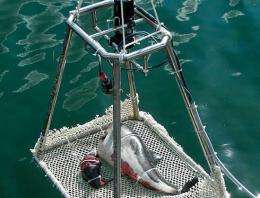
This underwater observatory is the first to show images live online. It is being put into position 30m under the sea in western Sweden and scientists are studying the scavengers that feed off this whale carcass.

(PhysOrg.com) -- Scientists, including those from the Natural History Museum, have developed the world's first underwater observatory connected to the internet.

Scientists, including those from the Natural History Museum, have developed the world's first underwater observatory connected to the internet, creating a window into the ocean, one of the least-studied environments on our planet.

Live images are streamed online from the observatory under the sea, which means scientists anywhere in the world are now able to study processes in real-time, helping them better understand how marine ecosystems work.

The system was created by a team from the Natural History Museum, University of Gothenburg, Maritime Museum and Aquarium Gothenburg, Scottish Association of , OceanLab Aberdeen, and Bangor University.

Natural History Museum marine biologist Adrian Glover showed the live stream of the observatory at the Museum's grand opening of the new Darwin Centre last week with special guests Prince William and Sir David Attenborough. The state-of-the-art building lets the public get a glimpse of some of the important science research that happens at the Museum.

Current underwater studies

The observatory is currently 30m underwater in a fjord on the west coast of Sweden at the Sven Loven Centre for Marine Sciences. It is beaming images of a community of scavenging creatures living on the remains of a dead whale.

'Even something simple like the decomposition of a small whale in shallow water is very poorly known,' says Glover.

'Until now, we had to make do with 'one-off' visits using submersibles, remotely operated-vehicles or scuba divers.'

Glover is currently studying the feeding behaviour of scavenging animals that feed on the carcass. He is also hoping to study the colonisation of the bones by the bone-eating worms from the genus Osedax, one species of which he discovered in 2005.

How the observatory works

The underwater observatory is made up of a video camera and instruments that are mounted onto a frame. Video data is sent live along cables to the observatory 'node', a type of communications hub that is in a hut on a nearby island. The node is powered and connected to the internet by fibre-optic cables.

Technology advances in the cabling and underwater instruments enabled this system to work whereas a few years ago it wouldn't have been possible. However, there were some hurdles to overcome along the way, from problems with computer software and flooding of the camera housing, to a sudden infestation of barnacles!

Future use of observatory

The observatory is designed so that it can be used in potentially much greater ocean depths. 'If we are successful in raising funds, we would like to deploy our observatory in the deep sea using a remotely-operated vehicle' says Glover.

'We know even less about processes in the deep sea, and a network of observatories like these could revolutionise our perception of the marine environment.’

More information: Underwater observatory live video stream: http://www.kmf.gu.se/bildcenter/kamera2/

Provided by American Museum of Natural History (news : web)


print this article email this article download pdf blog this article bookmark this article     Stumble it Digg this share on Facebook retweet share on Reddit add to delicious
Rate this story - 4.6 /5 (5 votes)


September 24, 2009 all stories

Comments: 0

4.6 /5 (5 votes)
  • Stumble this up

  • Digg this

  • share this

  • hide
  • Related Stories

  • Li-Air: Argonne opens new chapter in battery research (w/ Video)
    created Sep 23, 2009 | popularity not rated yet | comments 0
  • Video: Swine flu health tips
    created Apr 30, 2009 | popularity not rated yet | comments 0
  • Two Robot Chefs Make Omelets
    created Dec 04, 2008 | popularity not rated yet | comments 0
  • 'Curtain twitching' skylarks keep track of strangers through their songs (w/ Video)
    created Aug 26, 2009 | popularity not rated yet | comments 0
  • Security Alert: Beware of SMS Messages That Can Take Control of Your Phone
    created Apr 20, 2009 | popularity not rated yet | comments 0


  • hide
  • Relevant PhysicsForums posts

  • The IPCC and the term "most"
    created Nov 23, 2009
  • Is global warming a fact?
    created Nov 23, 2009
  • Random variability of wind patterns
    created Nov 23, 2009
  • Record precipitation in the UK
    created Nov 22, 2009
  • How to move cloud from one time to another..
    created Nov 22, 2009
  • Which countries around the world cause the most destruction to the rain forest
    created Nov 21, 2009
  • More from Physics Forums - Earth

Other News

Mars Reconnaissance Orbite

Mars Reconnaissance Orbite Team Plans Uplink of Protective Files

Space & Earth / Space Exploration

created 1hour ago | popularity not rated yet | comments 0

(PhysOrg.com) -- The team operating NASA's Mars Reconnaissance Orbiter plans to uplink protective files to the spacecraft next week as one step toward resuming the orbiter's research and relay activities.


America's increasing food waste is laying waste to the environment

Space & Earth / Environment

created 3 hours ago | popularity not rated yet | comments 0

Food waste contributes to excess consumption of freshwater and fossil fuels which, along with methane and carbon dioxide emissions from decomposing food, impacts global climate change. In a new paper published in the open-access, ...


Shuttle Atlantis leaves space station, headed home (AP)

Shuttle Atlantis leaves space station, headed home

Space & Earth / Space Exploration

created 3 hours ago | popularity not rated yet | comments 0

(AP) -- Atlantis and its seven astronauts have left the International Space Station.


First black holes may have incubated in giant, starlike cocoons, says CU-Boulder study

First black holes may have incubated in giant, starlike cocoons

Space & Earth / Astronomy

created 19 hours ago | popularity 4.4 / 5 (10) | comments 15

(PhysOrg.com) -- The first large black holes in the universe likely formed and grew deep inside gigantic, starlike cocoons that smothered their powerful x-ray radiation and prevented surrounding gases from ...


Cassini Captures Ghostly Dance of Saturn's Northern Lights

Cassini Captures Ghostly Dance of Saturn's Northern Lights (w/ Video)

Space & Earth / Space Exploration

created 16 hours ago | popularity 5 / 5 (7) | comments 1

(PhysOrg.com) -- In the first video showing the auroras above the northern latitudes of Saturn, Cassini has spotted the tallest known "northern lights" in the solar system, flickering in shape and brightness ...