New research may lead to revolutionary new devices
September 25, 2009 New research may lead to revolutionary new devices

Enlarge

Credit: Adam Tsen, Cornell University

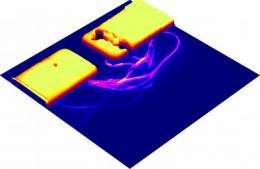
Dr. Jiwoong Park of Cornell University, who receives funding for basic research from the Air Force Office of Scientific Research (AFOSR), is investigating carbon nanostructures that may some day be used in electronic, thermal, mechanical and sensing devices for the Air Force.

"Devices that are required in many of the Air Force missions are somewhat different from commercial ones in the sense that they are often exposed to harsh environments while maintaining their maximum performance," Park said. "Carbon-based nanostructures, including carbon nanotubes and graphenes (thin layers of graphite) present many exciting properties that may lead to new device structures."

Park's team of researchers is examining single molecules, nanocrystals, nanowires, carbon nanotubes and their arrays in an effort to find a "bridging" material that has a stable structure for making molecular-level bonds. In addition, they are seeking an effective tool for resolving functional and structural challenges. If successful, they will be able to apply the research to future technological advances.

Park's research may contribute to the discovery of new electronic and that will revolutionize electrical engineering and bioengineering as well as physical and materials science.

As a result of Park's highly innovative work, the U.S. government has selected him to be a 2008 PECASE (Presidential Early Career Award in Science and Engineering) Award winner. The prestigious and much sought after award is the highest honor the government presents to promising scientists and engineers at the beginning of their careers. Each award winner receives a citation, a plaque, and up to $1 million in funding from the nominating agency (AFOSR).

"I fully expect that over the five-year period of the PECASE award, Professor Park will have established himself as a world leader in and graphene research," said Dr. Harold Weinstock, the AFOSR program manager responsible for nominating Park.

Source: Air Force Office of Scientific Research


print this article email this article download pdf blog this article bookmark this article     Stumble it Digg this share on Facebook retweet share on Reddit add to delicious
Rate this story - 4.3 /5 (7 votes)

Rank Filter

Move the slider to adjust rank threshold, so that you can hide some of the comments.


Display comments: newest first

  • sams - Sep 25, 2009
    • Rank: not rated yet
    "New research may lead to revolutionary new devices" - running out of headline ideas?

September 25, 2009 all stories

Comments: 1

4.3 /5 (7 votes)
  • Stumble this up

  • Digg this

  • share this

  • hide
  • Related Stories


  • hide
  • Relevant PhysicsForums posts

Other News

Using superconducting probes to get a picture of what it's like inside CNTs

Nanotechnology / Nanophysics

created Nov 20, 2009 | popularity 4.9 / 5 (7) | comments 0

(PhysOrg.com) -- "Carbon nanotubes are exciting for fundamental physics, and for potential technological applications," Nadya Mason tells PhysOrg.com. "However, we are generally limited in the way that we can study them. ...


Nanoparticles used in common household items caused genetic damage in mice

Nanotechnology / Bio & Medicine

created Nov 16, 2009 | popularity 4.7 / 5 (22) | comments 11

Titanium dioxide (TiO2) nanoparticles, found in everything from cosmetics to sunscreen to paint to vitamins, caused systemic genetic damage in mice, according to a comprehensive study conducted by researchers at UCLA's Jonsson ...


Nanotube defects equal better energy and storage systems

Nanotube defects equal better energy and storage systems

Nanotechnology / Nanomaterials

created Nov 19, 2009 | popularity 4.4 / 5 (9) | comments 2

(PhysOrg.com) -- Most people would like to be able to charge their cell phones and other personal electronics quickly and not too often. A recent discovery made by UC San Diego engineers could lead to carbon ...


When It Comes to Drug Delivery, Size Matters

Nanotechnology / Bio & Medicine

created Nov 20, 2009 | popularity 5 / 5 (1) | comments 0

(PhysOrg.com) -- One of the great promises of nanotechnologies lies in its ability to create drug-containing nanoparticles decorated with targeting molecules that recognize and bind to cancer cells, providing drug delivery ...


Scientists synthesize graphene-like material: Polymer with honeycomb structure

Scientists synthesize graphene-like material: Polymer with honeycomb structure

Nanotechnology / Nanomaterials

created Nov 19, 2009 | popularity 4.5 / 5 (6) | comments 1

Two-dimensional carbon layers, so-called graphenes, are regarded as a possible substitute for silicon in the semiconductor industry. The electronic properties of these layers can be varied by "building in" ...