Palau creates world's first shark sanctuary
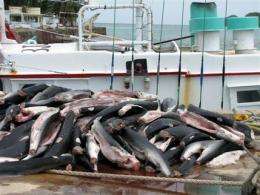
(AP) -- The tiny Pacific nation of Palau is creating the world's first shark sanctuary, a biological hotspot to protect great hammerheads, leopard sharks, oceanic whitetip sharks and more than 130 other species fighting extinction in the Pacific Ocean.
But with only one boat to patrol 240,000 square miles (621,600 square kilometers) of Palau's newly protected waters - including its exclusive economic zone, or EEZ, that extends 200 miles (320 kilometers) from its coastline - enforcement of the new measure could be almost like swimming against the tide.
Palau's president, who is to announce the news to the United Nations General Assembly on Friday, acknowledges the difficulty of patrolling ocean waters nearly the size of Texas or France with a single boat. But he hopes others will respect Palauan territorial waters - and that the shark haven inspires more such conservation efforts globally.
"Palau will declare its territorial waters and extended economic zone to be the first officially recognized sanctuary for sharks," Palauan President Johnson Toribiong told the Associated Press in an interview Thursday.
Shark fishing has grown rapidly since the mid-1980s, driven by a rising demand - mainly in China - for shark fin soup, a highly prized symbol of wealth. Because of their long life spans and low fertility rates, sharks are vulnerable to overfishing.
Within its EEZ, a nation may regulate fisheries and scientific research and develop other economic efforts. The U.N.'s Food and Agriculture Organization estimates more than half of highly migratory sharks are overexploited or depleted.
Toribiong said a recent flyover by Australian aircraft showed more than 70 vessels fishing Palau's waters, many of them illegally.
"We'll do the very best we can, given our resources," he said. "The purpose of this is to call attention to the world to the killing of sharks for commercial purposes, including to get the fins to make shark fin soups, and then they throw the bodies in the water."
Tourists go to Palau for its spectacular diving in the tropical waters, dramatic coral and rich marine life. The remote Pacific nation recently made global headlines when it agreed to President Barack Obama's request to take a group of Uighurs - Turkic Muslims from China's far western Xinjiang region - as part of plans to close the Guantanamo Bay detention center.
Palau is one of the world's smallest countries, with some 20,000 people scattered over 190-square mile (490-square kilometer) archipelago of lush tropical landscapes in the Western Pacific.
Its shark sanctuary will shelter more than 135 Western Pacific species of sharks and rays considered endangered or vulnerable, or for which there is not enough data to determine how the species is faring.
"Palau has basically raised the bar for the rest of the world for shark conservation," said Matt Rand, director for global shark conservation for Washington-based Pew Environment Group, an advocacy organization.
Elsewhere, Europe is trying to crack down on shark fishing in its waters.
In February, the European Commission proposed its first-ever shark conservation rules for European waters. EU countries account for a third of shark meat exports globally, and shark steaks are increasingly served in restaurants, replacing pricier swordfish steaks, and shark products are also finding their way into lotions and leather sports shoes.
Toribiong said he also will call for a global moratorium on "shark finning" - the practice of hacking off shark fins and throwing the body back into the sea - and an end to unregulated and destructive bottom trawling on the high seas.
Palau is among 20 seafaring nations that already have voluntary agreed to end bottom trawling, which involves fishing boats that drag giant nets along the sea floor.
Enormously effective at catching fish, the nets from bottom trawling also wipe out almost everything in their path, smash coral and stir clouds of sediment that smother sea life, marine experts say.
The U.N. has called bottom trawling a danger to unique and unexplored ecological systems and said slightly more than half the underwater mountain and coral ecosystems in the world can be found beyond the protection of national boundaries.
©2009 The Associated Press. All rights reserved. This material may not be published, broadcast, rewritten or redistributed.


