Origin of birds confirmed by exceptional new dinosaur fossils

September 25, 2009 Origin of birds confirmed by exceptional new dinosaur fossils

(PhysOrg.com) -- Chinese scientists today reveal the discovery of five remarkable new feathered dinosaur fossils which are significantly older than any previously reported. The new finds are indisputably older than Archaeopteryx, the oldest known bird, at last providing hard evidence that birds evolved from dinosaurs.

Talking from the conference in Bristol, Dr Xu Xing, lead scientist on the report published online in Nature today, said: “These exceptional fossils provide us with evidence that has been missing until now. Now it all fits neatly into place and we have tied up some of the loose ends”.

Professor Michael Benton, from the University of Bristol and one of the world’s leading experts on dinosaurs, commented: “This is one of the most exciting fossil discoveries in recent years. It’s like finding a missing piece of the jigsaw - suddenly the picture looks much more complete”.

Previous discoveries of dinosaur fossils with exquisitely preserved remains of feathers were undoubtedly some of the most important fossil finds ever made. At the time, many paleontologists considered this to be the Holy Grail that demonstrated once and for all that birds are highly derived dinosaurs.
Origin of birds confirmed by exceptional new dinosaur fossils
However, the oldest undisputed bird, Archaeopteryx, is older than the feathered dinosaurs previously found. Therefore, critics claimed, feathered dinosaurs could not have been ancestral to birds.

The new fossils are from two separate areas, named the Tiaojishan and Daohugou formations. Comparison of the Tiaojishan and Daohugou fossils suggests that they probably all belong to the same fauna. The isotopic dates range from 168 to 151 million years old for the Tiaojishan and 164 to 158 million years for the Daohugou Formation. Archaeopteryx lived 150-145 million years ago, so was significantly younger than these new dinosaurs.

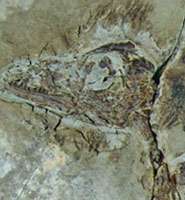
One of the dinosaurs, named Anchiornis huxleyi has extensive plumage and profusely feathered feet. It provides important new information on the origins of birds and the evolution of feathers.

“This fossil provides confirmation that the bird-dinosaur hypothesis is correct and supports the idea that birds descended from theropod dinosaurs, the group of predatory dinosaurs that include Allosaurus and Velociraptor”, said Xu.

Provided by University of Bristol


print this article email this article download pdf blog this article bookmark this article     Stumble it Digg this share on Facebook retweet share on Reddit add to delicious
Rate this story - 4.7 /5 (17 votes)

Rank Filter

Move the slider to adjust rank threshold, so that you can hide some of the comments.


Display comments: newest first

  • hooloovoo - Sep 25, 2009
    • Rank: 3 / 5 (2)
    This is great news. It's just a shame that it won't convince the people who really need convincing, i.e. the dangerous creationist movement in the US.

September 25, 2009 all stories

Comments: 1

4.7 /5 (17 votes)
  • Stumble this up

  • Digg this

  • share this

  • hide
  • Related Stories

  • Ancient Birds Flew On All-Fours
    created Sep 26, 2006 | popularity not rated yet | comments 0
  • Prehistoric bird fossil found in China
    created Dec 15, 2005 | popularity not rated yet | comments 0
  • Beaked, bird-like dinosaur tells story of finger evolution
    created Jun 17, 2009 | popularity not rated yet | comments 0
  • T.rex 'followed its nose' while hunting
    created Oct 29, 2008 | popularity not rated yet | comments 0
  • New fossil bird found
    created May 01, 2008 | popularity not rated yet | comments 0


  • hide
  • Relevant PhysicsForums posts

  • Questions about diffusion
    created 6 hours ago
  • Human Leukocyte Antigen (HLA) typing
    created 13 hours ago
  • Breeding program
    created Nov 20, 2009
  • How does a concentration gradient provide energy?
    created Nov 20, 2009
  • More from Physics Forums - Biology

Other News

Researcher: Faint writing seen on Shroud of Turin (AP)

Researcher: Faint writing seen on Shroud of Turin (Update)

Other Sciences / Archaeology & Fossils

created Nov 20, 2009 | popularity 2.1 / 5 (25) | comments 23

(AP) -- A Vatican researcher has rekindled the age-old debate over the Shroud of Turin, saying that faint writing on the linen proves it was the burial cloth of Jesus. Experts say the historian may be reading ...


Museum: Galileo's fingers, tooth are found (AP)

Museum: Galileo's fingers, tooth are found

Other Sciences / Archaeology & Fossils

created Nov 21, 2009 | popularity 4 / 5 (1) | comments 6

(AP) -- Two fingers and a tooth removed from Galileo Galilei's corpse in a Florentine basilica in the 18th century and given up for lost have been found again and will soon be put on display, an Italian museum ...


Three of a kind

Three of a kind: Revealing language’s universal essence

Other Sciences / Social Sciences

created Nov 20, 2009 | popularity 3.9 / 5 (11) | comments 6

(PhysOrg.com) -- On the surface, English, Japanese, and Kinande, a member of the Bantu family of languages spoken in the Democratic Republic of Congo, have little in common. It is not just that the vocabularies ...


Maya

New insights into the life of the Maya

Other Sciences / Archaeology & Fossils

created Nov 16, 2009 | popularity 4.6 / 5 (15) | comments 7

(PhysOrg.com) -- Ancient artifacts are almost always concerned with rich and powerful religious and political leaders, but new excavations of an ancient Maya site have unearthed a pyramid decorated with murals ...


Only tax increase can cure Illinois budget woes, study says

Other Sciences / Economics

created Nov 18, 2009 | popularity 1 / 5 (1) | comments 3

Tax increases are the only solution to a widening budget crisis that a new study says has landed Illinois among the nation's most financially troubled states, a soon-to-be-released report by a team of University of Illinois ...