Engineers track bacteria's kayak paddle-like motion for first time

September 25, 2009

Yale engineers have for the first time observed and tracked E. coli bacteria moving in a liquid medium with a motion similar to that of a kayak paddle.

Their findings, which appear online September 29 in the journal Physical Review Letters, will help lead to a better understanding of how bacteria move from place to place and, potentially, how to keep them from spreading.

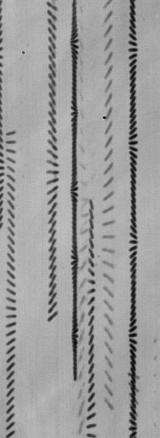
Scientists have long theorized that the cigar-shaped cell bodies of E. coli and other would follow periodic orbits that resemble the motion of a kayak paddle as they drift downstream in a current. Until now, no one had managed to directly observe or track those movements.

Hur Koser, associate professor at Yale's School of Engineering & Applied Science, previously discovered that hydrodynamic interactions between the bacteria and the current align the bacteria in a way that allows them to swim upstream. "They find the most efficient route to migrate upstream, and we ultimately want to understand the mechanism that allows them to do that," Koser said.
Engineers track bacteria's kayak paddle-like motion for first time
Enlarge

The team took sequential images of the E. coli bacteria to track their movements, which resemble the motion of a kayak paddle, through a liquid medium. Credit: Hur Koser/Yale University

In the new study, Koser, along with postdoctoral associate and lead author of the paper, Tolga Kaya, devised a method to see this motion in progress. They used advanced computer and imaging technology, along with sophisticated new algorithms, that allowed them to take millions of high-resolution images of tens of thousands of individual, non-flagellated E. coli drifting in a water and glycerin solution, which amplified the bacteria's paddle-like movements.

The team characterized the bacteria's motion as a function of both their length and distance from the surface. The team found that the longer and closer to the surface they were, the slower the E. coli "paddled."

It took the engineers months to perfect the intricate camera and computer system that allowed them to take 60 to 100 sequential images per second, then automatically and efficiently analyze the huge amount of resulting data.

FLV player

Yale engineers for the first time captured the kayak paddle-like motion of <i>E. coli</i> bacteria "paddling" in a liquid medium. Credit: Hur Koser/Yale University

E. coli and other bacteria can colonize wherever there is water and sufficient nutrients, including the human digestive tract. They encounter currents in many settings, from riverbeds to home plumbing to irrigation systems for large-scale agriculture.

"Understanding the physics of bacterial movement could potentially lead to breakthroughs in the prevention of bacterial migration and sickness," Koser said. "This might be possible through mechanical means that make it more difficult for to swim upstream and contaminate water supplies, without resorting to antibiotics or other chemicals."

Source: Yale University (news : web)


print this article email this article download pdf blog this article bookmark this article     Stumble it Digg this share on Facebook retweet share on Reddit add to delicious
Rate this story - 3 /5 (2 votes)


September 25, 2009 all stories

Comments: 0

3 /5 (2 votes)
  • Stumble this up

  • Digg this

  • share this

  • hide
  • Related Stories

  • Swimming 'to the left' gets bacteria upstream, may promote infection
    created Feb 26, 2007 | popularity not rated yet | comments 0
  • GIANT-Coli: A novel method to quicken discovery of gene function
    created Aug 07, 2008 | popularity not rated yet | comments 0
  • Mixing it up with E. coli
    created Jan 15, 2007 | popularity not rated yet | comments 0
  • Resistant gut bacteria will not go away by themselves
    created Jun 19, 2007 | popularity not rated yet | comments 0
  • A long-sought test for direct detection of disease-causing E. coli bacteria
    created Feb 18, 2008 | popularity not rated yet | comments 0


  • hide
  • Relevant PhysicsForums posts

  • Enthalpy and it's use in Gibb's Free Energy
    created 51 minutes ago
  • Newton Question #2 (centripetal motion)
    created 3 hours ago
  • Microwave vs metallic objects
    created 4 hours ago
  • Newtons law questions (rocket)
    created 6 hours ago
  • More from Physics Forums - General Physics

Other News

Scientists react as they stand in front of a screen at CERN

First atoms reported smashed in Large Hadron Collider (Update)

Physics / General Physics

created Nov 23, 2009 | popularity 4.5 / 5 (30) | comments 21

Two circulating beams on Monday produced the first particle collisions in the world's biggest atom smasher, the Large Hadron Collider (LHC), three days after its restart, scientists announced.


Restored machine to explore mysteries of Big Bang (AP)

Restored machine to explore mysteries of Big Bang

Physics / General Physics

created Nov 21, 2009 | popularity 4.6 / 5 (18) | comments 26

(AP) -- Scientists are preparing the world's largest atom smasher to explore the depths of matter after successfully restarting the $10 billion machine following more than a year of repairs.


nuclear power plant

Doubts raised on nuclear industry viability

Physics / General Physics

created Nov 19, 2009 | popularity 3.1 / 5 (21) | comments 19

(PhysOrg.com) -- The investment in nuclear power has been growing around the world over the last few years, being viewed as a means for countries to control their energy security, avoid the price fluctuations ...


In the Brain, Seven Is A Magic Number

In the Brain, Seven Is A Magic Number

Physics / General Physics

created Nov 23, 2009 | popularity 4.5 / 5 (33) | comments 9

Having a tough time recalling a phone number someone spoke a few minutes ago or forgetting items from a mental grocery list is not a sign of mental decline; in fact, it's natural.


Proton's party pals may alter its internal structure

Proton's party pals may alter its internal structure

Physics / General Physics

created Nov 18, 2009 | popularity 4.6 / 5 (20) | comments 9

A recent experiment at the DOE's Thomas Jefferson National Accelerator Facility has found that a proton's nearest neighbors in the nucleus of the atom may modify the proton's internal structure.