Prototype developed to detect dark matter
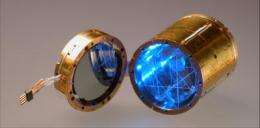
A team of researchers from the University of Zaragoza (UNIZAR, Spain) and the Institut d'Astrophysique Spatiale (IAS, in France) has developed a "scintillating bolometer", a device that the scientists will use in efforts to detect the dark matter of the Universe, and which has been tested at the Canfranc Underground Laboratory in Huesca, Spain.
"One of the biggest challenges in physics today is to discover the true nature of dark matter, which cannot be directly observed - even though it seems to make up one-quarter of the matter of the Universe. So we have to attempt to detect it using prototypes such as the one we have developed", Eduardo García Abancéns, a researcher from the UNIZAR's Laboratory of Nuclear Physics and Astroparticles, tells SINC.
García Abancéns is one of the scientists working on the ROSEBUD project (an acronym for Rare Objects SEarch with Bolometers UndergrounD), an international collaborative initiative between the Institut d'Astrophysique Spatiale (CNRS-University of Paris-South, in France) and the University of Zaragoza, which is focusing on hunting for dark matter in the Milky Way.
The scientists have been working for the past decade on this mission at the Canfranc Underground Laboratory, in Huesca, where they have developed various cryogenic detectors (which operate at temperatures close to absolute zero: −273.15 °C). The latest is a "scintillating bolometer", a 46-gram device that, in this case, contains a crystal "scintillator", made up of bismuth, germinate and oxygen (BGO: Bi4Ge3O12), which acts as a dark matter detector.
"This detection technique is based on the simultaneous measurement of the light and heat produced by the interaction between the detector and the hypothetical WIMPs (Weakly Interacting Massive Particles) which, according to various theoretical models, explain the existence of dark matter", explains García Abancéns.
The researcher explains that the difference in the scintillation of the various particles enables this method to differentiate between the signals that the WIMPs would produce and others produced by various elements of background radiation (such as alpha, beta or gamma particles).
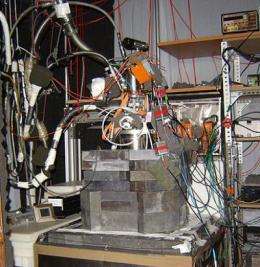
In order to measure the miniscule amount of heat produced, the detector must be cooled to temperatures close to absolute zero, and a cryogenic facility, reinforced with lead and polyethylene bricks and protected from cosmic radiation as it housed under the Tobazo mountain, has been installed at the Canfranc underground laboratory.
"The new scintillating bolometer has performed excellently, proving its viability as a detector in experiments to look for dark matter, and also as a gamma spectrometer (a device that measures this type of radiation) to monitor background radiation in these experiments", says García Abancéns.
The scintillating bolometer is currently at the Orsay University Centre in France, where the team is working to optimise the device's light gathering, and carrying out trials with other BGO crystals.
This study, published recently in the journal Optical Materials, is part of the European EURECA project (European Underground Rare Event Calorimeter Array). This initiative, in which 16 European institutions are taking part (including the University of Zaragoza and the IAS), aims to construct a one-tonne cryogenic detector and use it over the next decade to hunt for the dark matter of the Universe.
Methods of detecting dark matter
Direct and indirect detection methods are used to detect dark matter, which cannot be directly observed since it does not emit radiation. The former include simultaneous light and heat detection (such as the technique used by the scintillating bolometers), simultaneous heat and ionisation detection, and simultaneous light and ionisation detection, such as research into distinctive signals (the most famous being the search for an annual modulation in the dark matter signal caused by the orbiting of the Earth).
There are also indirect detection methods, where, instead of directly seeking the dark matter particles, researchers try to identify other particles, (neutrinos, photons, etc.), produced when the Universe's dark matter particles are destroyed.
More information: N. Coron, E. García, J. Gironnet, J. Leblanc, P. de Marcillac, M. Martínez, Y. Ortigoza, A. Ortiz de Solórzano, C. Pobes, J. Puimedón, T. Redon, M.L. Sarsa, L. Torres y J.A. Villar. "A BGO scintillating bolometer as dark matter detector prototype". Optical Materials 31(10): 1393-1397, 2009
Source: FECYT - Spanish Foundation for Science and Technology


