In The World: A better way to beat around the bush
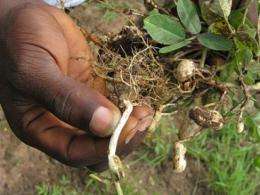
(PhysOrg.com) -- Many residents of New Longoro, a small village in the countryside of Ghana, are small-scale farmers, and one of the crops they grow is groundnuts — what we call peanuts. But harvesting and processing the nuts is a long and labor-intensive process, and the hardest part is the threshing — scraping the uprooted plants to release the pods containing the nuts. A better, faster way to thresh the nuts could enable each farmer to grow more of them and get them to market faster, thereby boosting their incomes.
That was one of a dozen projects worked on by the 70 participants in this year's International Design and Development Summit (IDDS), a month-long collaboration that brings together people from around the globe to build technologies for communities in the developing world. By the conclusion of this year's summit, which was held in Kumasi, Ghana's second-largest city, the team of five who worked on the threshing project had developed several different prototypes.
IDDS was founded and organized by Amy Smith, a senior lecturer in mechanical engineering at MIT who also co-founded the D-Lab series of classes devoted to designs for simple, low-cost products to help meet the needs of developing nations. She says that devising several different approaches to the groundnut threshing process allows for selection by the local people who would use the systems, depending on the specific local conditions, "so communities could choose what fits best."
Other IDDS teams this year worked on additional agricultural processes, such as finding better ways of extracting oil from shea nuts, an important local crop. Still others worked on generating electricity from the energy of children playing on a carousel, or finding better ways of chlorinating local water supplies. But the groundnut threshing turned out to produce concepts that seem especially likely to find their way into local use, Smith says.
Jodie Wu '09, who was a member of the threshing team, notes that because of all the challenges involved in growing and harvesting the crop, Ghanaian farmers often grow groundnuts for sustenance and not to make money. Traditionally, the nuts are left out in the fields to dry for weeks before threshing, but during this drying period birds and small animals will often consume a sizeable chunk of the crop. Harvesting the nuts can be a labor-intensive process: it takes one person a month to thresh a single acre by hand.
To streamline the process, Wu says, her team came up with eight different devices, based on three basic approaches: hand tools, threshing surfaces, and threshing machines.
Surprisingly, says Gwyndaf Jones, a D-Lab instructor who worked with the groundnut team, of the many devices the team came up with, the simplest of all proved to be the most popular with the village residents. It was just a wide-mesh wire screen attached to a wooden frame; the user would simply draw the roots with the attached groundnuts over the screen, where the nuts would fall through the holes, be pulled from the roots, and drop into a basket below.
At the end of the summit, each team gave a public presentation of their designs, at their base at Kwame Nkrumah University of Science and Technology, and then again in the capital city of Accra at a large exhibit called Maker Fair Africa. Those final presentations, attended by dozens of people from the villages who had taken part in the process, were received with great enthusiasm, and many participants said they were inspired to try out some of the new ideas in their own daily lives.
More importantly, the demonstrations showed how much faster the groundnut threshing devices worked than traditional threshing methods. "It was great to have the groundnut farmers calling for more and more nuts because our prototype made everything so easy," Wu says, making the process much faster than traditional threshing methods.
Jones says that the simplest design, the wire screen on a frame, should spread virally through the Ghanaian countryside: He notes that it is easy enough to assemble that people who saw it can make one for themselves, which will then be seen by others, and so on. "It's so simple, it's just a matter of going around and showing people," he said. "Some things are so simple they don't require starting a company."
The 12 teams made three different visits each to a total of 10 Ghanaian villages, working closely with the local people to make sure the ideas they were developing were appropriate for the people's needs and the conditions to which they would be exposed. "This was the model I had hoped for," Smith says, "with members of these communities participating with the teams."
"Being in Ghana was a special experience, as the ability to work with the villagers was really rewarding," Wu says. The purpose "wasn't just about the product, but about truly developing our prototypes with the villagers. It was co-creation in action, something that would be difficult to replicate anywhere else."
Provided by Massachusetts Institute of Technology (news : web)


