Comprehensive understanding of bacteria could lead to new insights into many organisms
September 25, 2009
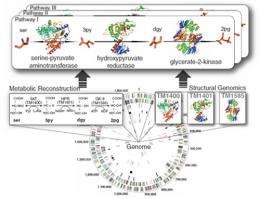
Underlying genomics information (bottom) enabled both a metabolic reconstruction (left) and an atomic-level structure determination/modeling of T. maritima proteins (right). Integration of these two approaches enabled detailed information to be acquired for every reaction in the network (top).
(PhysOrg.com) -- Investigators at Burnham Institute for Medical Research, University of California, San Diego, The Scripps Research Institute, Genomics Institute of the Novartis Research Foundation and other institutions have constructed a complete model, including three dimensional protein structures, of the central metabolic network of the bacterium Thermotoga maritima (T. maritima).
This is the first time scientists have developed such a comprehensive model of a metabolic network overlaid with an atomic resolution of network proteins. The analysis of the model, among others, highlights the important role of a small number of essential protein shapes, lending new insights into the evolution of protein networks and the functions within these networks. The study was published in the journal Science on September 18.
Combining biochemical studies, structural genomics and computer modeling, the researchers deciphered the shapes, functions and interactions of 478 proteins that make up T. maritima's central metabolism. The team also found connections between these proteins and 503 unique metabolites in 562 intracellular and 83 extracellular metabolic reactions.
"We have built an actual three dimensional model of every protein in the central metabolic system," said Adam Godzik, Ph.D., director of Burnham's Bioinformatics and Systems Biology program. "We got the whole thing. This is analogous to sequencing an entire genome."
With this data, scientists can simulate metabolism simultaneously on a biochemical and molecular level. This information has the promise to expand computer modeling to allow investigators to simulate the interactions between proteins and various compounds in an entire system. Furthermore, the procedure developed in this study could be applied to study many other organisms, including humans. It could potentially help identify both positive and adverse drug reactions before pre-clinical and clinical trials. The research may also have applications in energy research, as bacteria like T. maritima can be engineered to more efficiently produce hydrogen, a key source of clean energy.
"In addition to the systematic analysis of interacting components, the next challenge is addressing the levels or scales of biological organization, ranging from molecules to an individual and even to populations," said co-author John C. Wooley, Ph.D., of UC San Diego's Center for Research in Biological Systems and the California Institute for Telecommunications and Information Technology. "This work, by including both functional and architectural details, takes that first step and provides a novel, enriched view of the complexity of life."
Researchers were surprised by the degree of structural conservation within the network. Of the 478 proteins, with 714 domains, there were only 182 distinct folds. This supports the hypothesis that nature uses existing shapes, slightly modified, to perform new tasks.
The team used genomic, metabolic, and structural reconstruction to determine the network down to the atomic level. They then classified metabolic reactions based on whether they were similar, connected or unrelated and found that enzymes that catalyze similar reactions have a higher probability of having similar folds. In addition, using a reductive evolution simulation approach, they uncovered the absolutely essential proteins to support a minimal viable network.
"We were able to put together the information from the network biology as well as the protein structural biology," said co-author Bernhard Palsson, Ph.D., a UC San Diego bioengineering professor who leads the Systems Biology Research Group. "This is the first time this has been accomplished. We are in a position to study microorganisms in much greater detail, including those that are important in health care and those that are of environmental concern."
-
Building a complete metabolic model
Sep 17, 2009 |
not rated yet |
0
-
Study of protein folds offers insight into metabolic evolution
May 18, 2007 |
not rated yet |
0
-
New evidence on the robustness of metabolic networks
Sep 04, 2008 |
not rated yet |
0
-
Toward a systems biology map of iron metabolism
Apr 28, 2009 |
not rated yet |
0
-
Determining success or failure in cholesterol-controlling drugs
May 15, 2009 |
not rated yet |
0
-
Engineers build first sub-10-nm carbon nanotube transistor
Feb 01, 2012 |
4.9 / 5 (31) |
30
-
Something old, something new: Evolution and the structural divergence of duplicate genes
Jan 31, 2012 |
4.6 / 5 (7) |
1
-
The hidden nanoworld of ice crystals: Revealing the dynamic behavior of quasi-liquid layers
Jan 30, 2012 |
5 / 5 (3) |
1
-
Stock market network reveals investor clustering
Jan 27, 2012 |
3.9 / 5 (23) |
8
-
Of microchemistry and molecules: Electronic microfluidic device synthesizes biocompatible probes
Jan 26, 2012 |
5 / 5 (1) |
0
-
Stoichiometry
21 hours ago
-
Boiling and melting point of impure substances
22 hours ago
-
Safe nitrogen compound to decompose a 500 deg C in a furnace?
Feb 09, 2012
-
[ask]electron inside drinking water
Feb 08, 2012
-
How to avoid formation of Lithium Chromate ???
Feb 08, 2012
-
how to choose a reduced or oxidated form in a redox
Feb 08, 2012
- More from Physics Forums - Chemistry
More news stories
Fool's gold may prove an unlikely alternative to overexploited catalytic materials
Catalytic materials, which lower the energy barriers for chemical reactions, are used in everything from the commercial production of chemicals to catalytic converters in car engines. However, with current catalytic materials ...
12 hours ago |
4.3 / 5 (7) |
4
|
Unpicking HIV’s invisibility cloak
Drug researchers hunting for alternative ways to treat human immunodeficiency virus (HIV) infections may soon have a novel targetits camouflage coat. HIV hides inside a cloak unusually rich in a sugar ...
12 hours ago |
5 / 5 (4) |
0
No entry without protein recycling: Researchers discover new coherence in enzyme transport
The group of Prof. Dr. Ralf Erdmann at the Ruhr-Universität Bochum, Germany, discovered a connection of peroxisomal protein import and receptor export. In the Journal of Biological Chemistry, they disclo ...
12 hours ago |
not rated yet |
0
Hydrogen from acidic water: Researchers develop potential low cost alternative to platinum for splitting water
A technique for creating a new molecule that structurally and chemically replicates the active part of the widely used industrial catalyst molybdenite has been developed by researchers with the Lawrence Berkeley ...
Feb 09, 2012 |
5 / 5 (12) |
13
|
Under the microscope #7
In this video Dr Ingrid Graz shows us a thin layer of gold on top of rubber. Cracks in the gold allow it to stretch and we can use this for stretchable electronics.
14 hours ago |
not rated yet |
0
Google users warned of threat to smartphone wallets
Users of Google smartphone wallets were being warned on Friday that there is a way to crack pass codes intended to thwart thieves from going on illicit shopping sprees.
Anonymous knocks CIA website offline (Update)
The website of the Central Intelligence Agency was inaccessible on Friday after the hacker group Anonymous claimed to have knocked it offline.
New error-correcting codes guarantee the fastest possible rate of data transmission
Error-correcting codes are one of the triumphs of the digital age. Theyre a way of encoding information so that it can be transmitted across a communication channel such as an optical fiber o ...
Complex wiring of the nervous system may rely on a just a handful of genes and proteins
Researchers at the Salk Institute have discovered a startling feature of early brain development that helps to explain how complex neuron wiring patterns are programmed using just a handful of critical genes. ...
The power of estrogen -- male snakes attract other males
A new study has shown that boosting the estrogen levels of male garter snakes causes them to secrete the same pheromones that females use to attract suitors, and turned the males into just about the sexiest ...
Humans may have helped the decline of African rainforests 3000 years ago
(PhysOrg.com) -- Large areas of rainforests in Central Africa mysteriously disappeared over three thousand years ago, to be replaced by savannas. The prevailing theory has been that the cause was a change ...
Sep 25, 2009
Rank: not rated yet