Ants vs. worms: New computer security mimics nature
September 25, 2009 Ants vs. worms:  New computer security mimics nature

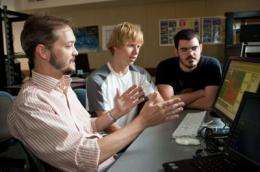
Wake Forest University computer science professor Errin Fulp works with graduate students Brian Williams (center) and Wes Featherstun (far right), who worked this summer at Pacific Northwest National Laboratory developing a new type of computer network security software modeled after ants. Credit: Ken Bennett/Wake Forest University

In the never-ending battle to protect computer networks from intruders, security experts are deploying a new defense modeled after one of nature's hardiest creatures -- the ant.

Unlike traditional security devices, which are static, these "digital " wander through networks looking for threats, such as "" — self-replicating programs designed to steal information or facilitate unauthorized use of machines. When a digital ant detects a threat, it doesn't take long for an army of ants to converge at that location, drawing the attention of human operators who step in to investigate.

The concept, called "swarm intelligence," promises to transform because it adapts readily to changing threats.

"In nature, we know that ants defend against threats very successfully," explains Professor of Computer Science Errin Fulp, an expert in security and computer networks. "They can ramp up their defense rapidly, and then resume routine behavior quickly after an intruder has been stopped. We were trying to achieve that same framework in a computer system."

Current security devices are designed to defend against all known threats at all times, but the bad guys who write malware — software created for malicious purposes — keep introducing slight variations to evade computer defenses.

As new variations are discovered and updates issued, security programs gobble more resources, antivirus scans take longer and machines run slower — a familiar problem for most computer users.

Glenn Fink, a research scientist at Pacific Northwest National Laboratory (PNNL) in Richland, Wash., came up with the idea of copying ant behavior. PNNL, one of 10 Department of Energy laboratories, conducts cutting-edge research in cyber security.

Fink was familiar with Fulp's expertise developing faster scans using parallel processing — dividing computer data into batches like lines of shoppers going through grocery store checkouts, where each lane is focused on certain threats. He invited Fulp and Wake Forest graduate students Wes Featherstun and Brian Williams to join a project there this summer that tested digital ants on a network of 64 computers.

Swarm intelligence, the approach developed by PNNL and Wake Forest, divides up the process of searching for specific threats.

"Our idea is to deploy 3,000 different types of digital ants, each looking for evidence of a threat," Fulp says. "As they move about the network, they leave digital trails modeled after the scent trails ants in nature use to guide other ants. Each time a digital ant identifies some evidence, it is programmed to leave behind a stronger scent. Stronger scent trails attract more ants, producing the swarm that marks a potential computer infection."

In the study this summer, Fulp introduced a worm into the network, and the digital ants successfully found it. PNNL has extended the project this semester, and Featherstun and Williams plan to incorporate the research into their master's theses.

Fulp says the new security approach is best suited for large networks that share many identical machines, such as those found in governments, large corporations and universities.

Computer users need not worry that a swarm of digital ants will decide to take up residence in their machine by mistake. Digital ants cannot survive without software "sentinels" located at each machine, which in turn report to network "sergeants" monitored by humans, who supervise the colony and maintain ultimate control.

Source: Wake Forest University (news : web)


print this article email this article download pdf blog this article bookmark this article     Stumble it Digg this share on Facebook retweet share on Reddit add to delicious
Rate this story - 3.4 /5 (13 votes)

Rank Filter

Move the slider to adjust rank threshold, so that you can hide some of the comments.


Display comments: newest first

  • weewilly - Sep 27, 2009
    • Rank: not rated yet
    Cute idea but it should be expanded to track it to its source and once someone is found to have make it and sent it out they should have their computers confiscated and they themselves should do some jail time. No one would tolerate tampering with the US Postal Service Mail or Telephone Privacy so they should be locked up fined and have their equipment confiscated.
  • rab96 - Sep 28, 2009
    • Rank: not rated yet
    Can the ant also be misused to perform harmful tasks? In that case we would be ant-eater software to protext ourselves from them...

September 25, 2009 all stories

Comments: 2

3.4 /5 (13 votes)
  • Stumble this up

  • Digg this

  • share this

  • hide
  • Related Stories

  • Scientists: Ants have internal pedometer
    created Jul 04, 2006 | popularity not rated yet | comments 0
  • Fire ants reappearing in Orange County
    created Apr 24, 2006 | popularity not rated yet | comments 0
  • Professor studies army-ant-following birds
    created Oct 16, 2007 | popularity not rated yet | comments 0
  • When industrious ants go too far
    created Apr 28, 2009 | popularity not rated yet | comments 0
  • Unpeaceful co-existence: How strengths and weaknesses maintain biodiversity in an ant community
    created Feb 09, 2007 | popularity not rated yet | comments 0


  • hide
  • Relevant PhysicsForums posts

  • Help with a camera choice
    created Nov 18, 2009
  • casio calculator that's similar to TI-89
    created Nov 08, 2009
  • Advice on what cell phone to get
    created Nov 08, 2009
  • Changing the language options on your phone.
    created Nov 03, 2009
  • More from Physics Forums - Computing & Technology

Other News

Newspaper circulation may be worse than it looks (AP)

Newspaper circulation may be worse than it looks

Technology / Internet

created 1hour ago | popularity not rated yet | comments 0

(AP) -- While U.S. newspapers are losing subscribers at a staggering rate, a few dailies stand out because their circulation is rising. But they aren't necessarily selling more copies.


Canadian woman loses benefits over Facebook photo

Technology / Internet

created 1hour ago | popularity not rated yet | comments 0

(AP) -- A Canadian woman on long-term sick leave for depression says she lost her benefits because her insurance agent found photos of her on Facebook in which she appeared to be having fun.


Hackers leak e-mails, stoke climate debate

Technology / Internet

created 22 hours ago | popularity 4.4 / 5 (26) | comments 23

(AP) -- Computer hackers have broken into a server at a well-respected climate change research center in Britain and posted hundreds of private e-mails and documents online - stoking debate over whether some scientists have ...


China is the world's largest emitter of the greenhouse gases blamed for global warming

China harnesses mountain wind power

Technology / Energy

created 11 hours ago | popularity 4 / 5 (6) | comments 0

In the mountains above the southwestern Chinese town of Dali, dozens of new wind turbines dot the landscape -- a symbol of the country's sky-high ambitions for clean, green energy.


Analysts say AmEx is most interested in the so-called peer-to-peer services of Revolution

American Express takes aim at PayPal with Revolution

Technology / Internet

created 8 hours ago | popularity not rated yet | comments 0

With its deal to buy Revolution Money, American Express is taking aim at the growing market for online and alternative payments, in a challenge to recognized leader PayPal, analysts say.