Finding Better Ways to Diagnose Heart Attacks
September 25, 2009 By Daniel Stolte
Finding Better Ways to Diagnose Heart Attacks

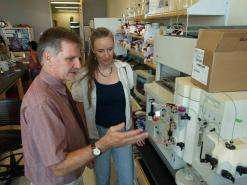
Jeff Walker explains how he and his colleagues purify samples of blood serum to analyze it by mass spectrometry to Lindsey Luke, who suffered a cardiac arrest and subsequent heart failure due to a genetic heart defect that was unknown at the time.

(PhysOrg.com) -- UA biochemistry researchers apply Nobel Prize technology to develop better diagnostics for heart attacks. Their work also could help predict individual risks of heart disease.

When a patient is whisked into the emergency room with symptoms of a attack, doctors run a test to determine Troponin-I levels in the bloodstream - the molecular aftermath of a traumatic event damaging the .

"Unfortunately, the Troponin-I test doesn't tell the whole story," said Jeff Walker, a professor in The University of Arizona department of physiology who is also a member of the UA's BIO5 Institute and the Sarver Heart Center. "The kits used to determine the levels of this protein don't tell doctors anything about the exact nature of the damage inflicted on the heart."

Troponin-I normally is found inside heart muscle cells, where it interacts with other protein molecules, causing the heart to squeeze and pump blood. During a , the cells in the affected area begin to die and disintegrate, spilling their contents, including Troponin, into the .
A blood test that comes back positive for Troponin tells doctors that a patient has suffered damage to the heart muscle. Knowing the exact level of Troponin-I could give doctors important clues to the exact nature of a heart attack, the best mode of treatment and the patient's individual risk of a recurring event that might be fatal.

"With the existing tests, this is very difficult to do," Walker said. "They are fairly blunt weapons."

His research group, which works on sharpening those weapons through the use of a sophisticated analytical method called mass spectrometry, has garnered worldwide recognition for overcoming a seemingly insurmountable obstacle: the limitation of mass spectrometry to very small molecules.

On the scale of atoms and molecules, Troponin-I, like most proteins, is huge. So large that even with recent improvements to mass spectrometry that earned three scientists from the United States, Japan and Germany the Nobel Prize in Chemistry in 2002, Troponin remained off limits to mass spectrometry - until now.

"We figured out a technological breakthrough that enabled us to tackle Troponin using mass spectrometry for the first time," Walker said.

"Troponin interacts with many other proteins in the heart muscle. You could say all those different and highly specialized proteins ‘talk' to each other, attaching or removing portions of their chemical makeup, changing their shape and activating or inhibiting nearby proteins. We are only beginning to understand these highly complex interactions and how they influence the function of a healthy heart, let alone a heart fraught with damage of any sort.

"Right now, all the Troponin test tells doctors is whether the biomarker is there. It doesn't give any information as to exactly how much is there, nor does it reveal anything about the chemical structure of the protein. We are seeking to develop better tests that will tell doctors the full story, so they have an accurate idea of the particular situation of an individual patient and can choose the treatment that is best for that patient."

Unlike the available tests, which use antibodies to detect either the absence or presence of Troponin in a blood sample, mass spectrometry analyzes the exact molecular structure, revealing the smallest details, such as the state of activation.

However, the possibilities do not end here. Walker's group is about to embark on a clinical study that seeks to enable clinicians to estimate their patients' cardiovascular risk profiles. Using blood samples obtained from patients who underwent diagnostic testing, the researchers are planning to use their highly sensitive to scan for and identify genetic variations that make an individual more or less susceptible to .

"Troponin-I controls the relaxation of the heart muscle after each contraction," Walker explained, "so it is easy to understand why a disruption in its molecular structure could result in cardiomyopathies - heart malformations, or arrhythmias - abnormal heart beats."

Provided by University of Arizona (news : web)


Rank 5 /5 (2 votes)
Relevant PhysicsForums posts
  • Is Everyday Technology Killing Us?
    createdFeb 08, 2012
  • Exercise and weight loss
    createdFeb 08, 2012
  • Why do we have head aches? Our brains can't feel anything.
    createdFeb 07, 2012
  • "The end of diseases" by David Agus, interview from Daily Show with Jon Stewart
    createdFeb 04, 2012
  • Oncolytic adenovirus
    createdFeb 04, 2012
  • Nutrition label stuffs and diets
    createdFeb 02, 2012
  • More from Physics Forums - Medical Sciences

More news stories

Researchers make breakthrough in stem cell research

(Medical Xpress) -- University of Queensland scientists have developed a world-first method for producing adult stem cells that will substantially impact patients who have a range of serious diseases.

Medicine & Health / Research

created 20 minutes ago | popularity 5 / 5 (1) | comments 0 | with audio podcast

Georgia Tech develops software for the rapid analysis of foodborne pathogens

2011 brought two of the deadliest bacterial outbreaks the world has seen during the last 25 years. The two epidemics accounted for more than 4,200 cases of infectious disease and 80 deaths. Software developed at Georgia Tech ...

Medicine & Health / Diseases

created 12 minutes ago | popularity not rated yet | comments 0

Social psychologist: Lust makes you smarter and evidence that seven deadly sins are good for you

(Medical Xpress) -- Good news for lovers on Valentine’s Day - the seven deadly sins, including Lust, are good for you. University of Melbourne social psychologist Dr Simon Laham uses modern research to make a compelling ...

Medicine & Health / Psychology & Psychiatry

created 42 minutes ago | popularity 4 / 5 (1) | comments 0

Couples in the same place emotionally stay together, study says

(Medical Xpress) -- Despite life’s ups and downs, couples whose feelings are in sync consistently over time are more likely to stay together, says a University of California, Davis, study.

Medicine & Health / Psychology & Psychiatry

created 7 minutes ago | popularity not rated yet | comments 0 | with audio podcast

Low levels of amplitude-modulated electromagnetic fields elicit therapeutic responses cancer patients

Ryne Ramaker, a senior UALR Donaghey Scholar and University Science Scholar with a double major in biology and chemistry, is a co-author of a cancer research paper creating excitement among other researchers. The article ...

Medicine & Health / Cancer

created 29 minutes ago | popularity not rated yet | comments 0


New molecule has potential to help treat genetic diseases and HIV

(PhysOrg.com) -- Chemists at The University of Texas at Austin have created a molecule that's so good at tangling itself inside the double helix of a DNA sequence that it can stay there for up to 16 days before ...

With climate change, today's '100-year floods' may happen every three to 20 years: research

Last August, Hurricane Irene spun through the Caribbean and parts of the eastern United States, leaving widespread wreckage in its wake. The Category 3 storm whipped up water levels, generating storm surges ...

The joy of cheques

An electronic cheque which eliminates the need for costly processing by banks but preserves the simplicity and ease of a traditional cheque book has been designed by a team of academics in the UK.

Research shows promise in converting camelina oil into jet fuel

(PhysOrg.com) -- Researchers at Montana State University-Northern have developed a process to convert camelina oil to jet fuel and other high-value chemicals. MSU has applied for a U.S. patent and research is ongoing.

Omega-3 fatty acid on trial: Study to evaluate long-term effects on intelligence, behavior

University of Kansas researchers John Colombo and Susan Carlson have been awarded $2.5 million for the next five years of a 10-year, double-blind randomized controlled trial to determine whether prenatal nutritional supplementation ...

Research finds injuries to professional athletes from routine play or practice often reported as 'freak accidents' in me

(Medical Xpress) -- A new report from the Johns Hopkins Center for Injury Research and Policy finds injuries to professional athletes from routine play or practice are often characterized as “freak accidents” in ...