Climate talks resume in Bangkok with deal in doubt
September 26, 2009 By MICHAEL CASEY , AP Environmental Writer
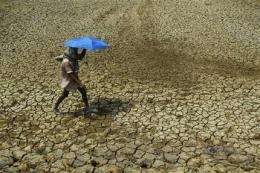
FILE - In this Saturday, May 2, 2009 file photo, a villager holding umbrella to protect himself from sun, walks over parched land on the outskirts of Bhubaneswar, India. Two years ago, the world's governments came together on the island of Bali and agreed they had to rein in the heat-trapping gases that were being blamed for deadly heat waves, melting glaciers and rising seas. But with delegates set to meet in Bangkok Monday, Sept. 23, 2009, negotiations are bogged down and there is a very real possibility that no deal will be reached in December when delegates meet in Copenhagen. (AP Photo/Biswaranjan Rout, File)
(AP) -- Two years ago, governments from around the world came together on the island of Bali and agreed to urgently rein in the heat-trapping gases blamed for deadly heat waves, melting glaciers and rising seas.
But with just over two months left to reach a deal at a conference in Copenhagen on fighting climate change, negotiations have bogged down over the big issues of emissions targets and financing for poor nations. The climate negotiations resume Monday in Bangkok, but a growing chorus of voices is warning a pact may be out of reach this year.
"The odds of concluding a final comprehensive treaty in Copenhagen are vanishingly small. Many world leaders have started to acknowledge that," said David M. Rubenstein, senior fellow for energy and the environment at the Council on Foreign Relations in New York.
At Copenhagen, the international community will try to forge a pact to replace the Kyoto Protocol, which expires in 2012.
U.N. climate chief Yvo de Boer told The Associated Press on Friday that negotiations were far behind where they should be. But he said he remained confident a deal would be reached in Copenhagen and that pushing negotiations into 2010 wasn't an option.
Many activists said they were disappointed that a G-20 meeting ended Friday in Pittsburgh without an agreement on financial assistance to help poor countries shift to cleaner economies.
"With 72 days to Copenhagen, rich countries have once again refused to put up the funds needed to deliver the deal in Copenhagen," David Waskow, a climate adviser for Oxfam America, said in Pittsburgh.
"For the hard-hit countries already on the front lines of climate change, the rich countries' failure to act is particularly devastating," he added.
At the Bangkok meeting, the second to last before Copenhagen, 1,500 delegates from 180 countries will try to reduce the 200-page draft agreement to something more manageable. Along the way, they hope to close the gap between rich and poor positions and come close to agreement on such issues as reducing deforestation and sharing of technology.
The two-week meeting follows a U.N. climate summit last week in New York, where 100 world leaders expressed their support for a deal.
President Barack Obama and Chinese President Hu Jintao, leaders of the world's two biggest greenhouse gas emitting countries, each vowed tough measures to combat climate change.
Hu said China would generate 15 percent of its energy from renewable sources within a decade, and for the first time pledged to reduce "by a notable margin" its carbon pollution growth rate as measured against economic growth. He did not give specific targets.
Japan's new prime minister, Yukio Hatoyama, whose nation generates more than 4 percent of the world's greenhouse gases, pledged his government would seek a 25 percent cut in emissions from 1990 levels by 2020.
"One of the big questions for Bangkok is whether the positive, qualitative spirit we saw from heads of state and ministers (in New York) will trickle down to the negotiating level and make countries more willing to clear away some of underbrush of the text," said Alden Meyer, director of strategy and policy for the Union of Concerned Scientists.
"If we come into Copenhagen with 200 pages of text with hundred of brackets (marking undecided text) and all kinds of options on the table, that will be hard for ministers and heads of state to grapple with and reach a political deal," he said.
Most countries want a new climate pact that includes measures limiting temperature increases to 2 degrees Celsius (3.6 degrees Fahrenheit) above preindustrial levels, a level necessary to avoid the worst impacts of climate change. But so far, there is no consensus on how to reach that goal.
Industrialized nations have offered emission cuts of 15 percent to 23 percent below 1990 levels by 2020 - far short of the 25 percent to 40 percent cuts scientists and activists say are needed to keep temperature increases below 2 degrees Celsius.
Developing countries have said they want to do their part but have refused to agree on binding targets and want to see more ambitious cuts by the West. They won't sign any deal until the West guarantees tens of billions of dollars in financial assistance.
"Without a financing package, there is no deal in Copenhagen at all," Meyer said.
©2009 The Associated Press. All rights reserved. This material may not be published, broadcast, rewritten or redistributed.
-
US more optimistic about climate deal after talks
Apr 28, 2009 |
not rated yet |
0
-
China: rich nations must cut emissions by 40 pct
May 22, 2009 |
not rated yet |
0
-
EU to step up efforts for new global climate pact
Sep 10, 2009 |
not rated yet |
0
-
US in spotlight as UN climate talks resume
Mar 29, 2009 |
not rated yet |
0
-
Climate change poker: The barriers which are preventing a global agreement
Aug 05, 2009 |
not rated yet |
0
-
Engineers build first sub-10-nm carbon nanotube transistor
Feb 01, 2012 |
4.9 / 5 (32) |
30
-
Something old, something new: Evolution and the structural divergence of duplicate genes
Jan 31, 2012 |
4.6 / 5 (7) |
1
-
The hidden nanoworld of ice crystals: Revealing the dynamic behavior of quasi-liquid layers
Jan 30, 2012 |
5 / 5 (4) |
1
-
Stock market network reveals investor clustering
Jan 27, 2012 |
3.9 / 5 (23) |
8
-
Of microchemistry and molecules: Electronic microfluidic device synthesizes biocompatible probes
Jan 26, 2012 |
5 / 5 (2) |
0
-
Do some geologists actually act a lot like Randy Marsh?
Feb 11, 2012
-
Discrepancy between oxygen and carbon-dioxide levels
Feb 09, 2012
-
where gems are found in the world
Feb 09, 2012
-
Wind Waves in Reservoir ~ Wind run-up and Wind set-up
Feb 08, 2012
-
Balance of oxygen in the atmosphere
Feb 01, 2012
-
The case for a methanol-based economy
Jan 30, 2012
- More from Physics Forums - Earth
More news stories
Salvage workers begin pumping fuel from Italian shipwreck
Salvage workers Sunday began pumping fuel from the shipwrecked Italian cruise liner Costa Concordia, a day ahead of schedule, officials said.
32 minutes ago |
not rated yet |
0
Latin America mining boom clashes with conservation
Latin America is experiencing a mining boom as prices rise fuelled by a hike in global demand, but the region is also being hit by a wave of violent protests, strikes and rallies by environmentalists.
8 hours ago |
5 / 5 (1) |
0
Political leaders play key role in how worried Americans are by climate change: study
More than extreme weather events and the work of scientists, it is national political leaders who influence how much Americans worry about the threat of climate change, new research finds.
Feb 06, 2012 |
5 / 5 (6) |
73
NASA budget will axe Mars deal with Europe: scientists
US President Barack Obama's budget proposal to be submitted next week for 2013 will cut NASA's budget by 20 percent and eliminate a major partnership with Europe on Mars exploration, scientists said Thursday.
Space & Earth / Space Exploration
Feb 10, 2012 |
5 / 5 (3) |
55
Humans may have helped the decline of African rainforests 3000 years ago
(PhysOrg.com) -- Large areas of rainforests in Central Africa mysteriously disappeared over three thousand years ago, to be replaced by savannas. The prevailing theory has been that the cause was a change ...
Scientists discover molecular secrets of 2,000-year-old Chinese herbal remedy
For roughly two thousand years, Chinese herbalists have treated Malaria using a root extract, commonly known as Chang Shan, from a type of hydrangea that grows in Tibet and Nepal. More recent studies suggest that halofuginone, ...
New method to examine batteries -- MRI from the inside
There is an ever-increasing need for advanced batteries for portable electronics, such as phones, cameras, and music players, but also to power electric vehicles and to facilitate the distribution and storage of energy derived ...
A mitosis mystery solved: How chromosomes align perfectly in a dividing cell
Although the process of mitotic cell division has been studied intensely for more than 50 years, Whitehead Institute researchers have only now solved the mystery of how cells correctly align their chromosomes during symmetric ...
Starve a virus, feed a cure? Findings show how some cells protect themselves against HIV
A protein that protects some of our immune cells from the most common and virulent form of HIV works by starving the virus of the molecular building blocks that it needs to replicate, according to research published online ...
Researchers find extensive RNA editing in human transcriptome
In a new study published online in Nature Biotechnology, researchers from BGI, the world's largest genomics organization, reported the evidence of extensive RNA editing in a human cell line by analysis of RNA-seq data, demons ...
The proteins ensuring genome protection
Researchers from the University of Geneva (UNIGE), Switzerland, have discovered the crucial role of two proteins in developing a cell 'anti-enzyme shield'. This protection system, which operates at the level of molecular ...
Sep 26, 2009
Rank: 3.7 / 5 (3)
It was absurd from the start to assume that Earth's climate is immune to cyclic changes in the Sun, but extremely sensitive to trace levels of the gaseous plant food (CO2) that is part of the natural cycle of life here on planet Earth.
Recently sunspots have vanished, Earth has cooled, and CO2 has continued to rise.
Politicians may not be great scientists, but neither are they . . . .
That's my opinion,
Oliver K. Manuel
Sep 26, 2009
Rank: 3.7 / 5 (3)