Nearly 70 percent of Argentine forests lost in a century
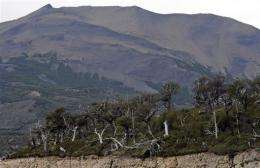
September 26, 2009 A partial view of the lenga's forest

Enlarge

A partial view of the lenga's forest taken from the base of Perito Moreno glacier in 2008 in Patagonia, Argentina. Argentina has lost nearly 70 percent of its forests in a century, the Environmental Secretariat said at a UN conference on desertification.

Argentina has lost nearly 70 percent of its forests in a century, the Environmental Secretariat said at a UN conference on desertification.

Forests that spread across 100 million hectares (247 million acres) in 1900 have dwindled to 33.19 million hectares (82 million acres), officials said.

"In 100 years, we have lost between 60 and 70 percent of our forest heritage," Environmental Undersecretary Sergio La Rocca told reporters on Friday.

Forest destruction has accelerated in the past 10 years with the boom of soy crops, a major motor of growth in Argentina, the top exporter of soy flour and oil and the third-largest exporter of soy seeds.

The northern province of Salta alone lost 26 percent of its forests in the past 30 years, according to a study by the College of Agronomics at the University of Buenos Aires (UBA).

The UBA study found that in 2007, "the highest rate was reached: 2.1 percent of forests destroyed in a single year."

Faced with the breadth of the devastation in the province, the Supreme Court ordered a halt to deforestation in natural forests, following an appeal by indigenous populations.

The move ran counter to the provincial authorities, which had authorized exploitation.

La Rocca spoke at the ninth session of the conference of parties to the United Nations Convention to Combat Desertification (UNCDD) in Buenos Aires.

The scourge of desertification directly affects 200 million people, according to UN figures.

Buenos Aires will host the 23rd World Forestry Congress October 18-23, a forum where governments, civil society and the private sector exchange views to formulate forestry policy.

(c) 2009 AFP


Rate this story - 3.5 /5 (6 votes)


September 26, 2009 all stories

Comments: 0

3.5 /5 (6 votes)

  • hide
  • Related Stories


  • hide
  • Relevant PhysicsForums posts

  • Carbon Dioxide emissions question
    created Feb 08, 2010
  • Photosynthesis vs. carbonization
    created Feb 07, 2010
  • Sheep's footprints
    created Feb 05, 2010
  • How did Victorians estimate the ages of fossils?
    created Feb 03, 2010
  • More from Physics Forums - Earth

Other News

Space shuttle Endeavour pulls in at space station (AP)

Space shuttle Endeavour pulls in at space station

Space & Earth / Space Exploration

created 3 hours ago | popularity not rated yet | comments 0

(AP) -- Shuttle Endeavour arrived to a warm welcome at the International Space Station early Wednesday, delivering a new room and observation deck that will come close to completing construction 200 miles ...


Climate 'Tipping Points' May Arrive Without Warning, Says Top Forecaster

Space & Earth / Environment

created 13 hours ago | popularity 3 / 5 (8) | comments 9 | with audio podcast

(PhysOrg.com) -- A new University of California, Davis, study by a top ecological forecaster says it is harder than experts thought to predict when sudden shifts in Earth's natural systems will occur -- a worrisome finding ...


38 percent of world's surface in danger of desertification

38 percent of world's surface in danger of desertification

Space & Earth / Environment

created 10 hours ago | popularity 2.3 / 5 (3) | comments 5

A team of Spanish researchers has measured the degradation of the planet's soil using the Life Cycle Assessment (LCA), a scientific methodology that analyses the environmental impact of human activities, and ...


A new 3-D map of the interstellar gas within 300 parsecs from the sun

A new 3D map of the interstellar gas within 300 parsecs from the Sun

Space & Earth / Astronomy

created 16 hours ago | popularity 5 / 5 (5) | comments 0 | with audio podcast

(PhysOrg.com) -- Astronomy & Astrophysics is publishing new 3D maps of the interstellar gas in the local area around our Sun. A French-American team of astronomers presents new absorption measurements toward ...


URI researcher calls for global effort to monitor marine pollutants

Space & Earth / Environment

created 14 hours ago | popularity 3 / 5 (2) | comments 1

A University of Rhode Island researcher who studies chemical pollutants in the marine environment has called on colleagues around the world to establish a global monitoring network to verify that the chemicals banned by the ...