Australia embarks on great broadband adventure
September 27, 2009 by Amy Coopes
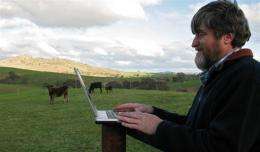
A senior manager with auditing giant KPMG works on his laptop at a beef cattle farm near the small Australian town of Harden, four hours drive away from Sydney. From snowy mountains and sun-baked deserts to the steamy tropical north, Australia has begun wiring its vast expanse with a high-tech broadband network in a giant project being closely followed abroad.
From snowy mountains and sun-baked deserts to the steamy tropical north, Australia has begun wiring its vast expanse with a high-tech broadband network in a giant project being closely followed abroad.
Workmen are already digging trenches in island state Tasmania, the first step in a 37 billion US dollar scheme which Prime Minister Kevin Rudd calls Australia's biggest ever infrastructure venture.
The ambitious plan aims to connect 90 percent of homes, including remote Outback settlements and sprawling coastal cities, with fibre-optic cable by 2017, accelerating lagging network speeds and boosting the economy.
The sheer scale of the project has drawn interest from foreign governments including the United States, where President Barack Obama has outlined similar plans.
Engineers will lay cable across 7.7 million square kilometres (3 million square miles) of often challenging terrain which covers an area equivalent to two European Unions.
"There's no kidding about it, it's a massive job," telecommunications analyst Paul Budde told AFP.
"You have to physically go to 10 million premises and bring a cable there, either (by) digging it or via (power) poles and then obviously it's not just having the cable, you have to have the installation in the house."
Specialised French digging machines have been shipped to Tasmania to lay the first of millions of kilometres of fibre-optic cable. By next June, three pilot towns are expected to be enjoying connection speeds of 100 megabits per second.
Just 0.1 percent of Australians are currently linked to fibre-optic cable with most accessing the Internet over the 100-year-old copper telephone network, prompting Rudd to call the country a "broadband backwater".
Rudd, announcing the project in April, said Australia had some of the developed world's slowest Internet speeds and lowest access rates. Some Outback communities rely on dial-up connections and others have no Internet at all.
"It is good for business, good for productivity, good for the delivery of e-health, good for e-education and good for Australia," Rudd said this month.
Industry expert Reg Coutts, who advised the government on the network, said the venture had attracted top-level attention in the United States and other countries.
"There's really an absolute interest, particularly in America, but also in Europe," he told AFP.
"People are asking, 'What the hell are you doing and how are you doing it?' People of course are sceptical," he said.
Laying the network was only the first step, he added, with the real challenge transitioning 10 million customers from old TV, telephone and Internet networks to the new system.
"That alone, we have never seen on that magnitude anywhere in the world," Budde said.
Once laid, there was "really no limit" to what the fibre network could do, said Ravi Bhatia, CEO of Primus Telecom and spokesman for industry consortium Terria.
He said technological advances in areas such as satellite mapping would make the roll-out easier than it would have been even three years ago, allowing for "smart" deployment of resources and machines to dig and pull cable.
"By using the latest technology building this network we create another set of skills which we can then export to other countries and build their networks," said Bhatia.
Government adviser Coutts said every developed country was grappling with the same question: how to replace ageing once-public infrastructure that now belonged to private companies.
Teams of lawyers and economists were racing to untangle complex commercial questions of how to use existing exchanges, underground ducts and power lines to minimise building work, said Budde.
Australia moved to deal with the problem by serving telco giant Telstra, the former state-owned monopoly, with an ultimatum to split its network and retail businesses or face being barred from further wireless spectrum.
Coutts said there was "a lot of infrastructure that could potentially be utilised in the NBN (National Broadband Network)" but estimated it was only about 10 percent of what was needed.
"Most of what's going to go on is purely civil works, actually pulling in and splicing optical fibre to replace the copper," he said.
(c) 2009 AFP
-
Australia announces $30 bln broadband plan
Apr 07, 2009 |
not rated yet |
0
-
Kenya gets undersea broadband fibre optic cable
Jun 12, 2009 |
not rated yet |
0
-
First Afghan fibre optic cable connects to Tajikistan
Jun 04, 2009 |
not rated yet |
0
-
Super-fast Internet connections with existing cable-TV networks
Apr 23, 2007 |
not rated yet |
0
-
Want FiOS from Your Cable Company? Motorola Can Help
May 08, 2007 |
not rated yet |
0
-
Engineers build first sub-10-nm carbon nanotube transistor
Feb 01, 2012 |
4.9 / 5 (31) |
30
-
Something old, something new: Evolution and the structural divergence of duplicate genes
Jan 31, 2012 |
4.6 / 5 (7) |
1
-
The hidden nanoworld of ice crystals: Revealing the dynamic behavior of quasi-liquid layers
Jan 30, 2012 |
5 / 5 (3) |
1
-
Stock market network reveals investor clustering
Jan 27, 2012 |
3.9 / 5 (23) |
8
-
Of microchemistry and molecules: Electronic microfluidic device synthesizes biocompatible probes
Jan 26, 2012 |
5 / 5 (1) |
0
-
Need help reading 3-D
7 hours ago
-
A way to send and receive wireless data
13 hours ago
-
Tabletop Cold Fusion Reactor
14 hours ago
-
Calling function with no input argument
Feb 10, 2012
-
Force free body diagram problem on gym equipment
Feb 10, 2012
-
Empirical data regarding shower heads and water
Feb 10, 2012
- More from Physics Forums - General Engineering
More news stories
Walney offshore wind farm is world's biggest (for now)
(PhysOrg.com) -- The Walney wind farm on the Irish Sea--characterized by high tides, waves and windy weather--officially opened this week. The farm is treated in the press as a very big deal as the Walney ...
GPS court ruling leaves US phone tracking unclear
A US Supreme Court decision requiring a warrant to place a GPS device on the car of a criminal suspect leaves unresolved the bigger issue of police tracking using mobile phones, legal experts say.
16 hours ago |
4 / 5 (2) |
0
Europeans protest controversial Internet pact
Tens of thousands of people marched in protests in more than a dozen European cities Saturday against a controversial anti-online piracy pact that critics say could curtail Internet freedom.
12 hours ago |
4.5 / 5 (8) |
0
Netflix settlement trims 14 pct off 4Q earnings
(AP) -- Netflix pressed the rewind button on its fourth-quarter earnings after settling allegations that the video subscription service violated a consumer-privacy law.
16 hours ago |
not rated yet |
0
Navy to begin tests on electromagnetic railgun prototype launcher
The Office of Naval Research (ONR)'s Electromagnetic (EM) Railgun program will take an important step forward in the coming weeks when the first industry railgun prototype launcher is tested at a facility ...
Feb 06, 2012 |
4.7 / 5 (15) |
91
|
Europe stakes billion-dollar bet on new rocket
A pencil-slim rocket is scheduled to lift into space from South America on Monday, carrying a billion-dollar bet that Europe can grab a juicy slice of the market to place satellites in low orbit.
Study finds that anti-diabetic medication can prevent the long-term effects of maternal obesity
In a study to be presented today at the Society for Maternal-Fetal Medicine's annual meeting, The Pregnancy Meeting, in Dallas, Texas, researchers will report findings that show that short therapy with the anti-diabetic medication ...
Explained: Sigma
It's a question that arises with virtually every major new finding in science or medicine: What makes a result reliable enough to be taken seriously? The answer has to do with statistical significance -- but ...
Political leaders play key role in how worried Americans are by climate change: study
More than extreme weather events and the work of scientists, it is national political leaders who influence how much Americans worry about the threat of climate change, new research finds.
New power source discovered
(PhysOrg.com) -- Researchers at the Massachusetts Institute of Technology (MIT) and RMIT University have made a breakthrough in energy storage and power generation.
NASA budget will axe Mars deal with Europe: scientists
US President Barack Obama's budget proposal to be submitted next week for 2013 will cut NASA's budget by 20 percent and eliminate a major partnership with Europe on Mars exploration, scientists said Thursday.
Sep 27, 2009
Rank: not rated yet