Discovery brings new type of fast computers closer to reality
September 27, 2009 Discovery brings new type of fast computers closer to reality

Enlarge

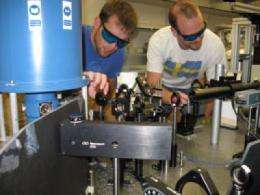
Alex High and Aaron Hammack adjust the optics in their UCSD lab. Credit: UC San Diego

Physicists at UC San Diego have successfully created speedy integrated circuits with particles called "excitons" that operate at commercially cold temperatures, bringing the possibility of a new type of extremely fast computer based on excitons closer to reality.

Their discovery, detailed this week in the advance online issue of the journal Nature Photonics, follows the team's demonstration last summer of an integrated circuit -- an assembly of transistors that is the building block for all electronic devices -- capable of working at 1.5 degrees Kelvin above absolute zero. That temperature, equivalent to minus 457 degrees Fahrenheit, is not only less than the average temperature of deep space, but achievable only in special research laboratories.

Now the scientists report that they have succeeded in building an integrated circuit that operates at 125 degrees Kelvin, a temperature that while still a chilly minus 234 degrees Fahrenheit, can be easily attained commercially with liquid nitrogen, a substance that costs about as much per liter as gasoline.

"Our goal is to create efficient devices based on excitons that are operational at room temperature and can replace electronic devices where a high interconnection speed is important," said Leonid Butov, a professor of physics at UCSD, who headed the research team. "We're still in an early stage of development. Our team has only recently demonstrated the proof of principle for a transistor based on excitons and research is in progress."

Excitons are pairs of negatively charged and positively charged "holes" that can be created by in a semiconductor such as gallium arsenide. When the electron and hole recombine, the exciton decays and releases its energy as a flash of light.

The fact that excitons can be converted into light makes excitonic devices faster and more efficient than conventional with optical interfaces, which use electrons for computation and must then convert them to light for use in communications devices.

"Our transistors process signals using excitons, which like electrons can be controlled with electrical voltages, but unlike electrons transform into photons at the output of the circuit," Butov said. "This direct coupling of excitons to photons allows us to link computation and communication."

Source: University of California - San Diego (news : web)


print this article email this article download pdf blog this article bookmark this article     Stumble it Digg this share on Facebook retweet share on Reddit add to delicious
Rate this story - 4.5 /5 (33 votes)

Rank Filter

Move the slider to adjust rank threshold, so that you can hide some of the comments.


Display comments: newest first

  • Husky - Sep 27, 2009
    • Rank: 4 / 5 (2)
    What they should do to achieve roomtemperature is using a combo naked graphene (excellent conductor), partially , alternating rows doped graphene (semi conductor) and fully doped graphene (insulater), There you have it, a nanosized roomtemperature transister capable of both very fast massless electron flow as wel as electron/exciton conversion with excellent heat dissipating properties and very low energy needed to drive both the electrons/excitons in the chip

    It would be interesting to use such transistor in combo with Intels Light Peak plans for replacing copper interconnects on the mobo andexternal cables...

September 27, 2009 all stories

Comments: 1

4.5 /5 (33 votes)
  • Stumble this up

  • Digg this

  • share this

  • hide
  • Related Stories


  • hide
  • Relevant PhysicsForums posts

  • Laser spots
    created 2 hours ago
  • Do you know elementary physics?
    created 4 hours ago
  • Bicycles and their mad skillz
    created 4 hours ago
  • Clarification of doubts on rolling motion
    created 8 hours ago
  • More from Physics Forums - General Physics

Other News

Aquatic creatures mix ocean water

Physics / General Physics

created 4 hours ago | popularity 5 / 5 (1) | comments 0

Understanding mixing in the ocean is of fundamental importance to modeling climate change or predicting the effects of an El Niņo on our weather. Modern ocean models primarily incorporate the effects of winds and tides. However, ...


Generating electricity from air flow

Physics / General Physics

created 7 hours ago | popularity 3.7 / 5 (7) | comments 1

A group of researchers at the City College of New York is developing a new way to generate power for planes and automobiles based on materials known as piezoelectrics, which convert the kinetic energy of motion into electricity. ...


Nuclear weapons: Predicting the unthinkable

Physics / General Physics

created 7 hours ago | popularity 1.5 / 5 (2) | comments 0

If a nuclear weapon were detonated in a metropolitan area, how large would the affected area be? Where should first responders first go? According to physicist Fernando Grinstein, we have some initial understanding to address ...


Butterfly proboscis to sip cells

Physics / General Physics

created 4 hours ago | popularity not rated yet | comments 0

A butterfly's proboscis looks like a straw -- long, slender, and used for sipping -- but it works more like a paper towel, according to Konstantin Kornev of Clemson University. He hopes to borrow the tricks of this piece ...


Restored machine to explore mysteries of Big Bang (AP)

Restored machine to explore mysteries of Big Bang

Physics / General Physics

created Nov 21, 2009 | popularity 4.6 / 5 (18) | comments 17

(AP) -- Scientists are preparing the world's largest atom smasher to explore the depths of matter after successfully restarting the $10 billion machine following more than a year of repairs.