Researchers discover a new antibacterial lead
September 27, 2009 by Laura Thompson Researchers discover a new antibacterial lead

A promising discovery by McMaster University researchers has revealed an ideal starting point to develop new interventions for resistant infections.

(PhysOrg.com) -- Antibiotic resistance has been a significant problem for hospitals and health-care facilities for more than a decade. But despite the need for new treatment options, there have been only two new classes of antibiotics developed in the last 40 years.

Now a promising discovery by McMaster University researchers has revealed an ideal starting point to develop new interventions for resistant infections.

Eric Brown, a professor and chair of the Department of Biochemistry and Biomedical Sciences, and a team of researchers from the Michael G. DeGroote Institute for Infectious Disease Research have identified a novel that targets drug-resistant bacteria in a different way from existing antibiotics. The discovery could lead to new treatments to overcome in certain types of microorganisms.

The findings were published September 27 in the science research journal Nature Chemical Biology.

"Everyone reads the headlines about drug-resistant bugs, it's a big problem," said Brown, who holds the Canada Research Chair in Antimicrobial Research. "Really what we're trying to do is understand whether or not there are new ways to tackle this problem."

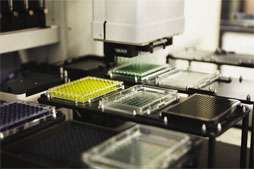
The research team, which included biochemists and chemists from McMaster University, used high-throughput screening to uncover the new class of chemical. The approach allows scientists to look for small molecules that kill bacteria as well as examine the molecular mechanisms and pathways they exploit.

Existing antibiotics destroy bacteria by blocking production of its cell wall, DNA or protein. The new McMaster-discovered compound, MAC13243, is directed at blocking a particular step in the development of the bacteria's cell surface, which until now has not been recognized as a target for .

"We're excited about finding a new probe of a relatively uncharted part of bacterial physiology," Brown said. "It's a new way of thinking about the problem. Who knows, could this chemical become a drug? Anything's possible. But at the very least we've advanced the field and created some tools that people can use now to try to better understand this pathway."

Source: McMaster University (news : web)


print this article email this article download pdf blog this article bookmark this article     Stumble it Digg this share on Facebook retweet share on Reddit add to delicious
Rate this story - 3.8 /5 (6 votes)


September 27, 2009 all stories

Comments: 0

3.8 /5 (6 votes)
  • Stumble this up

  • Digg this

  • share this

  • hide
  • Related Stories


  • hide
  • Relevant PhysicsForums posts

  • Putting every element in a box
    created 5 hours ago
  • a question in Lewis structure???
    created 12 hours ago
  • Paint Technology
    created Nov 24, 2009
  • About pH, Metallic electrodes
    created Nov 24, 2009
  • More from Physics Forums - Chemistry

Other News

Blocking biofilms: Alzheimer's research sheds light on potential treatments for urinary tract infections

Chemistry / Biochemistry

created 9 hours ago | popularity 5 / 5 (1) | comments 0

(PhysOrg.com) -- Research into Alzheimer's disease seems an unlikely approach to yield a better way to fight urinary tract infections (UTIs), but that's what scientists at Washington University School of Medicine in St. Louis ...


Chemists get custom-designed microscopic particles to self-assemble in liquid crystal

Chemists get custom-designed microscopic particles to self-assemble in liquid crystal

Chemistry / Materials Science

created 10 hours ago | popularity 5 / 5 (5) | comments 0

(PhysOrg.com) -- The scientists anticipate their "LithoParticles" will have significant applications in photonics, optical communications and other areas.


Study shows flavanol antioxidant content of US chocolate and cocoa-containing products

Chemistry / Other

created 12 hours ago | popularity 1 / 5 (2) | comments 0

A recent study confirms that the antioxidants and other plant-based nutrients in chocolate and cocoa products are highly associated with the amount of non-fat cocoa-derived ingredients in the product. The study expands on ...


Sandia CR5

Machine Converts CO2 into Gasoline, Diesel, and Jet Fuel

Chemistry / Biochemistry

created Nov 23, 2009 | popularity 4.6 / 5 (30) | comments 19

(PhysOrg.com) -- Researchers at Sandia National Laboratories have built a machine that uses the sun's energy to convert carbon dioxide waste from power plants into transportation fuels such as gasoline, diesel, ...


New hydrogen-storage method discovered

New hydrogen-storage method discovered

Chemistry / Materials Science

created Nov 22, 2009 | popularity 4.3 / 5 (41) | comments 15

Scientists at the Carnegie Institution have found for the first time that high pressure can be used to make a unique hydrogen-storage material. The discovery paves the way for an entirely new way to approach ...