Feds reviewing humpback whale endangered status
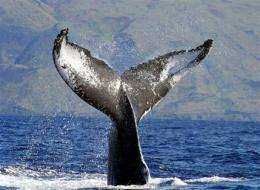
(AP) -- The federal government is considering taking the humpback whale off the endangered species list in response to data showing the population of the massive marine mammal has been steadily growing in recent decades.
Known for their acrobatic leaps from the sea and complex singing patterns, humpback whales were nearly hunted to extinction for their oil and meat by industrial-sized whaling ships well through the middle of the 20th century. But the species has been bouncing back since an international ban on their commercial whaling in 1966.
"Humpbacks by and large are an example of a species that in most places seems to be doing very well, despite our earlier efforts to exterminate them," said Phillip Clapham, a senior whale biologist with the National Oceanic and Atmospheric Administration (NOAA).
The government is required by law to review the endangered species status of an animal or plant if it receives "significant new information." The National Marine Fisheries Service, a NOAA agency, received results last year from an extensive study showing that the North Pacific humpback population has been growing 4 to 7 percent a year in recent decades.
Public comment is being accepted until Oct. 13 on the upcoming review, which is expected to take less than a year. It's the first review for humpbacks since 1999.
A panel of scientists will then study the data and produce a scientific report on their analysis in late spring or early summer. It's unclear what the decision on delisting the humback will be.
"I don't know where the humpback people are going to come out," said David Cottingham, who heads the marine mammal and sea turtle conservation division at the Fisheries Service. "It would be premature to talk about it."
Some environmental groups are already opposing the possibility of a delisting.
Miyoko Sakashita, the ocean programs director at the Center for Biological Diversity, said that ongoing climate change and ocean acidification are emerging threats that may hurt humpback whales.
"Ocean conditions are changing so rapidly right now that it would probably be hasty to delist the humpbacks," Sakashita said.
Ralph Reeves, who chairs the cetacean specialist group at the International Union for the Conservation of Nature, said the U.S. should remove humpbacks from the list if populations have sufficiently recovered.
He said conservationists must "be prepared and willing to embrace success" if they're to maintain what he called a "meaningful" endangered species program.
"The whole process, the credibility of it, depends on telling people that things are really bad when they're really bad and tell people that they aren't so bad when they aren't so bad," Reeves said.
There are now an estimated 18,000 to 20,000 humpbacks in the North Pacific, up from just 1,400 in the mid-1960s.
An early 1990s survey of humpbacks in the North Atlantic showed the population there was some 10,600. The results of a follow-up to that study, expected by the end of the year, are likely to show this population has grown, too.
The global humpback population is estimated to be about 60,000, according to the Swiss-based Conservation of Nature union.
Helping the humpbacks is that they reproduce once every two to three years, as opposed to every three to five years for other whale species. They also have a diverse diet, including krill and herring, capelin and other fish.
"They feed on a lot of different kinds of things, so they're adaptable," Clapham said. "They seem to be a resilient species generally with a lot of options."
There are some subpopulations of humpbacks, however, that aren't as robust. A South Pacific group that feeds in the Antarctic and then migrates to the warm waters off New Caledonia, Samoa and Tonga to breed and calve isn't doing as well.
Whale experts say this is because commercial whaling, and later, illegal whaling by the Soviet Union, shrunk this population so dramatically that it's had a harder time recovering.
There are also humpback populations about which relatively little is known. These include humpbacks that spend the winter in waters off southern Japan and the Philippines and the summer near Russia's Far East coast.
This group also appears to be relatively small, with only about 1,000 whales.
There is a chance the review could lead to the removal of healthier subpopulations from the endangered species list while other groups that are still at risk could be left on.
Something similar happened in 1994 when the federal government removed a U.S. West Coast population of the gray whale from the endangered species list but left on the list a separate population of gray whale that lives off Russia's Pacific coast.
The U.S. doesn't have authority over species management in the waters of other nations, but it may prosecute U.S. citizens and corporations that violate U.S. endangered species law overseas.
©2009 The Associated Press. All rights reserved. This material may not be published, broadcast, rewritten or redistributed.


