Lab-grade economics
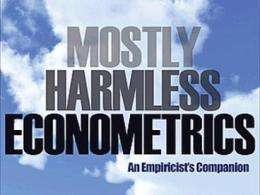
(PhysOrg.com) -- Can economists conduct studies with solid scientific foundations? MIT's Joshua Angrist explains how to carry out 'natural experiments' with numbers.
Labor economists often study a fundamental social question: What impact does education have upon earnings? As important as this issue is, it can be fiendishly hard to analyze accurately. Children of wealthier families might have more extensive schooling, but also higher earnings for reasons not strictly related to education. Here cause and effect form an unruly tangle.
Joshua Angrist has spent two decades refining methods that give a firm scientific foundation to economic studies in this area. Now Angrist, Ford Professor of Economics at MIT, has distilled those insights into a surprise-hit book, "Mostly Harmless Econometrics," along with co-author Jorn-Steffen Pischke, a former MIT professor who now teaches at the London School of Economics. "Mostly Harmless Econometrics" (the title riffs on the final book in the "Hitchhiker's Guide to the Galaxy" series) is a do-it-yourself microeconomics manual that in early September was ranked at number 879 on Amazon.com — unusual for a higher ed textbook.
"Many of the core tools used in modern empirical economics are not covered very well in the traditional econometrics sequence, which partly reflects a shift in what applied economists are doing," says Angrist, explaining why they wrote the book. Indeed, those tools are in wide use. MIT economist Esther Duflo, a 2009 recipient of a MacArthur "genius" fellowship for her analysis of anti-poverty programs in the developing world, is just one former student of Angrist who has applied his methods in her own work.
The book itself has generated a warm critical response. "It should be required reading for anyone who is trying to write an applied dissertation," wrote Yale economist Ian Ayres on the "Freakonomics" blog of The New York Times.
Econometrics goes to school
In large part, "Mostly Harmless Econometrics" is a guide to doing microeconomic research on bread-and-butter subjects: Education, work, and family. As Angrist and Pischke see it, the initial planning that goes into a study can determine if it succeeds or fails. "What's decisive is the quality of your research design," says Angrist. His ideal is to mimic a randomized medical trial — no easy task in economics, where the data available to researchers often reflects those intertwined social complexities.
Angrist and Pischke discuss a number of empirical methods in the book. Perhaps the most important is the use of "instrumental variables" — pieces of supplemental information that, even when seemingly incidental to a basic cause-and-effect relationship, actually reveal its strength. These supplemental data points are the economist's "instrument."
In a widely cited 1991 study, Angrist and economist Alan Krueger of Princeton scrutinized the education-earnings connection by using dates of birth as an instrumental variable. Many states have required children to start school in the calendar year they turn six, and to stay in school until age 16. Children born in December start at about age 5-3/4, while those born in January start the same grade at about age 6-3/4. Using census data on men born in the 1930s, Angrist and Krueger determined that people born in the final two quarters of the year obtained more compulsory schooling (since they started at a younger age) and earned more money than those born in the first two quarters.
Dates of birth are not an all-powerful explanation for the outcomes of these lives. Rather they form the "instrument" identifying groups of otherwise similar people who have varying education levels. As Angrist and Pischke state, "an individual's date of birth is probably unrelated to his or her innate ability, motivation, or family connections." Each quarter-of-birth group is essentially a random collection of people, apart from their different aggregate levels of schooling. That allows Angrist and Krueger to examine how much differences in education alone — and not those other factors — have a causal effect on earnings.
"Mostly Harmless Econometrics" also emphasizes the importance of validating an instrumental variable. In this case, because compulsory schooling laws varied from state to state, their effects should also vary in a predictable way. This conjecture, Angrist and Krueger found, fit the facts.
Pushing the economics envelope
Instrumental variables are not the only topic of the book, but they are its central focus, and represent an important part of Angrist's influence. Ultimately, the instrumental variables technique allows scrutiny of one factor while other elements are held constant, in areas where this was previously not considered possible: Historical studies, interpretations of clinical trials, and more. "We've learned how to get reliable estimates of causal effects in situations that were once thought to be hopelessly muddled," says Angrist.
In the 1970s and 1980s, he notes, even leading-edge papers on topics like education struggled to produce reliable estimates of causal effects. Now, researchers can dig into historical data from around the world to uncover valuable findings: Duflo used the instrumental variables method in a 2001 paper on the expansion of primary schools in Indonesia during the 1970s, finding that greater education again increased earnings, among other things. And Duflo and her colleagues have used the technique to interpret the field experiments they have brought to development economics.
"Mostly Harmless Economics" is not a comprehensive guide to the field; it skips topics like time-series econometrics, which can be used to make forecasts. As Angrist acknowledges, the work covers "a particular part, but by no means a small part, of the econometric universe." Even so, says Angrist, "Our hope is to have an effect on the way econometrics is taught, not just at MIT and LSE, but around the world, and I think we are."
Now Angrist just needs to find a way to measure that effect.
Provided by Massachusetts Institute of Technology (news : web)


