IBM Celebrates 20th Anniversary of Moving Atoms (w/ Video)
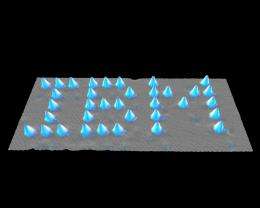
September 28, 2009 IBM spelled with 35 Xenon Atoms

Enlarge

On this day in 1989, IBM Fellow Don Eigler became the first person in history to move and control an individual atom. Shortly thereafter, on November 11 of that year, Eigler and his team used a custom-built microscope to spell out the letters IBM with 35 xenon atoms.

(PhysOrg.com) -- On this day in 1989, IBM Fellow Don Eigler became the first person in history to move and control an individual atom. Shortly thereafter, on November 11 of that year, Eigler and his team used a custom-built microscope to spell out the letters IBM with 35 xenon atoms. This unprecedented ability to manipulate individual atoms signaled a quantum leap forward in in nanoscience experimentation and heralded in the age of nanotechnology.

Eigler built his (STM) in order to visualize and experiment with individual molecules and . As he experimented, he discovered that it was possible to slide individual atoms across a surface using the tip of his STM. To demonstrate both the atomic precision and reproducibility he achieved, he wrote the letters “IBM” with 35 atoms, each positioned with atomic-scale precision.

You need Flash installed to watch this ideo

“Don Eigler’s accomplishment remains, to this day, one of the most important breakthroughs in nanoscience and technology,” said T.C, Chen, IBM Fellow and vice president, Science & Technology, Research. “At the time, the implications of this achievement were so far-reaching they almost seemed like science fiction. But now, twenty years later, it’s clear that this was a defining moment that has spawned the kind of research that will eventually bring us beyond CMOS and Moore’s Law, to advance computing to handle the massive volumes of data in the world while using less energy resources. ”

Understanding the properties, movement and interaction of various materials at the nanoscale is essential for one day building smaller, faster and more energy-efficient processors and memory devices. This understanding could also eventually enable a whole new level of personalized health care and targeted treatments and therapies. Already, the ability to understand and manipulate atoms is leading to new kinds of fabrics, products and more. Ever wonder what makes a raincoat water resistant, or how sunscreen stays put even after swimming? More often than not, it’s nanotechnology at work.

Because of Eigler’s seminal work, scientists continue making breakthroughs that continue driving the field of nanotechnology, the exploration of building structures and devices out of ultra-tiny components as small as a few atoms or molecules. Such devices might be used as future computer chips, storage devices, biosensors, and things nobody has even imagined.

Provided by IBM


Rate this story - 5 /5 (1 vote)

Rank Filter

Move the slider to adjust rank threshold, so that you can hide some of the comments.


Display comments: newest first

  • snowman95 - Sep 29, 2009
    • Rank: not rated yet
    Can anyone explain why the Xenon atoms look like Hershy's Kisses? I always imagined atoms as appearing round, even though I know they are mostly empty space. What are we seeing here?

September 28, 2009 all stories

Comments: 1

5 /5 (1 vote)

  • hide
  • Related Stories

  • Li-Air: Argonne opens new chapter in battery research (w/ Video)
    created Sep 23, 2009 | popularity not rated yet | comments 0
  • Scientists Image the 'Anatomy' of a Molecule (w/ Video)
    created Aug 28, 2009 | popularity not rated yet | comments 0
  • Video: Swine flu health tips
    created Apr 30, 2009 | popularity not rated yet | comments 0
  • Two Robot Chefs Make Omelets
    created Dec 04, 2008 | popularity not rated yet | comments 0
  • 'Curtain twitching' skylarks keep track of strangers through their songs (w/ Video)
    created Aug 26, 2009 | popularity not rated yet | comments 0


  • hide
  • Relevant PhysicsForums posts

  • How to find static friction
    created 2 hours ago
  • Calculating decible increases
    created 9 hours ago
  • Coefficients of friction
    created 9 hours ago
  • Deduction of centripetal force
    created 10 hours ago
  • More from Physics Forums - General Physics

Other News

Nanoscale Structures with Superior Mechanical Properties Developed

Nanoscale Structures with Superior Mechanical Properties Developed

Nanotechnology / Nanomaterials

created 11 hours ago | popularity 4.5 / 5 (8) | comments 1 | with audio podcast

(PhysOrg.com) -- Researchers at the California Institute of Technology have developed a way to make some notoriously brittle materials ductile -- yet stronger than ever -- simply by reducing their size.


Spray-on liquid glass

Spray-on liquid glass is about to revolutionize almost everything

Nanotechnology / Nanomaterials

created Feb 02, 2010 | popularity 4.7 / 5 (240) | comments 93 | with audio podcast report

(PhysOrg.com) -- Spray-on liquid glass is transparent, non-toxic, and can protect virtually any surface against almost any damage from hazards such as water, UV radiation, dirt, heat, and bacterial infections. ...


IBM Scientists Demonstrate World's Fastest Graphene Transistor

IBM Scientists Demonstrate World's Fastest Graphene Transistor

Nanotechnology / Nanophysics

created Feb 05, 2010 | popularity 4.9 / 5 (38) | comments 25 | with audio podcast

(PhysOrg.com) -- In a just-published paper in the magazine Science, IBM researchers demonstrated a radio-frequency graphene transistor with the highest cut-off frequency achieved so far for any graphene device ...


Conductive eTextiles: Stanford finds a new use for cloth

Conductive eTextiles: Researchers move from making batteries from paper to making batteries from cloth

Nanotechnology / Nanomaterials

created Feb 05, 2010 | popularity 4.3 / 5 (7) | comments 4 | with audio podcast

(PhysOrg.com) -- Stanford researchers have moved from making batteries from paper to making batteries from cloth. Your-T-shirt could become a lighted, moving display.


Carbon Based Chips May One Day Replace Silicon Transistors

Carbon Based Chips May One Day Replace Silicon Transistors

Nanotechnology / Nanomaterials

created Feb 03, 2010 | popularity 4.7 / 5 (18) | comments 3 | with audio podcast weblog

(PhysOrg.com) -- IBM researchers are hopeful that, over the next decade, silicon-based transistors will be replaced by carbon-based transistors. IBM has already laid out the ground work for carbon-based transistors.